
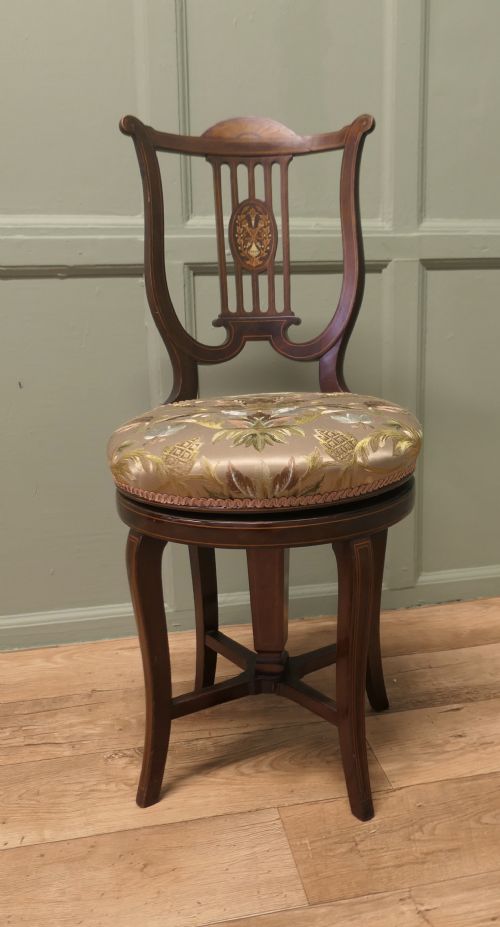
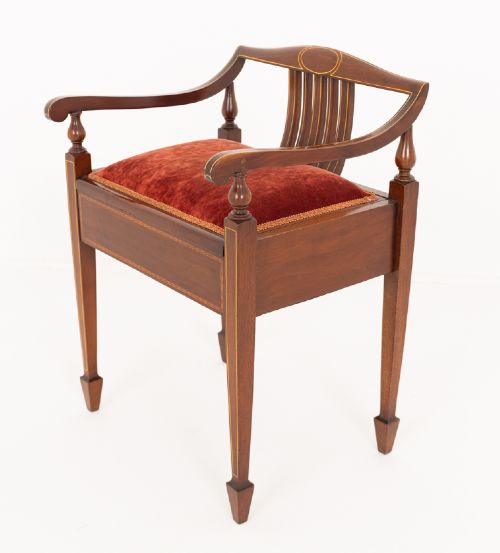


Inlaid Mahogany Music Seat
An inlaid mahogany music seat combines practical piano seating with refined period cabinet-making, offering adjustable comfort alongside delicate woodwork.
Inlaid Mahogany Music Seat
An inlaid mahogany music seat forms a specialised form of seating designed specifically for musicians at the piano or harp. These pieces primarily appear from the Victorian and Edwardian periods, alongside Sheraton Revival and Regency interpretations.
The objects take various functional forms across the inventory, including revolving lyre-back music chairs, X-framed stools, and box seats designed for storing sheet music. Most examples rely on Edwardian and 1900s craftsmanship built from mahogany.
Buyers seeking an inlaid mahogany music seat encounter pieces shaped by nineteenth and early twentieth-century domestic music rooms. The selection ranges from revolving harpist chairs to freestanding piano stools with hinged storage compartments.
Materials and construction
Makers constructed these seats using solid and veneered mahogany, enhanced by contrasting satinwood and boxwood inlay or marquetry details. Brass inlay also appears on earlier Regency examples.
Upholstery forms an essential component of the construction, utilising various fabrics including velvet and tapestry to provide a comfortable surface for the musician.
Judging quality
Quality rests upon the crispness of the satinwood and boxwood inlay against the mahogany ground, alongside the structural integrity of revolving mechanisms and X-frames. Superior execution shows in balanced proportions and refined carving, such as lyre-shaped backs.
The integrity of the original upholstery fabric or traditional tapestry contributes significantly to the integrity of the piece. Finer examples maintain robust mechanical action in revolving music chairs and smooth operation in box seat hinges.
The Inlaid Mahogany Music Seat Glossary
- Inlay
- A technique where contrasting woods such as boxwood and satinwood are fitted into recesses within the mahogany surface to create decorative patterns. This ornament defines the aesthetic of Sheraton Revival pieces.
- Lyre back
- A chair back shaped in the form of a classical lyre musical instrument. This motif frequently appears on revolving music chairs.
- X-framed
- A structural design where the legs cross in the shape of an X beneath the seat. Such frames provide sturdy support for piano stools.
- Marquetry
- Elaborate veneer work forming pictorial or decorative designs using various wood species. It adds intricate detail to the music seat surface.
- Sheraton Revival
- A late nineteenth and early twentieth-century style resurrecting the neoclassical elegance of Thomas Sheraton. Pieces from this movement often feature delicate mahogany and satinwood inlay.
Inlaid Mahogany Music Seat: Frequently Asked Questions
What is a music seat?
A music seat is a specialised piece of furniture created for keyboard and string players during the nineteenth and early twentieth centuries.
These pieces include revolving chairs, X-framed stools, and box seats intended to hold sheet music near the piano.
How do I date a music seat?
Dating relies on stylistic markers, construction methods, and materials recorded in the specific design eras.
Edwardian and 1900s pieces often display light satinwood inlay, whereas Regency examples feature heavier mahogany forms with brass details.
Why do some music seats revolve?
Revolving mechanisms allowed harpists and cellists to adjust their position easily while performing.
This mechanical function appears primarily on specialised music chairs featuring lyre backs.
What are box seat music stools?
Box seat music stools feature a hinged top that opens to reveal internal storage compartments.
Victorian and Edwardian makers used this hollow base to keep sheet music organised beneath the player.