
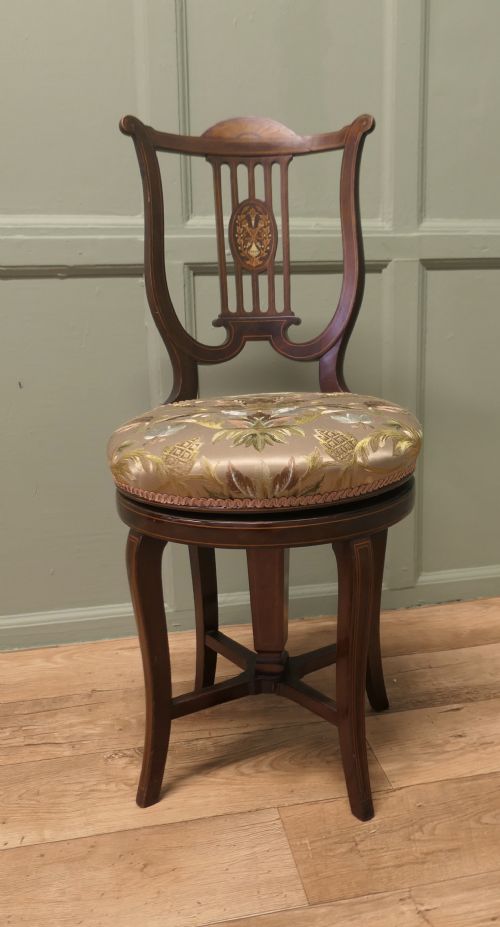
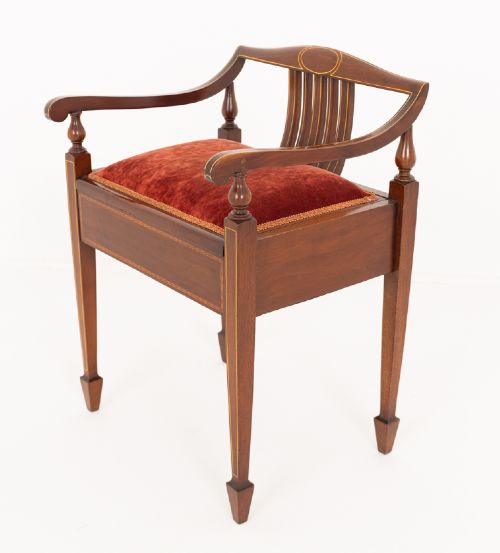


Edwardian Piano Chair
An edwardian piano chair is a practical seat built for the keyboard player, offering adjustable height and swivel movement.
Edwardian Piano Chair
An edwardian piano chair brings together seating designed specifically for musicians and dressing rooms from the late nineteenth and early twentieth centuries. You will most frequently encounter mahogany and rosewood examples featuring revolving or rise and fall mechanisms.
The forms span from simple music stools to elaborate lyre back revolving harpist chairs and tripod bases. Styles range across Edwardian, Sheraton Revival, and Victorian Arts & Crafts designs.
Many of these pieces serve double duty today as dressing table stools or desk chairs in modern interiors. Their compact footprints and adjustable heights make them remarkably versatile for smaller spaces.
How They Were Made
Cabinet makers utilised dense hardwoods such as mahogany, walnut, rosewood, and satinwood to construct the frames, often incorporating decorative inlay or ebonised finishes. Brass hardware frequently appears in the swivel mechanisms and adjustable screw threads.
Upholstery forms a key component of these seats, utilising fabrics like velvet and tweed linen over padded seating areas. Woodturning and carving define the structural supports, from tripod legs to heavy central pedestals.
Listings feature woods like mahogany, rosewood, satinwood, and walnut across periods from 1850 to 1920.
What Varies in Quality
The sophistication of the mechanical adjustment mechanism sets the standard for these seats, distinguishing basic fixed heights from smooth revolving or screw-rise systems. Timber selection and the crispness of carved details further separate standard production pieces from finer cabinet work.
Makers such as James Shoolbred represent a higher tier of construction, where secondary woods and joinery exhibit superior craftsmanship. The integrity of the original wood finish and the quality of the chosen upholstery materials also influence the overall character.
James Shoolbred
The Edwardian Piano Chair Glossary
- Rise and fall
- A mechanical seating adjustment that allows the seat height to increase or decrease by turning the top. This mechanism relies on a central threaded screw shaft hidden within the pedestal.
- Sheraton Revival
- A late nineteenth and early twentieth century design movement inspired by the neoclassical furniture of George Sheraton. Pieces in this style typically display lighter proportions, satinwood timbers, and delicate inlay.
- Lyre back
- A chair backrest shaped in the outline of a classical lyre instrument. This ornamental motif appears frequently on musical seating from the Victorian and Edwardian eras.
- Ebonised
- Timber treated with a dark stain or finish to imitate expensive ebony wood. This technique gained popularity during the nineteenth century for accentuating carved details.
- Tripod base
- A three-legged support structure commonly found on revolving piano stools and music chairs. This configuration provides stable footing on uneven floors.
Edwardian Piano Chair: Frequently Asked Questions
How do you adjust the height?
Many of these seats feature a screw mechanism operated by turning the upholstered top clockwise or anticlockwise.
This action raises or lowers the seating platform along a central threaded metal rod hidden inside the column.
Can I use it at a desk?
These seats adapt well to modern desks and dressing tables due to their compact size and adjustable height range.
The swivel function and absence of armrests allow for easy movement in confined workspaces.
What is a music chair?
A music chair is specialised seating designed for instrumentalists, featuring supportive backrests and revolving seats.
Unlike standard stools, these chairs offered musicians greater mobility and comfort during long practice sessions.
How do I date the piece?
Dating relies on identifying stylistic markers like Sheraton Revival inlay, Victorian carving, or Edwardian proportions.
Hardware materials and timber choices also help narrow down the manufacturing decade between the mid nineteenth and early twentieth centuries.