
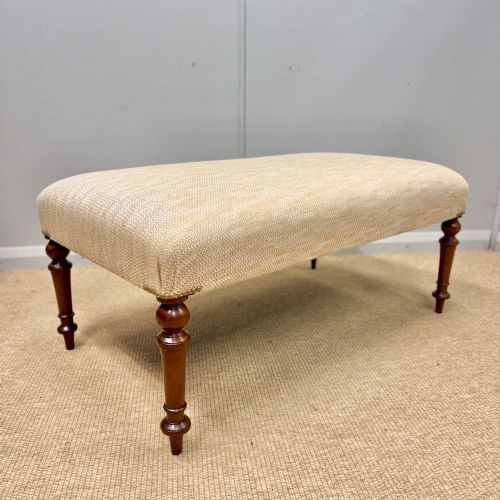
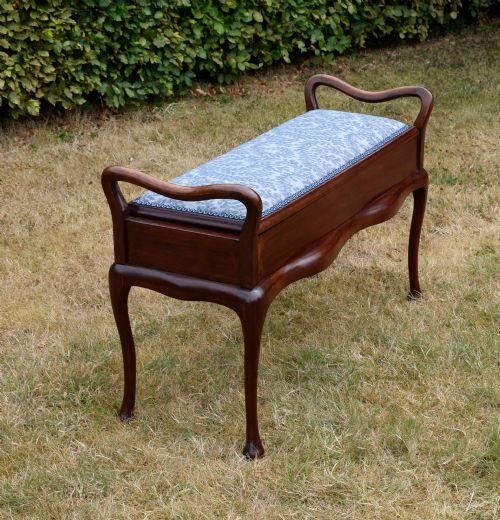


Traditional Mahogany Piano Bench
These traditional mahogany piano bench examples bring genuine period character to a room, offering practical seating alongside hidden storage for sheet music.
Traditional Mahogany Piano Bench
A traditional mahogany piano bench serves as functional seating while offering a practical lift up seat for storing scores near the instrument. These pieces primarily date from the Victorian, Edwardian, and early twentieth century eras, spanning the nineteenth century up to nineteen twenty.
The selection here includes piano stools, duet stools designed for two players, oblong footstools, and long benches. Stylistic influences draw heavily from Georgian, Queen Anne, and Chippendale revivals alongside dedicated Edwardian and Victorian designs.
Makers utilised rich timber alongside various textiles and fabric upholstery, occasionally incorporating satinwood inlay or brass castors. Buyers will encounter both single player and duet formats, some featuring ball and claw detail or deep buttoned upholstery.
How they were made
Cabinet makers constructed these seats using solid mahogany and mahogany veneers, often shaping the timber into cabriole legs with ball and claw detail. Workshops employed traditional joinery methods to ensure the framework could withstand regular use at the keyboard.
Upholstery techniques varied from simple fabric coverings to deep buttoned padding and decorative tapestry textiles. Many examples incorporated a hinged seat mechanism to reveal a compartment beneath for sheet music storage.
Some Edwardian musicians clearly needed extra help sliding around, hence the addition of brass castors to rush between demanding passages.
What varies in quality
The refinement of the timber carving and the subtlety of any satinwood inlay distinguish finer examples from standard production pieces. Stronger proportions and crisp detailing on legs and edgings elevate a piece above simpler utilitarian seating.
The choice of original or sympathetic upholstery fabrics, alongside the smooth operation of hinged lift up seats and brass castors, marks the difference in overall execution. Pieces displaying cohesive period design characteristics hold greater interest for collectors.
The Traditional Mahogany Piano Bench Glossary
- Duet Stool
- A wider seat designed to accommodate two pianists side by side. These longer benches often feature hinged lift up seats for expanded music storage.
- Cabriole Leg
- A furniture leg that curves out and then tapers inward, frequently terminating in a ball and claw foot. This form appears often on revival styles.
- Castors
- Small wheel attachments fitted to the feet of furniture to allow easy movement across the floor. Victorian examples frequently utilise brass mountings.
- Inlay
- A decorative technique where contrasting woods such as satinwood are inserted into the primary mahogany surface. Edwardian makers favoured this method for delicate ornamentation.
Traditional Mahogany Piano Bench: Frequently Asked Questions
What is a duet piano bench?
A duet piano bench is an extended seating option built to accommodate two musicians at once during practice or performance. They provide extra length while maintaining the standard height required for proper keyboard posture.
Most versions include a hinged top that opens to reveal a generous internal compartment for organising sheet music and books. This dual purpose made them a staple in nineteenth and twentieth century music rooms.
How do I date a mahogany piano stool?
Dating involves examining the combination of timber, upholstery style, and decorative motifs present on the frame. Victorian examples often feature deep buttoning and turned legs, while Edwardian pieces frequently showcase satinwood inlay.
Revival styles such as Chippendale or Queen Anne provide further clues through specific foot carvings like ball and claw details. Hardware components like brass castors also help narrow down the period of manufacture.
Did all piano benches have storage?
Not all period examples feature a compartment beneath the cushion for holding scores. Many simpler stools were manufactured with fixed upholstered tops and open frame structures.
When a hinged lid is present, the interior typically consists of a wooden box designed to keep music clean and flat. Buyers should check the description to confirm whether a lift up seat is included.
How do I incorporate one into modern rooms?
These benches function well beyond the music room as dressing table seats, window benches, or hallway footstools. Their compact proportions allow them to fit easily into smaller spaces while adding warmth through dark mahogany timber.
The rich upholstery and classic wood tones complement both traditional interiors and more contemporary living spaces as accent pieces.