






Serpentine Walnut Sideboard
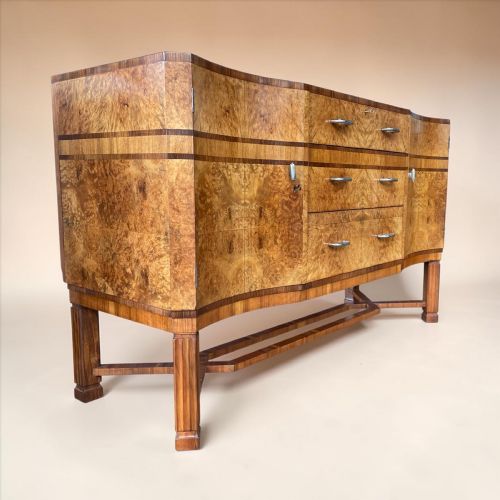
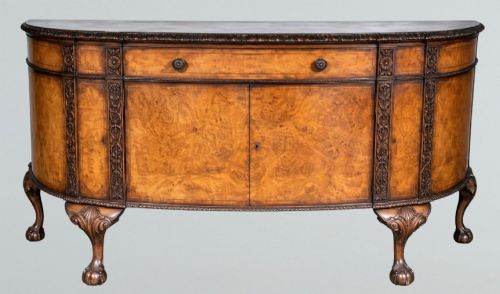
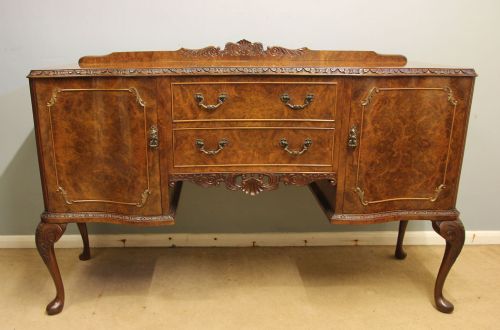
When you search for a serpentine walnut sideboard, you encounter substantial serving furniture built with undulating front profiles.

Serpentine Walnut Sideboard
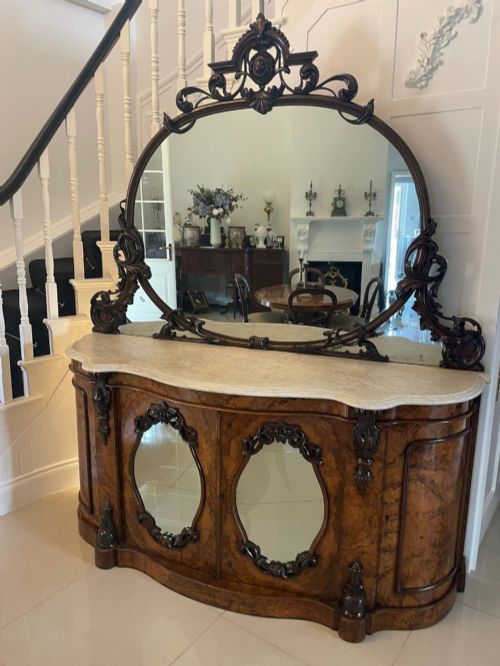
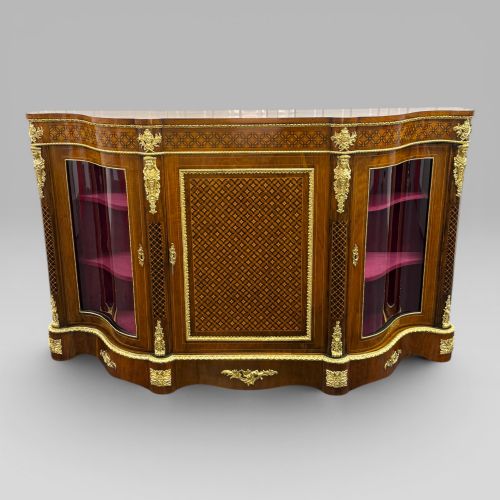
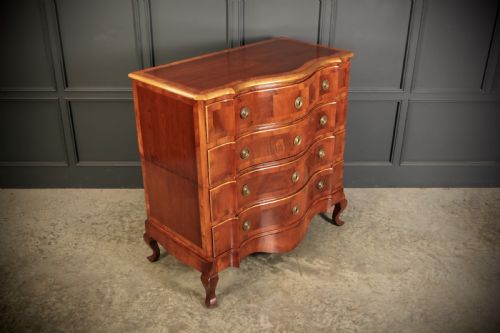
A serpentine walnut sideboard brings together curved timber fronts and substantial storage capacity, serving both dining rooms and principal reception rooms across various historical periods. These pieces appear most frequently in Victorian interpretations and twentieth-century server variations, often incorporating credenza forms or console configurations.
The characteristic undulating front creates a distinct visual rhythm that sets these items apart from standard flat-fronted case furniture. Buyers frequently encounter examples featuring mirrored backs, marble tops, or detailed marquetry inlays that reflect specific revival movements.
Materials and construction
Cabinet makers utilised burr walnut and plain walnut veneers applied over solid secondary timbers, selecting figured sections to create symmetrical grain patterns across curved doors and drawer fronts. This veneer work required considerable skill to lay smoothly over the complex concave and convex curves of the serpentine shape.
Metal mounts in brass and ormolu often accent the corners, borders, and feet, while inset marble slabs provide durable surfaces on specific credenza and commode variations. Marquetry inlay work employing contrasting woods frequently decorates the central panels and doors.
Listings include items spanning the eighteenth century, the Victorian era, and the 1930s.
Factors determining quality
The standard of execution in the veneer selection and marquetry detailing marks the primary distinction between ordinary production and exhibition pieces. Cohesion in the grain matching across the undulating serpentine facade demonstrates superior cabinet making competence.
The integration of heavy mounts, original marble tops, and detailed carved elements elevates certain items above simpler servers. The crispness of the serpentine curve itself and the retention of original fittings dictate the standing of individual pieces.
Maison Gagneau·Epstein·Maple and Co
The Serpentine Walnut Sideboard Glossary
- Serpentine
- A furniture front shaped with a central convex curve flanked by concave sweeps. This profile demands advanced woodworking skill to execute correctly.
- Burr walnut
- Timber obtained from the growth warts of walnut trees, displaying complex and swirling grain patterns. It is sliced into thin veneers for decorative cabinet work.
- Credenza
- A low cabinet or sideboard, frequently featuring glass doors or mirrored backs. Victorian examples often incorporate intricate marquetry and ormolu mounts.
- Ormolu
- Gilded bronze ornamentation applied to furniture mounts and decorative accents. It provides a bright metallic contrast against dark walnut surfaces.
- Marquetry
- Inlaid patterns formed by fitting small pieces of contrasting veneer into a prepared ground. It appears frequently on Victorian and eighteenth-century case pieces.
Serpentine Walnut Sideboard: Frequently Asked Questions
What periods do these sideboards come from?
The selection spans from eighteenth-century items through nineteenth-century Victorian pieces up to twentieth-century twentieth revival designs. Victorian examples represent a large portion of the available inventory.
Craftsmen across these different eras utilised similar walnut veneers while applying distinct stylistic details reflecting their respective decades.
How do I care for burr walnut surfaces?
Protect the wood from direct sunlight and excessive moisture fluctuations to prevent veneer lifting or fading. Regular dusting with a soft, dry cloth preserves the polished finish.
Avoid commercial silicone sprays and rely on traditional beeswax sparingly to maintain the natural lustre of the timber.
Are marble tops original to these pieces?
Many credenzas and server cabinets were manufactured specifically with fitted marble slabs, particularly those inspired by French revival designs. These stone tops provided practical, heat-resistant surfaces for serving food and displaying objects.
Examining the rebate and surrounding timber helps confirm whether a marble top belongs to the original construction.
Where were these pieces used historically?
Dining rooms utilised these items for storing cutlery, serving dishes, and provisions during meals. Reception rooms and grand halls also accommodated them as display cabinets and pier tables.
The inclusion of mirrored backs in certain Victorian models served to reflect light and display decorative ceramics.