
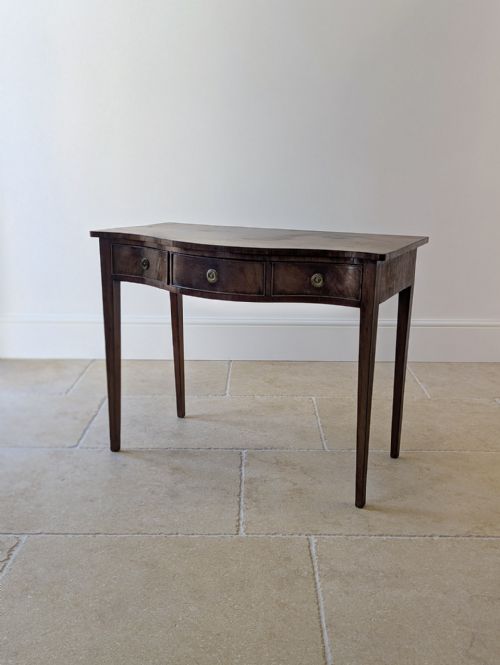
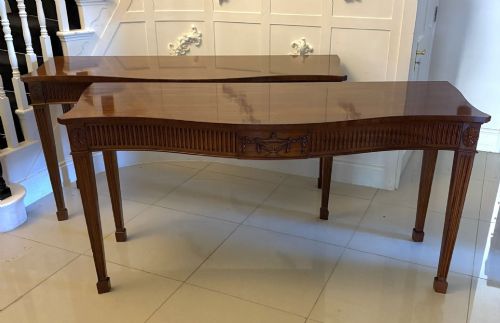
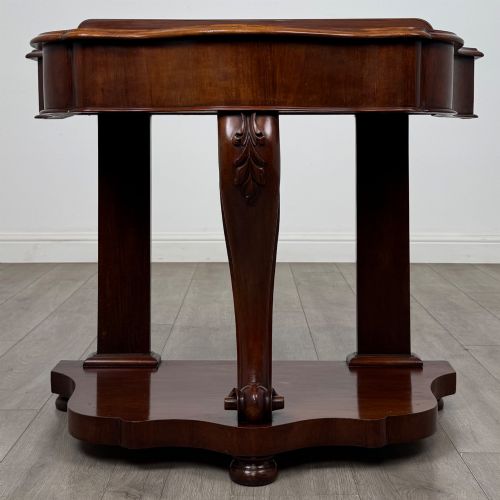
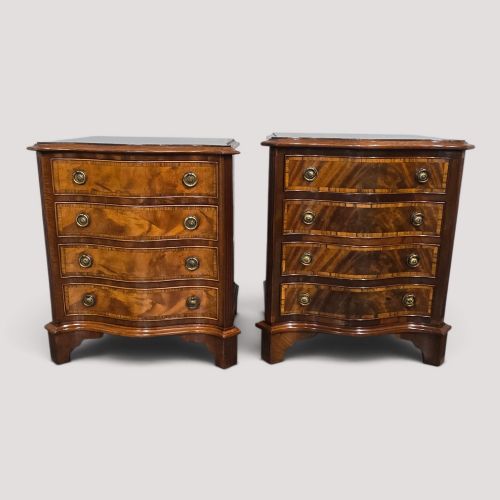
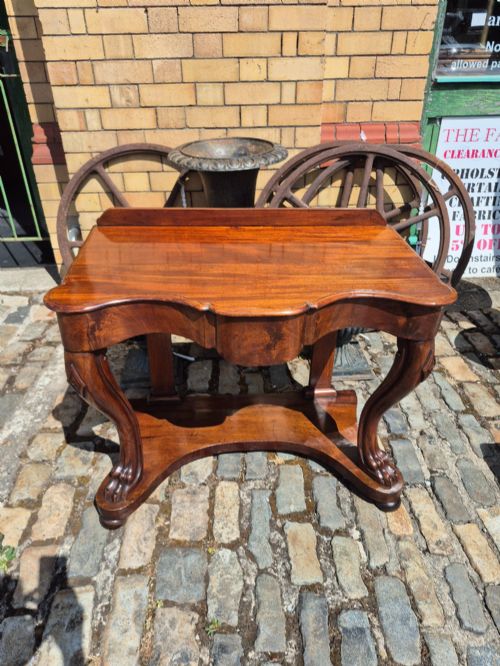
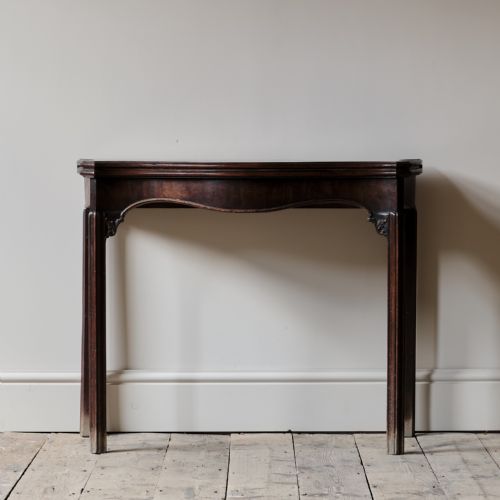
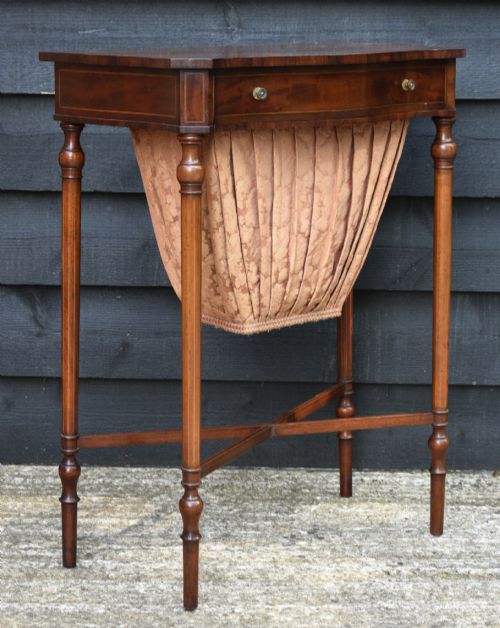
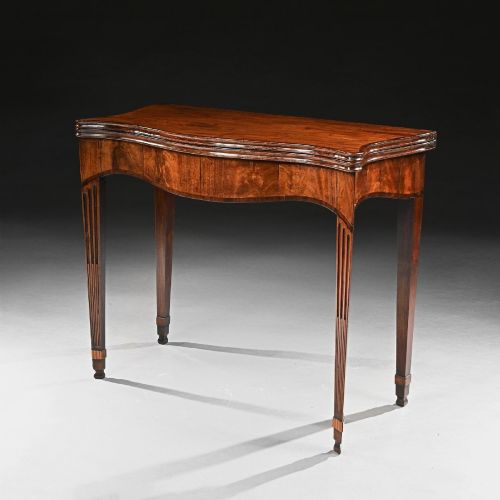

Serpentine Mahogany Side Table
A serpentine mahogany side table brings fluid movement and rich timber grain to a room, offering a distinctively shaped surface rooted in eighteenth-century design.

Serpentine Mahogany Side Table
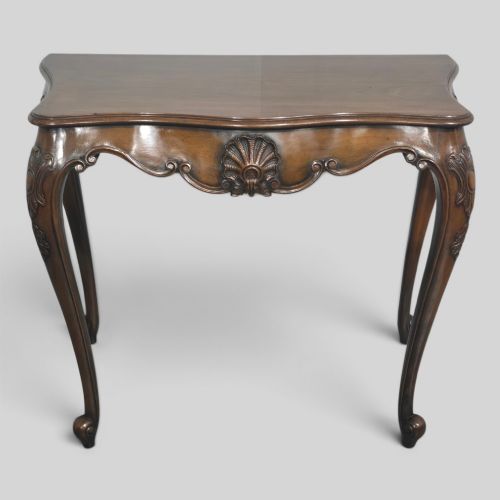
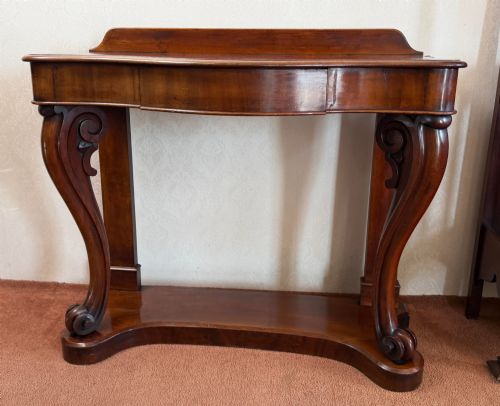
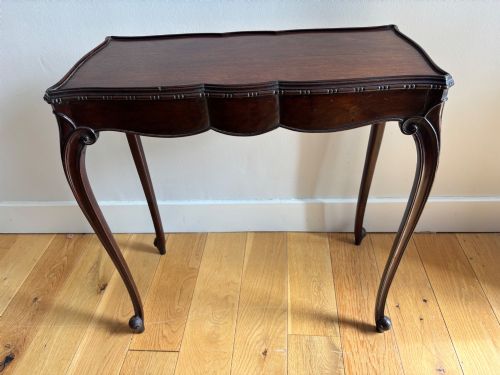
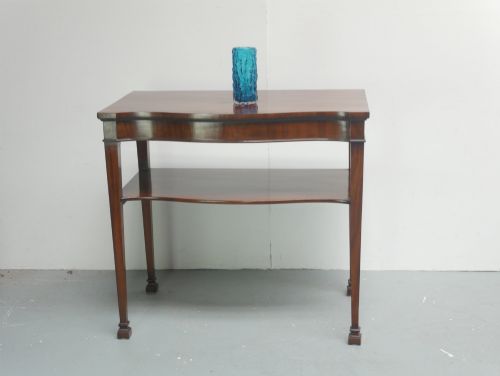
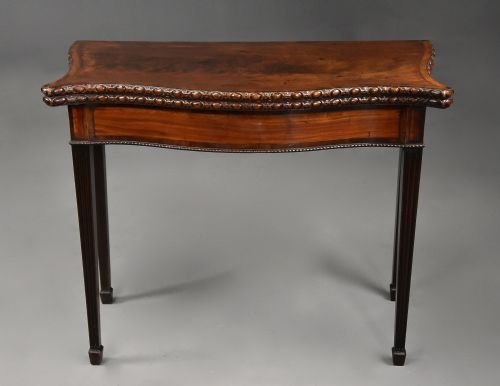
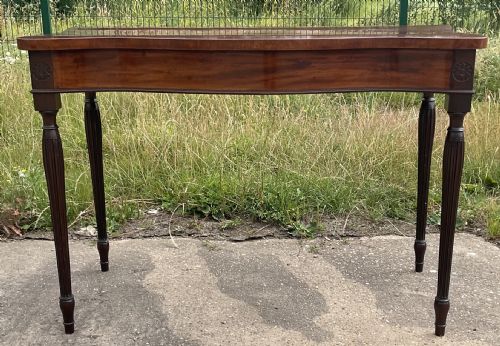
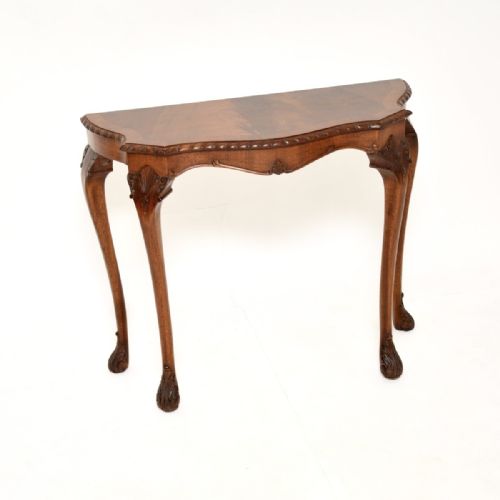
A serpentine mahogany side table is defined by its gently curving front edge, which undulates inward and outward in a continuous, flowing line. When searching for this form, buyers encounter examples spanning from the Georgian period through to Edwardian revivals.
The pieces appearing on this page range from compact folding card tables and tea tables to substantial serving consoles and hall tables. Eighteenth-century George III originals sit alongside later nineteenth-century interpretations and early twentieth-century revival pieces.
Makers working in the Georgian era established the archetype, often incorporating Hepplewhite or Chippendale influences. Later cabinet-makers replicated these graceful proportions during the Edwardian period and the early decades of the twentieth century.
How they were made
Construction relies heavily on solid mahogany and carefully selected wood veneers, sometimes enhanced by flame mahogany grain patterns. Cabinet-makers used thin sheets of veneer applied to secondary woods to create complex curved surfaces without warping.
Detailed embellishments often include satinwood and boxwood stringing, alongside delicate Neoclassical or Chippendale-style carving along the frieze and legs. Brass hardware, such as original swing handles and escutcheons, frequently completes the construction.
The serpentine curve itself requires precise carpentry, as the timber must be shaped to follow the convex and concave contours of the front elevation. Joinery often incorporates hand-cut dovetails within the drawer construction.
Listings feature mahogany, satinwood, marble, and brass, spanning the Georgian, Victorian, and Edwardian periods.
What varies in quality
The depth of the timber's natural figure and the warmth of its underlying patination set exceptional examples apart from simpler pieces. Tables that have retained their original wax finish over centuries display a deeper lustre.
Proportion and the execution of the curved front dictate the overall elegance of the furniture. Finer items feature crisp, hand-carved detailing along the edge and legs rather than cast or heavily simplified ornamentation.
Gillow·Wright & Elwick·Edwards & Roberts
The Serpentine Mahogany Side Table Glossary
- Serpentine
- A furniture front characterised by a curved shape consisting of a convex centre flanked by concave sides. This undulating profile requires advanced woodworking skill to execute cleanly.
- Patina
- The surface sheen and colour developed by wood over many years of handling, polishing and exposure to light. A well-preserved patination is highly prized by collectors.
- Flame mahogany
- A veneer cut from the point where a branch joins the main tree trunk, producing a distinctive flame-like pattern. It was frequently utilised on the primary surfaces of high-status tables.
- Stringing
- Thin lines of contrasting timber, such as boxwood or satinwood, inlaid into channels on the surface for decorative effect. This technique is common in Sheraton and Edwardian pieces.
- Frieze
- The horizontal band running directly beneath the top surface of the table. On finer pieces, this area often houses drawers and carries carved or inlaid decoration.
Serpentine Mahogany Side Table: Frequently Asked Questions
How do I spot a Georgian original?
Examine the timber used for secondary framing elements like drawer linings, which on eighteenth-century pieces are typically oak or pine rather than modern manufactured boards.
Hand-cut dovetails and timber movement appropriate to age also help confirm the period of manufacture.
Where were these tables placed?
In period homes, these items stood against walls in hallways, drawing rooms or dining parlours as serving surfaces. Their shallow depth allowed them to fit into narrow circulation spaces without blocking walkways.
Folding variations functioned as gaming tables for cards or as tea tables before being pushed back against the wall.
How do I care for the wood?
Keep the timber away from direct heat sources and strong sunlight to prevent the mahogany veneer from drying out or splitting.
Apply a traditional beeswax polish occasionally and buff gently with a soft cloth to maintain the surface sheen.
What is the difference between George III and revival pieces?
George III pieces date from the mid to late eighteenth century and exhibit period-specific construction methods and wear. Revival pieces, made around the Edwardian era or the early twentieth century, imitate these earlier styles using machinery alongside hand-finishing.
Revival furniture often utilises cleaner internal secondary woods and displays less wear to the primary finish.