
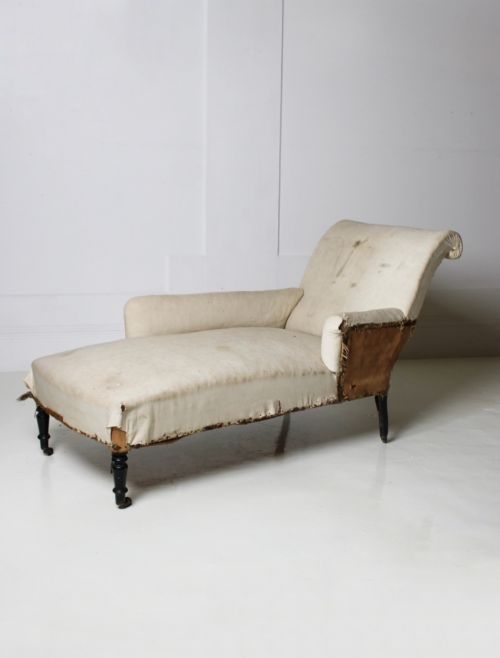
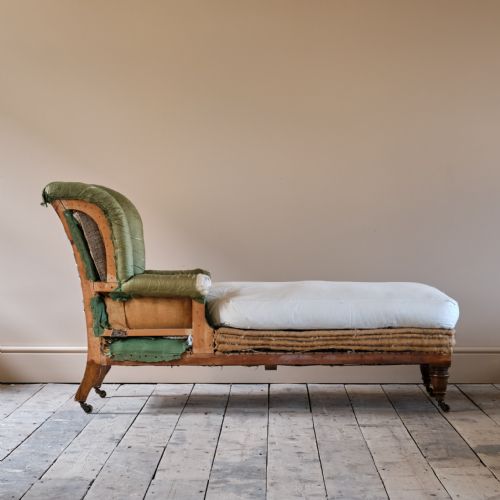


Scroll Back Chaise
These scroll back chaise pieces are daybeds and couches built for reclining, and a proper one gives a room instant architectural weight.
Scroll Back Chaise
A scroll back chaise functions as a daybed or couch designed primarily for reclining in comfort, appearing in forms from full country house daybeds to miniature furniture. The pieces answering to a scroll back chaise search most frequently date to the nineteenth century, spanning Regency and Victorian eras.
Makers utilised rich hardwoods such as mahogany, walnut, rosewood, and beech, often ebonised or finished as show wood frames. Surviving examples include large country house proportions alongside smaller models, all sharing the characteristic curved profile.
The design vocabulary incorporates upholstered finishes in calico, fabric, and braided textiles, supported on turned legs fitted with original castors. These daybeds and couches serve as striking focal points in traditional interiors.
Construction and materials
Carpenters built the structural frames using dense timbers like mahogany, walnut, beech, and pitch pine, ensuring stability for prolonged reclining. Show wood sections frequently featured hand carving to articulate the scrolling backrest and frame edges.
Upholstery techniques involved traditional stuffing and buttoning finished in calico and heavy fabrics. Turned wooden legs were regularly fitted with brass castors to allow smooth movement across grand rooms.
Judging quality and craftsmanship
Superior examples distinguish themselves through the crispness of the timber carving on the show wood frame and the quality of the underlying joinery. Dense hardwoods like rosewood and walnut command attention for their grain and finish.
The integrity of the original castors and the execution of button upholstery contribute significantly to a piece's structural and visual authority. Scale also dictates utility, ranging from grand country house daybeds to intricate miniature pieces.
Holland and Sons·Miles and Edwards
The Scroll Back Chaise Glossary
- Show wood
- Exposed timber framing on an upholstered piece of furniture, carved or polished for visual effect. This highlights the cabinetmaker's skill.
- Castor
- A small wheel mounted on a swivel at the bottom of a leg. These allow heavy daybeds to be repositioned easily.
- Button upholstery
- A technique where buttons are pulled deep into the padding to secure stuffing and create a tufted pattern. This adds texture and firmness to the backrest.
Scroll Back Chaise: Frequently Asked Questions
What is a scroll back chaise?
A scroll back chaise is a nineteenth-century daybed or couch featuring a distinctive curved or scrolled wooden backrest designed for reclining.
These pieces combine extended seating with upholstered comfort, often utilising dense hardwoods like mahogany and walnut.
How were they originally used?
These daybeds served as elegant resting places in withdrawing rooms and large country house parlours during the Victorian and Regency periods.
Occupants used them for daytime lounging without retiring fully to a bedroom.
How do I date a chaise?
Dating relies on timber selection, leg turnings, and the presence of makers' marks or specific carving styles associated with Victorian and Regency eras.
Earlier pieces often display restrained Regency lines, while later Victorian examples frequently incorporate heavy button upholstery and rosewood show wood.
Will a daybed fit a modern room?
These substantial pieces require adequate floor space to function as visual centrepieces rather than cramped furniture.
Their elongated profiles work best placed against primary walls or floating in spacious drawing rooms.