
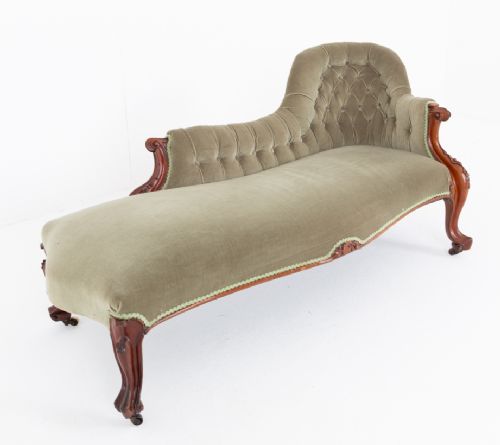


Tufted Recamier Sofa
These tufted recamier sofa examples are classical reclining seating forms designed for lounging, combining nineteenth-century joinery with rich upholstery to anchor a formal interior.
Tufted Recamier Sofa
A tufted recamier sofa sits among nineteenth-century seating forms that combine the reclining function of a day bed with the elevated scroll end of a classical chaise longue. Buyers searching this phrase encounter nineteenth-century pieces including Victorian and Regency examples.
The physical forms on this page span Victorian rosewood and mahogany chaise longues alongside earlier Regency mahogany day beds and reclining day bed variations. Makers such as Holland & Sons and Miles & Edwards appear among the nineteenth-century listings.
Most pieces show traditional bolster ends and upholstered frames covered in velvet, blue damask fabric, or whisky brown leather. These day bed variants provide single-ended lounging suited to period drawing rooms and parlours.
How they were made
Makers built the structural frames using dense timbers like mahogany, rosewood, and general hardwood, joined to support the weight of a reclining user. Selected pieces incorporate brass castors and details beneath the wooden chassis.
Upholstery techniques involved stuffing fabrics over spring or webbing foundations, secured with deep button tufting across velvet, damask, and leather covers. Wood surfaces received polished finishes to highlight the grain of the rosewood or mahogany.
What varies in quality
The refinement of the carved scrollwork and the choice of primary timber create a distinct separation between standard production pieces and higher workshop outputs. Dense rosewood frames and documented cabinet-maker attributions command greater attention than plain hardwood alternatives.
Upholstery execution alters the character of each piece, where precise button tufting and high-grade damask, velvet, or leather elevate the visual weight of the furniture. The proportion of the raised end relative to the length of the seat dictates the overall elegance of the form.
Holland & Sons·Miles & Edwards
The Tufted Recamier Sofa Glossary
- Recamier
- A day bed or couch with two raised ends, named after the French socialite Madame Récamier. It is designed for reclining in a semi-seated position.
- Chaise Longue
- Literally a long chair in French, combining a chair with an extended seat for reclining. Nineteenth-century examples often feature a single scrolled backrest.
- Regency
- An English stylistic period spanning the early nineteenth century, characterised by classical revival motifs and refined mahogany joinery. Pieces from this era display clean architectural lines.
- Victorian
- A nineteenth-century period spanning the reign of Queen Victoria, known for eclectic revivals and robust furniture construction. Rosewood and mahogany predominated during this era.
- Damask
- A reversible figured fabric traditionally woven on a jacquard loom, frequently utilised for period upholstery. Its patterned surface catches the light.
- Tufting
- An upholstery method where buttons or stitches are pulled deep through the padding to secure the filling and create a geometric pattern. This technique secures the inner layers.
Tufted Recamier Sofa: Frequently Asked Questions
What is a tufted recamier sofa?
A tufted recamier sofa is a nineteenth-century day bed or chaise longue featuring button-tufted upholstery and a raised scroll end. These pieces serve as formal lounging furniture originating from the Regency and Victorian eras.
They combine the seating utility of a sofa with the full recumbent length of a bed. Makers constructed them primarily in mahogany and rosewood to anchor drawing room interiors.
How do I distinguish Regency from Victorian pieces?
Regency examples date from the early nineteenth century around eighteen twenty-five, displaying classical proportions and restrained mahogany woodwork. Victorian pieces tend to be heavier in scale, often utilising rosewood or walnut with more exuberant carving.
Examining the turning of the legs and the profile of the scroll end clarifies the stylistic period. Cabinet-making signatures or attribution labels further confirm the chronology.
Where should I place a day bed?
These pieces suit placement against a primary wall in a drawing room, library, or large bedroom where their singular scroll end remains visible. Because many are finished with one raised arm, positioning them to face the room highlights their asymmetrical profile.
Ensure adequate clearance around the piece to allow full appreciation of the exposed timber frame and upholstery. They function well as statement seating rather than tucking into tight corners.
What fabrics were traditionally used?
Upholstery materials on nineteenth-century examples include silk damask, velvet, and leather. These textiles were chosen to complement the polished mahogany or rosewood frames.
Deep button tufting secured these heavy fabrics across the backrests and squab cushions. Surviving covers reflect both original period specifications and later nineteenth-century restoration choices.