


Schoolhouse Dial Clock
A schoolhouse dial clock brings reliable timekeeping and bold public presence straight onto a domestic wall.
Schoolhouse Dial Clock
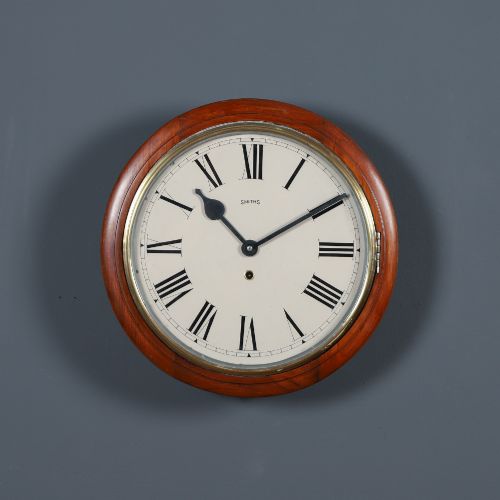
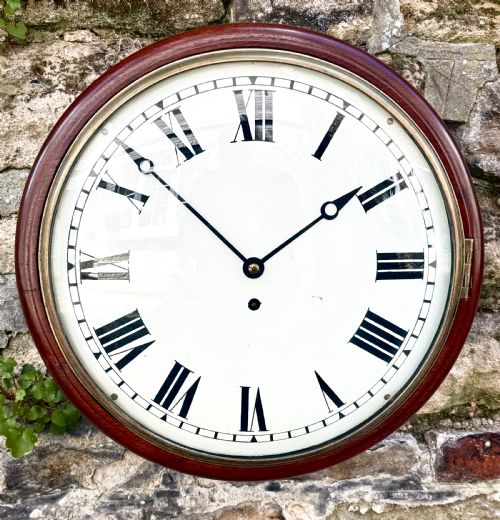
When you search for a schoolhouse dial clock, you are looking at substantial circular wall clocks designed for public buildings, offices and educational spaces. These timepieces typically feature clear, easy-to-read painted dials housed within sturdy timber frames.
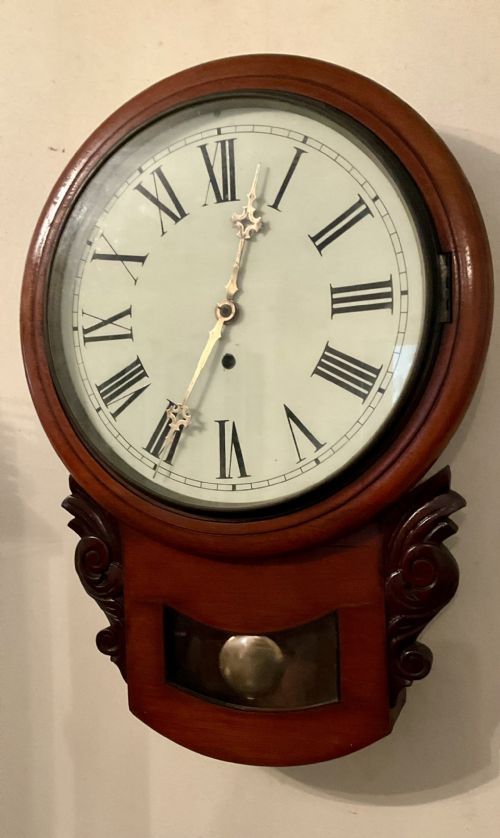
On this page, you are most likely to meet wall clocks originating from the nineteenth and early twentieth centuries. Examples span Victorian drop-dial formats, heavy oak cases, and railway station variants dating from the nineteen-thirties.
How they were made
Cases on these clocks rely primarily on solid timbers such as mahogany, oak, and walnut to protect the internal movement. The bezels and side doors allow easy access to the paper or painted dials and protective glass faces.
Mechanisms often utilise fusee movements to ensure steady, even tension as the mainspring unwinds. Brass components work alongside iron and wood to build a robust wall-hanging timepiece.
Listings on this page include mahogany, oak, and walnut cases housing glass-fronted paper and metal dials from the nineteenth and twentieth centuries.
What varies in quality
The sophistication of the internal movement dictates the higher end of the range, particularly with reliable fusee mechanisms. Simpler timepieces offer straightforward utility, whereas signed dial faces and refined cabinet timbers elevate a piece.
The clarity and preservation of the dial face heavily influence desirability. Crisp numbering, original hands, and clean timber patination separate standard workshop clocks from superior examples.
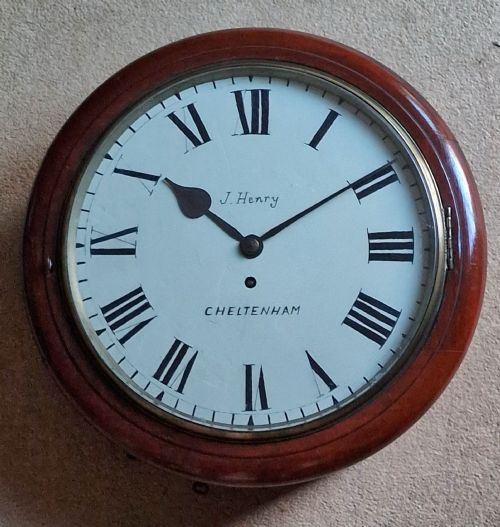
J Henry Cheltenham·Payne of Tunbridge Wells
The Schoolhouse Dial Clock Glossary
- Fusee
- A conical pulley connected to the mainspring by a chain or cord, designed to equalise the torque as the spring unwinds. This mechanism improves the timekeeping accuracy of the clock.
- Drop dial
- A wall clock case featuring a circular dial at the top and an extended lower trunk or box to house the pendulum. This shape is characteristic of many nineteenth-century station and office clocks.
- Timepiece
- A clock that indicates the time without a striking mechanism for hours or quarters. Most standard dial wall clocks function purely as timepieces.
- Bezel
- The ring of brass or wood that holds the glass protecting the dial. It usually hinges open to allow hand adjustments.
Schoolhouse Dial Clock: Frequently Asked Questions
What is a schoolhouse dial clock?
A schoolhouse dial clock is a wall-mounted timepiece featuring a prominent round face designed for visibility in public rooms and classrooms. They combine functional timekeeping with sturdy wooden cases.
Most examples use traditional movements and simple frames intended to hang securely in high-traffic areas.
How do fusee movements work?
A fusee movement uses a conical drum and a chain to regulate the pull of the mainspring. This ensures the driving force remains constant as the spring loses tension.
Such mechanisms represent a higher standard of clockmaking found in many nineteenth-century dial clocks.
Where were these clocks used?
These clocks hung in railway stations, government offices, post offices, and educational institutions where accurate timekeeping was essential. Their clear dials allowed people to read the hour from across a busy room.
Today, they adapt well to domestic kitchens, hallways, and studies.
How do I date a dial clock?
Dating relies on examining the timber, construction methods, and the style of the dial face. Victorian and Edwardian examples often show distinct cabinet proportions and painted paper or metal dials.
Maker signatures or railway markings on the dial provide further clues to the exact era.