


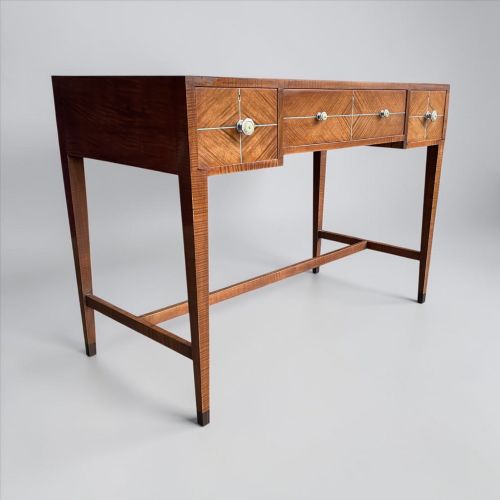
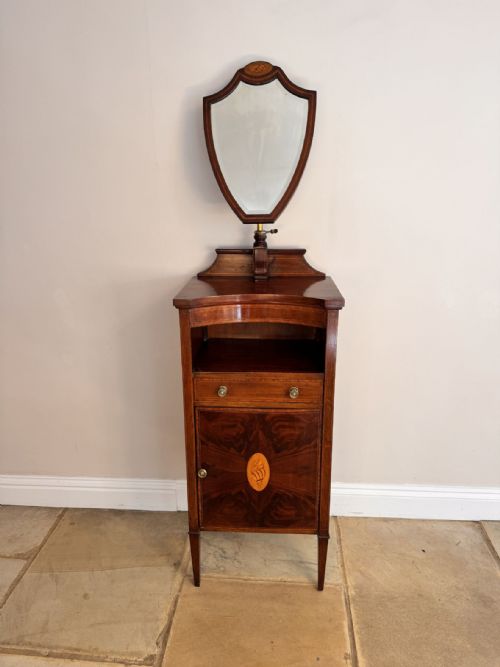
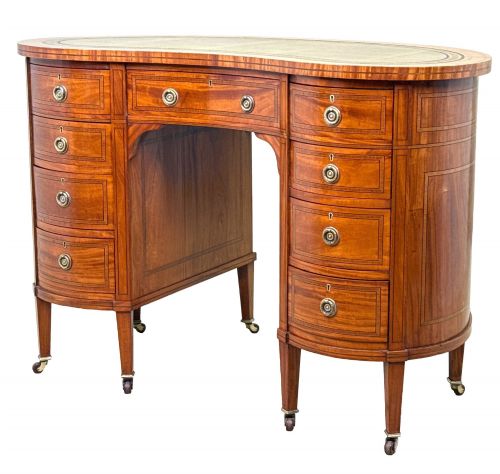
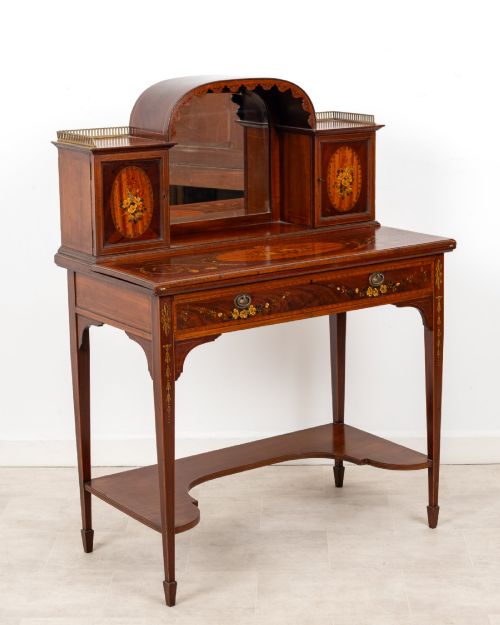
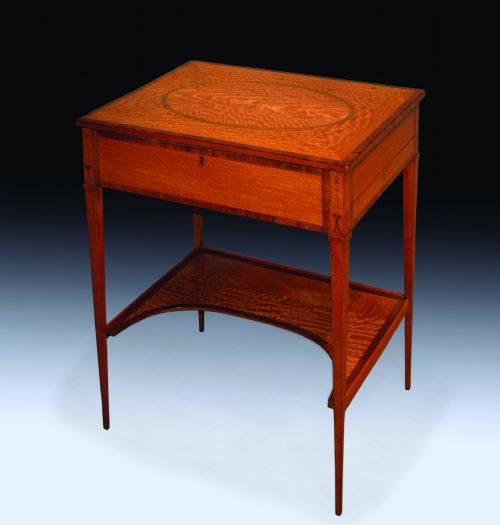


Satinwood Inlay Dressing Table
A satinwood inlay dressing table brings a luminous warmth to a bedroom through pale timbers and delicate marquetry.
How they were made
Cabinet makers utilised satinwood and mahogany as the primary foundations, often applying contrasting veneers and banding in tulipwood. Artisans incorporated brass handles, mirror glass, and leather or fabric inserts to complete the surfaces.
Inlay and marquetry techniques defined the decoration, creating geometric patterns and floral motifs across drawer fronts and table tops. Workshops relied on precise joinery to ensure the stability of curved kidney desks and dressing table mirrors.
What varies in quality
The crispness of the inlay and the selection of figured timber distinguish standard production from exceptional cabinet work. Superior pieces display seamless matching of veneers across curved surfaces and tightly fitted drawer construction.
Hardware choice and secondary woods reveal the workshop standard, where heavy brass mounts and solid mahogany framing elevate the overall execution. The balance of proportions and the refinement of painted details separate ordinary items from those of notable makers.
Satinwood Inlay Dressing Table Retail Price Guide 2026
Typical asking prices for satinwood inlay dressing table among the pieces listed under this phrase on Sellingantiques today, from the lower quarter to the upper quarter. They describe what is for sale here now, not the wider market.
George III ladies worktables often concealed secret rising compartments for needles and notes, keeping private correspondence safe from polite society.
James Shoolbred of London·Edwards and Roberts·Maple and Co.·Gillows·Collinson and Lock
The Satinwood Inlay Dressing Table Glossary
- Satinwood
- A hard, yellow timber with a lustrous sheen, highly valued for decorative veneers in fine cabinet making. Its bright surface reflects light effectively across tabletops and drawer fronts.
- Marquetry
- The art of applying pieces of veneer to a structure to form decorative patterns and pictures. Craftsmen cut contrasting woods to fit precisely within the design.
- Sheraton Revival
- A late 19th and early 20th-century style inspired by the furniture designs of George III designer Thomas Sheraton. It relies on satinwood, delicate inlay, and neoclassical symmetry.
- Kidney desk
- A writing table shaped with a curved front resembling a kidney bean, designed to wrap around the user. These forms frequently incorporate satinwood inlay and multiple small drawers.
- Tulipwood
- A pale yellowish or rose-coloured wood with darker streaks, often utilised for banding and contrasting borders on fine tables. It frames the primary satinwood veneers.
Satinwood Inlay Dressing Table: Frequently Asked Questions
How do I care for satinwood?
Keep these surfaces away from direct sunlight and excessive heat to prevent the delicate veneers from fading or drying out. Regular dusting with a soft, dry cloth preserves the natural sheen without stripping the polish.
Avoid placing damp items directly onto the wood, and use protective pads beneath any decorative objects. Gentle waxing once or twice a year maintains the moisture in older timber.
Are these tables for daily use?
These pieces function well for writing or display, provided you treat the aged timber and delicate inlay with care. Many include drawers that offer practical storage for everyday items.
Consider placing a protective glass top if you plan to use the surface intensively for writing. Otherwise, treat the antique polish with the same respect as any fine dining table.
How do I spot a reproduction?
Examine the secondary woods inside the drawers and the ageing of the brass hardware for consistency with the stated period. Genuine pieces show natural wear and timber shrinkage appropriate to their age.
Look closely at the inlay work to ensure the contrasting woods have aged naturally together. Machine-cut precision without hand-cut irregularities often points to a later manufacture.
What is satinwood inlay?
Satinwood inlay involves setting contrasting woods into the primary surface of a piece to create decorative borders or intricate motifs. This technique highlights the luminous quality of the golden timber.
Craftsmen cut precise channels into the main structure and inserted darker woods like mahogany or tulipwood. The result is a crisp, flat design that enhances the elegance of the furniture.