
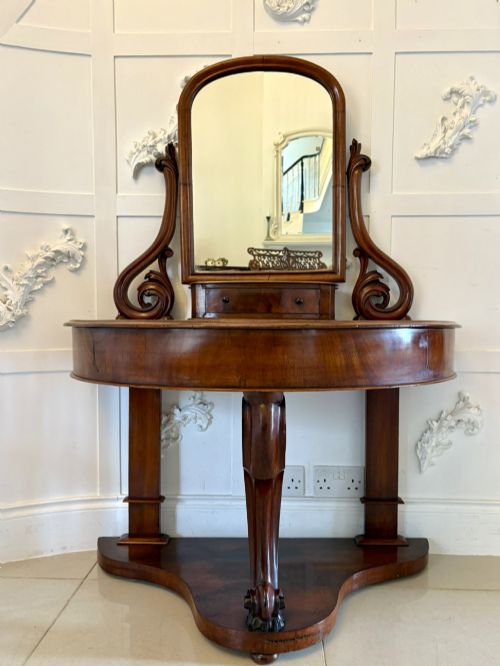
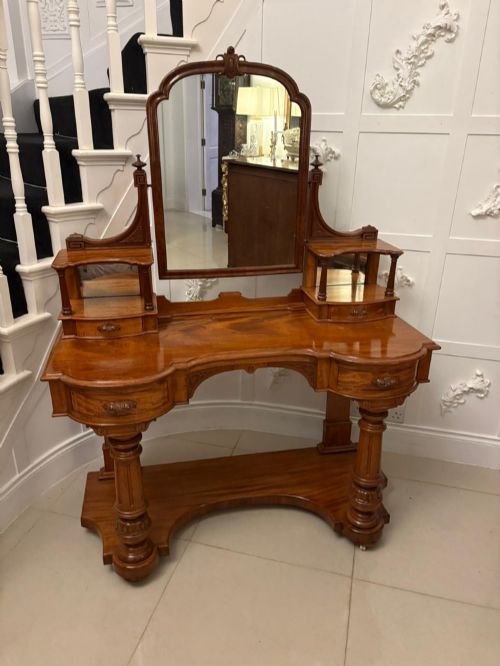
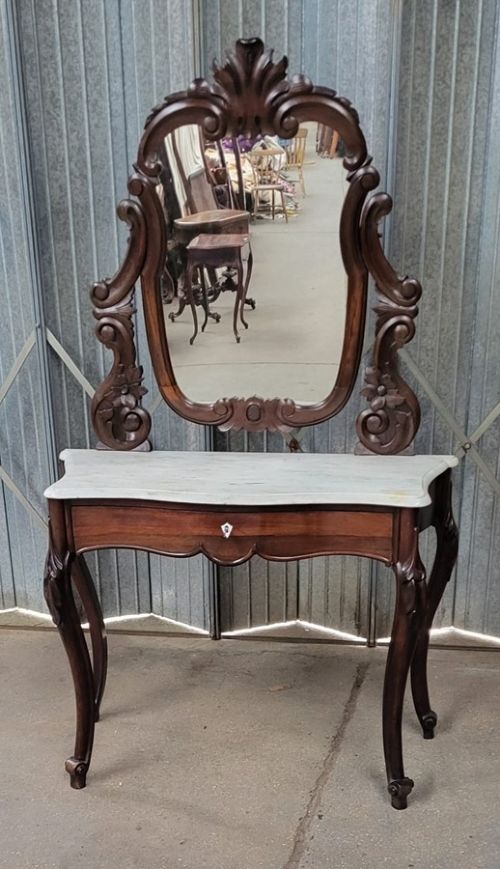


Duchesse Dressing Table
A duchesse dressing table brings dramatic Victorian scale and large pivoting mirrors into a bedroom, offering deep drawers and a characteristic horseshoe or shaped surface.

What a duchesse dressing table is
A duchesse dressing table is a substantial bedroom vanity piece defined by a large, centrally mounted swiveling mirror, often flanked by smaller trinket drawers or supports. These pieces primarily date from the Victorian period, spanning the nineteenth century, and frequently appear in Edwardian variations as well.
The form typically combines a lower dressing chest or table base with an upper mirror assembly. Surviving examples demonstrate that these dressing tables served grand domestic spaces, ranging from country house chambers to elegant period townhouses.
When browsing this selection, a buyer is most likely to encounter nineteenth-century mahogany and flame mahogany variants, alongside occasional burr walnut pieces. Edwardian iterations and satinwood or painted examples also surface to represent the later evolution of the style.

Materials and construction
Cabinet makers constructed these dressing tables using dense hardwoods, most notably mahogany, flame mahogany, and burr walnut, sometimes incorporating satinwood or painted finishes. These timber surfaces were polished to highlight the natural grain patterns and rich colour of the wood.
Structural embellishments relied on brass hardware for drawer pulls and fixtures, while glass formed the large tilting mirrors. Certain washstand and dressing table variants integrated marble tops into their designs to provide durable, water-resistant surfaces.
Carved wooden details and sturdy chest bases provided the foundational support for the heavy mirror frames. Joinery techniques of the Victorian and Edwardian eras ensured these complex multi-tier structures remained stable under daily use.
Retail Price Guide 2026
Typical UK retail prices for duchesse dressing table, calculated from the Sellingantiques database of over a million retail prices indexed since 2003. This retail price guide relies exclusively on Sellingantiques data; no external sources or auction records are used, so the figures do not describe the wider market.
Empire Revival and Art Nouveau stylistic influences appear alongside standard Victorian forms in the archive.
Distinctions in quality
The distinction between standard examples and the finest pieces rests upon the choice of timber veneer. Flame mahogany and burr walnut displays with highly figured, symmetrical grain command greater appreciation than plain timber surfaces.
Carving depth and refinement of detail separate superior tables from simpler workshops. Crisp mouldings, well-turned supports, and substantial proportions indicate a higher grade of craftsmanship.
The integrity of the original mirror glass and the weight of the supporting superstructure influence the overall coherence of a piece. Comprehensive survival of matching elements, such as associated washstands or intact brass fittings, elevates the status of an individual table.

The Duchesse Dressing Table Glossary
- Duchesse dressing table
- A grand vanity unit featuring a large adjustable mirror set above a base of drawers and a shaped top. It emerged as a prominent bedroom furnishing during the Victorian era.
- Flame mahogany
- A highly decorative cut of mahogany timber displaying undulating, flame-like grain patterns. Cabinet makers prized this veneer for the dramatic visual movement it brought to prominent surfaces.
- Satinwood
- A pale, hard exotic timber known for its natural golden sheen and smooth finish. It saw use in fine dressing furniture during the late nineteenth and Edwardian periods.
- Swiveling mirror
- A glass plate hung on pivoting side arms that allows the user to adjust the angle of reflection. This component forms the defining upper superstructure of a duchesse dressing table.
Frequently Asked Questions
What is a duchesse dressing table?
A duchesse dressing table is a large nineteenth-century vanity unit that incorporates a prominent swiveling mirror mounted above a chest of drawers or a shaped table base. These pieces were designed for principal bedrooms and combined storage with grooming space.
They emerged strongly during the Victorian period, utilising rich timbers like mahogany and walnut to create a commanding visual presence in period interiors.
How do I date a duchesse dressing table?
Dating relies on observing the timber choices, construction methods, and stylistic cues present in the piece. Mid-nineteenth-century examples often feature heavy flame mahogany, while later Victorian and Edwardian pieces might display satinwood, painted finishes, or lighter proportions.
Art Nouveau influences begin to appear towards the end of the nineteenth century, altering the standard carved motifs into more flowing, organic lines.
What woods were used for these dressing tables?
The primary wood found across these listings is mahogany, often selected for its deep colour and structural stability. Flame mahogany veneers provided striking surface patterns on the main carcase and drawer fronts.
Burr walnut also appears on finer examples, offering intricate swirling grain patterns, while satinwood and painted finishes represent lighter aesthetic choices from the Edwardian period.
Did these tables come with matching pieces?
Surviving records indicate that duchesse dressing tables were occasionally produced alongside matching washstands sharing identical timber and stylistic details. These suites furnished large country house bedrooms where coordinated bedroom sets were fashionable.
While dressing tables often appear independently today, matching marble-top washstands occasionally surface to complete the original pairing.