
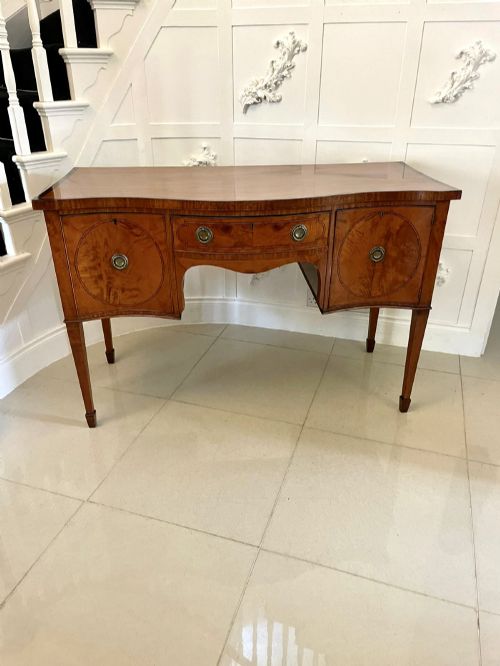


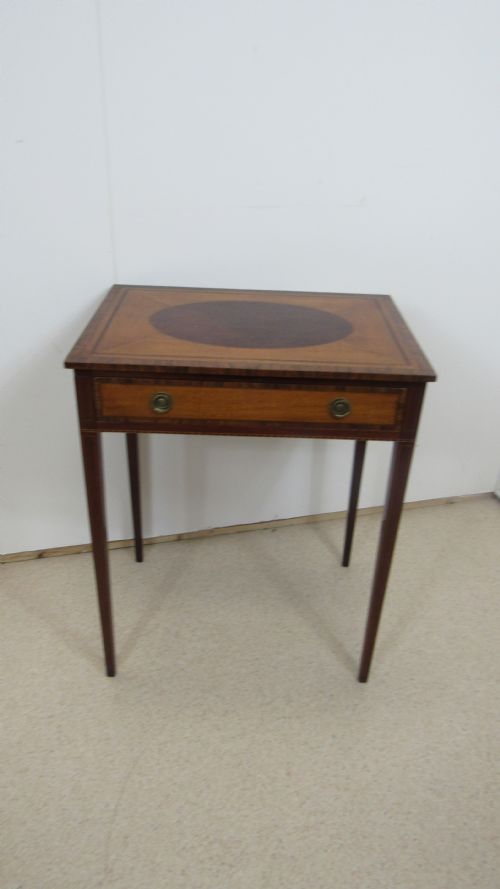

Satinwood Hallway Table
These satinwood hallway table examples bring figured timber and inlaid detail straight from the Victorian and Edwardian eras into your entrance.
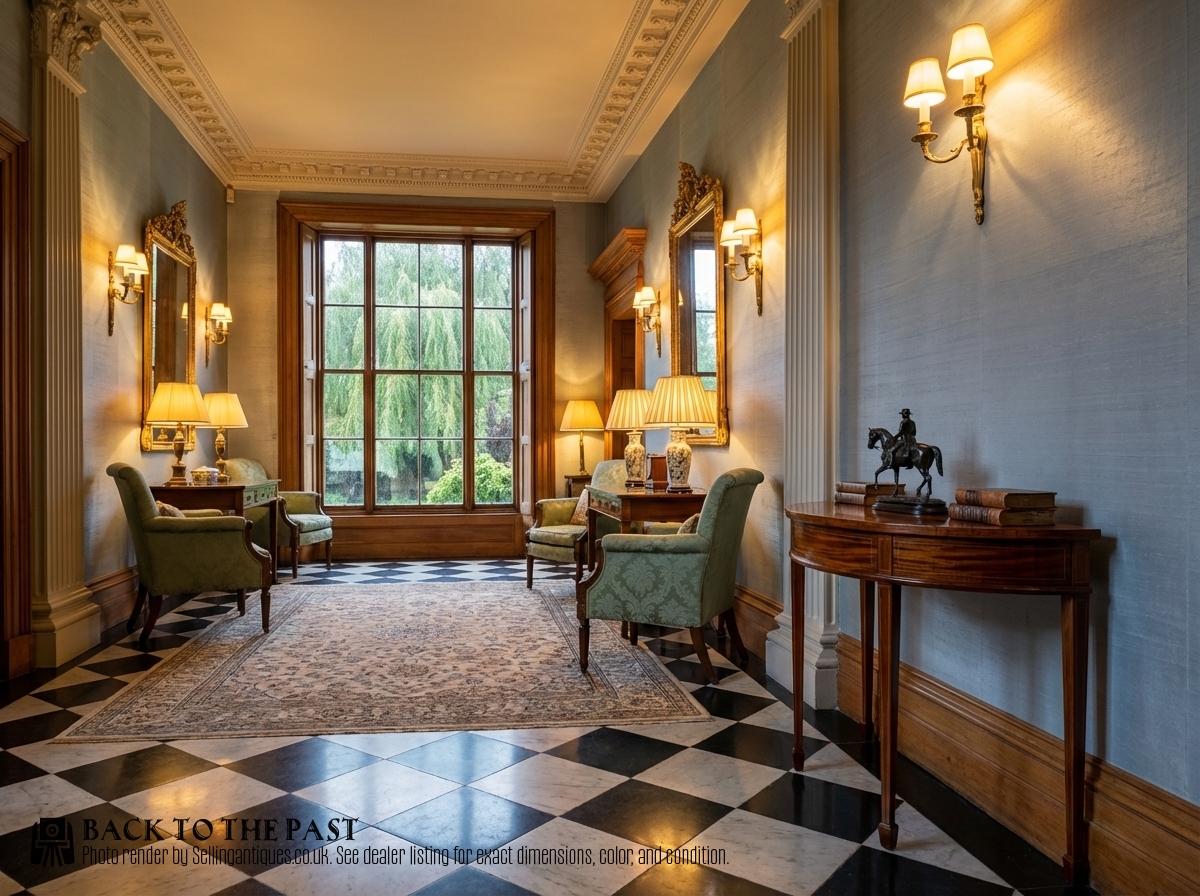
Satinwood Hallway Table
When you search for a satinwood hallway table, you are looking at entrance furniture fashioned primarily as demi-lune consoles, side tables, and compact sideboards. These pieces span the Georgian, Victorian, and Edwardian periods, bringing refined surfaces to narrow spaces.
The versions you are most likely to meet on this page include Edwardian satinwood console tables and nineteenth-century demi-lune pieces. Many incorporate mahogany and boxwood details alongside the characteristic golden timber.
Makers such as Heal & Son appear among the broader selection of sideboards, writing desks, and sofa tables. The forms reflect stylistic influences ranging from Sheraton Revival to French Empire.
How they were made
Cabinet makers utilised satinwood veneers over secondary timbers like mahogany, often applying intricate wood inlay and boxwood stringing to create geometric or floral motifs. Painted decoration also appears on French demi-lune surfaces from the nineteenth century.
Construction methods rely on traditional joinery suited to curved demi-lune and serpentine shapes. Brass hardware frequently complements the polished timber surfaces.
One unexpected Edwardian piece doubles as a cheval mirror, proving that nineteenth-century hallways needed to check reflections just as much as mail.
What varies in quality
The distinction between standard and superior pieces rests in the intricacy of the wood inlay and the figuring of the satinwood veneer. Finer examples display meticulous banding and balanced proportions across serpentine or demi-lune forms.
The execution of painted decoration and the selection of contrasting timbers, such as rosewood and mahogany, further divide the output of ordinary workshops from distinguished makers.
Heal & Son
The Satinwood Hallway Table Glossary
- Demi-lune
- Half-moon shape. This curve defines many console and side tables designed to sit flush against a wall.
- Serpentine
- Wavy outline. The curving front edge requires advanced cabinet-making skill to execute cleanly.
- Stringing
- Thin inlay lines. These contrasting borders frame drawer fronts and tabletops.
- Satinwood
- Luminous hardwood. Its golden sheen and smooth grain make it the primary decorative surface here.
Satinwood Hallway Table: Frequently Asked Questions
What periods do these tables represent?
The pieces span multiple eras, including Georgian, Victorian, and Edwardian periods. You will also find items from the nineteenth and early twentieth centuries.
Design influences range from Sheraton Revival to French Empire, showing how tastes evolved across these decades.
Where should I place a demi-lune table?
A demi-lune shape sits flat against a wall, making it suited for narrow entranceways and hallways. Their shallow depth preserves floor space while offering a display surface.
They function well beneath mirrors or beside doorways where bulkier furniture would obstruct movement.
How do I identify satinwood?
Satinwood exhibits a distinct golden-yellow colour and a natural sheen that catches the light. It frequently appears as a veneer rather than solid timber.
Craftsmen often combined it with darker woods like mahogany and rosewood to create contrast through banding and inlay.
What is Sheraton Revival style?
Sheraton Revival furniture draws inspiration from eighteenth-century neoclassical designs. These pieces often feature delicate inlay and balanced proportions.
Edwardian cabinet makers frequently utilised this style for lighter hallway and side tables.