
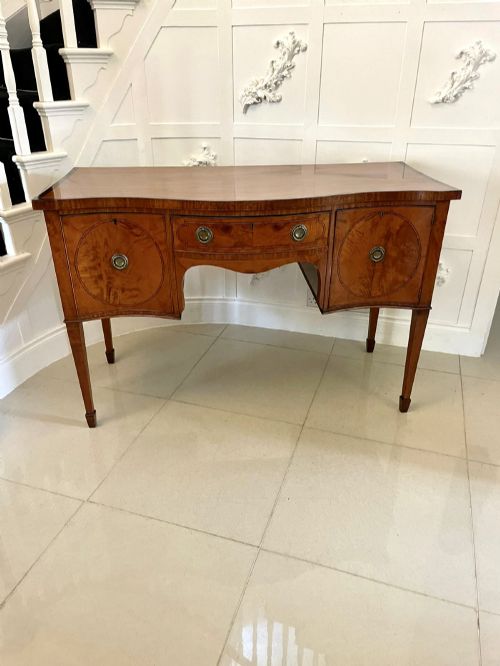
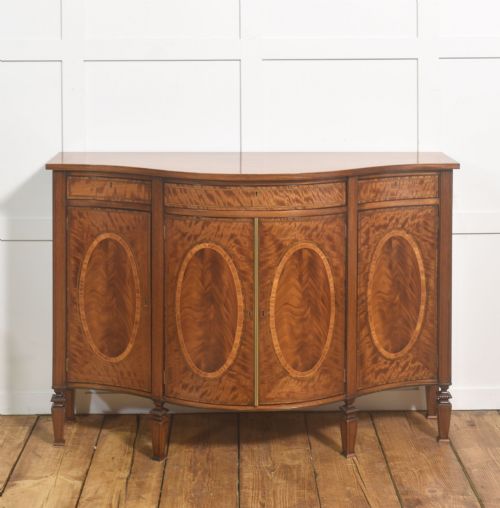
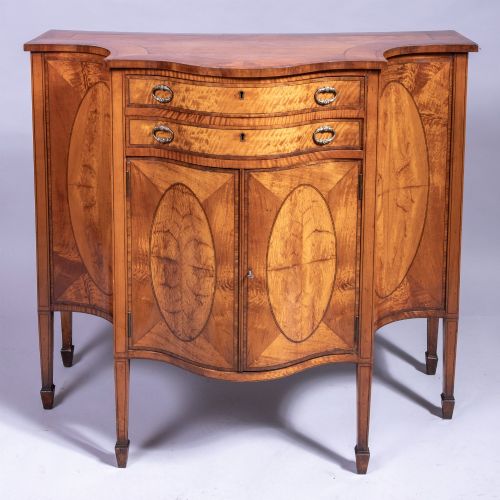

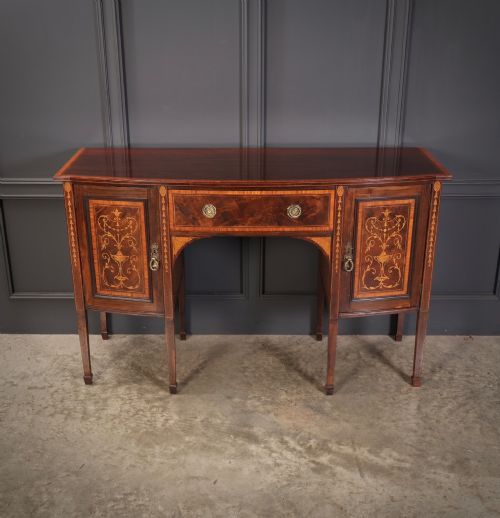
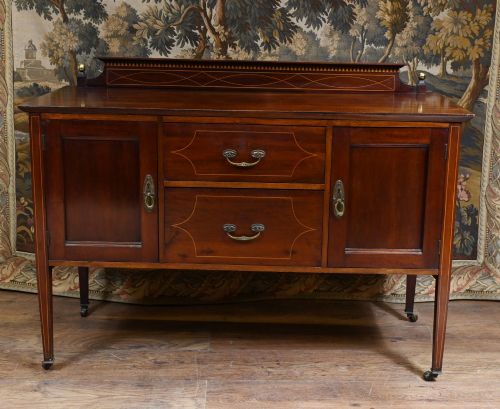

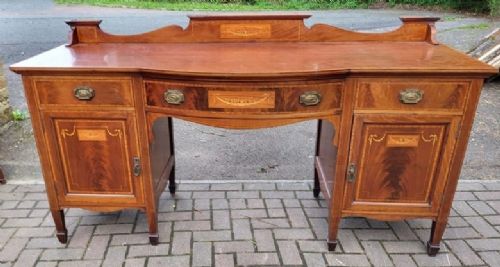


Satinwood Dining Sideboard
A satinwood dining sideboard brings light timber tones and refined neoclassical design to a traditional dining room.
Satinwood Dining Sideboard
When searching for a satinwood dining sideboard, a buyer encounters formal dining furniture designed for serving and storage, most frequently appearing in Sheraton Revival and Edwardian interpretations of Georgian elegance.
The pieces on this page span the late nineteenth and early twentieth centuries, alongside earlier Georgian examples, taking the form of serpentine shapes, bow-fronts, and breakfront sideboards.
These servers and side cabinets combine functional storage capacity with decorative veneers, serving as the focal point of a dining space.
Materials and Construction
Cabinet makers built these pieces using solid wood carcasses, predominantly mahogany, overlaid with figured satinwood veneers to create pale, luminous surfaces.
Detailing relied on precision wood inlay, boxwood, ebony, and rosewood stringing, complemented by marquetry motifs and cast brass hardware.
Listings feature pieces spanning the Georgian, Victorian, and Edwardian periods, constructed in satinwood and mahogany with brass and boxwood details.
Evaluating Craftsmanship
Quality rests in the selection of the timber figures, where even matching of satinwood veneer and crispness of floral or classical marquetry define the superior examples.
The finesse of the cross-banding, the structural integrity of curved serpentine or bow fronts, and the original condition of the brass fittings further separate standard production from masterwork execution.
Edwards and Roberts
The Satinwood Dining Sideboard Glossary
- Satinwood
- A dense, lustrous timber native to tropical regions, prized for its golden, reflective sheen and pale yellow colour.
- Bow-front
- A convex curved cabinet front that projects outward in a smooth arc, softening the linear geometry of a dining room.
- Cross-banding
- A border technique where thin strips of veneer are laid perpendicular to the grain of the central panel, framing the surface.
- Marquetry
- Elaborate decorative patterns formed by fitting together pieces of coloured wood veneer into a design.
Satinwood Dining Sideboard: Frequently Asked Questions
What is a satinwood dining sideboard?
A satinwood dining sideboard is a formal storage and serving piece featuring light-toned satinwood veneers, commonly associated with Sheraton Revival and Edwardian styles.
These cabinets provide surface space for serving food and interior cupboards or drawers for storing dining silver and linen.
How do I care for satinwood furniture?
Satinwood surfaces require gentle maintenance using soft, dry cloths to remove dust without abrasive polishes that can damage fine veneers.
Keep the timber away from direct sunlight and heat sources to prevent the wood from fading or the veneer from lifting over time.
How do I date an antique sideboard?
Dating relies on examining construction methods, timber choices, and stylistic markers such as Sheraton Revival inlay patterns or Georgian proportions.
Secondary woods inside drawers and the style of the brass hardware offer further clues to the period of manufacture.
Where should I place a sideboard?
Sideboards traditionally sit against the main wall of a dining room, anchoring the space and remaining easily accessible during meals.
Ensure adequate clearance around the piece so that cabinet doors and drawers can open fully without obstruction.