




Edwardian Satinwood Buffet
An edwardian satinwood buffet brings refined timber and classic revival proportion to a dining room, offering both display space and practical storage.
Edwardian Satinwood Buffet
An edwardian satinwood buffet combines the light, glowing timber characteristic of the period with classic revival forms. When you search for this phrase, you encounter pieces designed for formal dining rooms, primarily originating around the turn of the twentieth century and the late Victorian era.
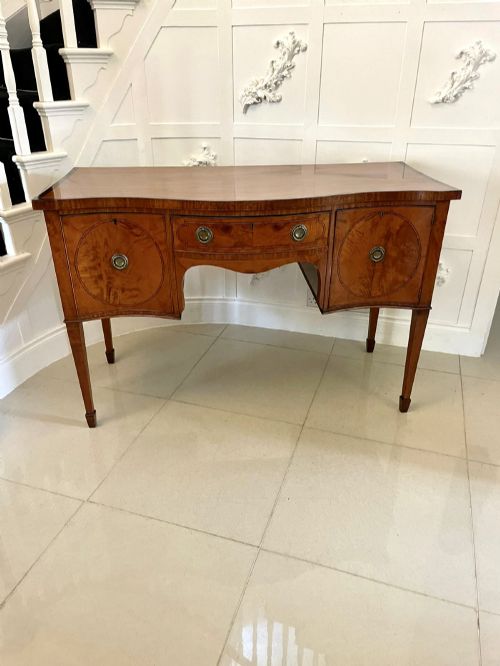
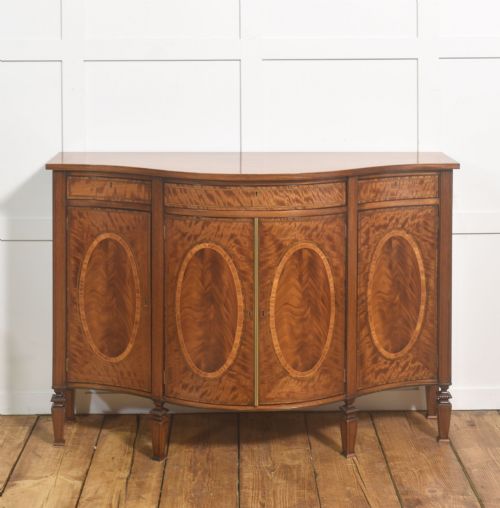
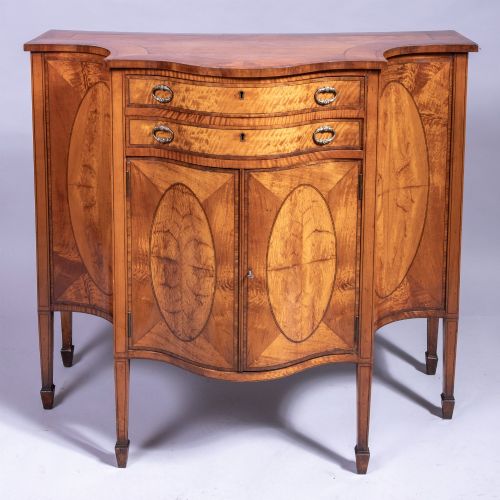
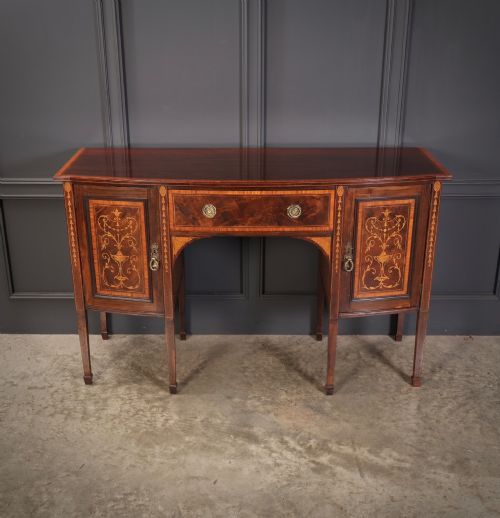
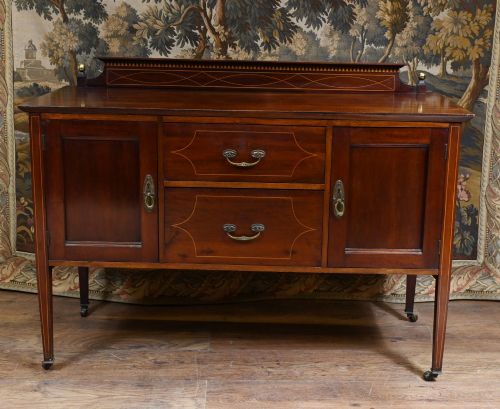
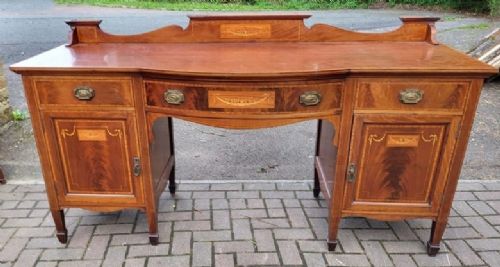
The pieces on this page appear in various forms, including sideboards, side cabinets, serving tables, and credenzas. While satinwood is the defining finish, many examples combine this bright veneer with contrasting mahogany, boxwood, and ebony details.
Stylistically, these items frequently draw on Sheraton Revival and George III Revival aesthetics. Makers of the period utilised classical urn, bellflower, and marquetry motifs to emulate earlier centuries with lighter modern proportions.
How they were made
Cabinet makers built these pieces using solid wood carcasses, such as mahogany, overlaid with figured satinwood veneers. Artisans employed cross-banding to frame the drawer fronts and top surfaces, creating distinct geometric borders.
Inlay work defines the decorative technique of the era, utilising contrasting woods like boxwood, ebony, and rosewood alongside delicate wood inlay. Some pieces incorporate brass galleries, floral painted panels, and elaborate marquetry scenes set into the timber.
Listings span multiple eras from Georgian origins to Sheraton Revival revivals executed in mahogany, satinwood, and brass.
What varies in quality
Quality rests heavily on the crispness and complexity of the inlay work and the choice of timber figure. Finer examples feature meticulously cut marquetry and deeply figured flame mahogany or satinwood that catches the light.
Construction methods also separate standard production from superior cabinet work, seen in the selection of secondary timbers and the precision of the cross-banding. The inclusion of original brass hardware and galleries elevates the distinction of a piece.
Edwards and Roberts
The Edwardian Satinwood Buffet Glossary
- Satinwood
- A lustrous, hard timber native to the tropics, prized for its golden, reflective sheen and smooth texture. It serves as the primary visual veneer on higher-end pieces from this era.
- Cross-banding
- A decorative border technique where veneer strips are laid perpendicular to the grain of the central panel. This frames the drawer fronts and tabletops with a contrasting direction of grain.
- Marquetry
- The art of forming decorative patterns using fitted pieces of various coloured woods, veneers, and shell. It appears on finer cabinets in floral or classical motifs.
- Sheraton Revival
- A late nineteenth and early twentieth century design movement copying the neoclassical furniture style of Thomas Sheraton. It favours straight tapered legs, light satinwood, and symmetrical urn inlays.
- Breakfront
- A piece of furniture whose central section projects forward from the flanking wings. This architectural arrangement creates depth and shadow across the front elevation.
Edwardian Satinwood Buffet: Frequently Asked Questions
How do I identify Sheraton Revival style?
Sheraton Revival furniture draws inspiration from eighteenth-century neoclassical designs, featuring light satinwood, symmetrical proportions, and delicate inlay work.
Look for straight tapered legs, oval drawer panels, and classical motifs such as bellflowers and urns executed in contrasting dark woods.
Where were these pieces used?
These pieces originated in formal dining rooms of substantial homes, where they acted as auxiliary surfaces for carving meat and displaying silver.
Today, buyers place them in modern dining rooms, hallways, and living spaces as statement storage credenzas.
What is cross-banded mahogany?
Cross-banded mahogany refers to a cabinet-making technique where a border of mahogany veneer is laid with its grain running at right angles to the central panel.
This method frames the primary wood and adds subtle geometric contrast to drawer fronts and tabletops.