



Georgian Satinwood Server
A georgian satinwood server brings refined timber and subtle inlay into a dining space, offering both generous storage and elegant display.
Georgian Satinwood Server
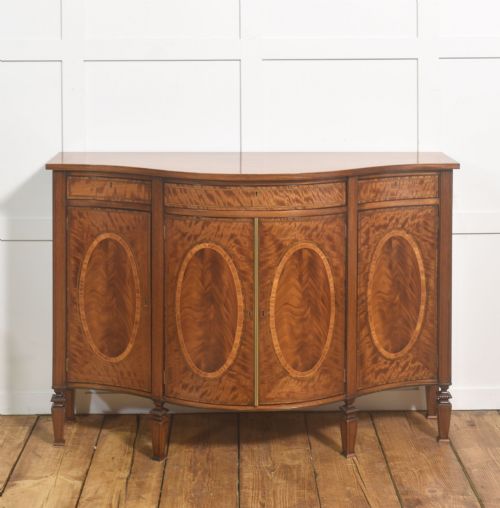
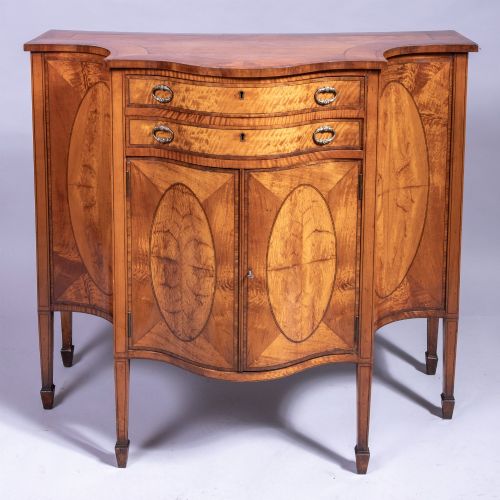
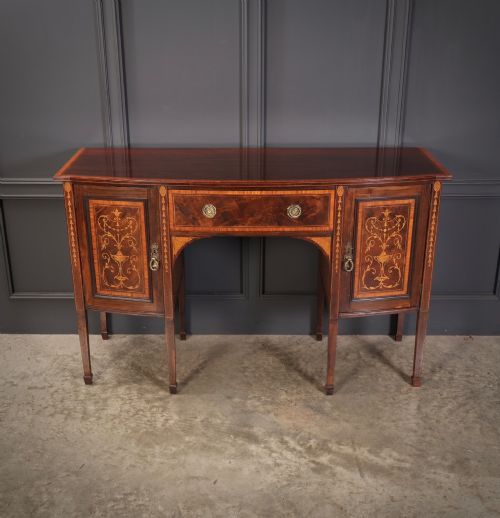
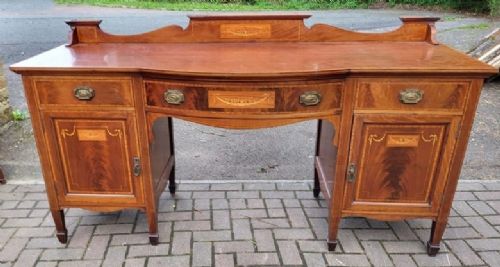
A georgian satinwood server encompasses versatile serving tables, sideboards, and side cabinets originating from the Georgian era through to later revivals like the Edwardian period and the early twentieth century. The primary forms seen here include bow-fronted and breakfront examples, alongside serpentine designs that utilise the distinctive grain of satinwood or mahogany.
Buyers will most frequently encounter Sheraton Revival pieces dating from around nineteen hundred, alongside genuine George III items and nineteenth-century interpretations. These items range from compact sideboards to grand serving tables equipped with brass galleries, reflecting the enduring popularity of eighteenth-century neoclassical design idioms in later domestic interiors.
Materials and construction methods
Construction relies upon solid timber carcasses, predominantly mahogany or satinwood, often enhanced with contrasting boxwood and wood inlay. Craftsmen applied intricate marquetry and satinwood cross-banding to flat and curved drawer fronts to create geometric or floral patterns.
Specialised techniques enabled the shaping of bow-front and serpentine carcasses, requiring skilled timber bending and veneer application. Fine brass hardware, including handles and occasional galleries, completed the functional assembly of these serving pieces.
Some nineteenth-century servers come equipped with a brass gallery, ideal for stopping your best claret decanter from sliding off during an enthusiastic dinner party.
Judging the quality of a server
Quality rests upon the selection and matching of wood veneers, particularly the grain figuration in the satinwood and flame mahogany panels. Superior examples exhibit precise, crisp boxwood inlay and well-defined marquetry rather than painted substitutes or blurred patterns.
Structural integrity and proportion distinguish finer items, with attention paid to the seamless alignment of curved drawers and the quality of original brass mounts. The subtlety of the cross-banding and the crispness of the Sheraton Revival carving further separate standard utility pieces from masterwork outputs.
The Georgian Satinwood Server Glossary
- Satinwood
- A lustrous tropical hardwood with a natural golden sheen, frequently used for veneers and inlay in fine furniture.
- Bow-front
- A convex curved front profile popular in late eighteenth- and nineteenth-century case furniture.
- Marquetry
- Decorative patterns formed by the insertion of different woods, veneers, or shell into a solid timber surface.
- Cross-banding
- A border veneer applied perpendicularly to the grain of the primary surface to frame panels or drawer fronts.
- Serpentine
- A furniture front shaped with a central convex curve flanked by two concave curves.
Georgian Satinwood Server: Frequently Asked Questions
What is a satinwood server used for?
These pieces functioned historically as dining room side tables for holding dishes, silverware, and serving platters during meals. Today, they serve equally well in living areas or hallways for storage and display.
Their substantial surface tops and internal cabinet space make them practical furniture for modern rooms requiring surface area and concealed organisation.
How do I date a satinwood server?
Dating relies on identifying structural characteristics, timber choices, and stylistic cues such as inlay motifs. George III pieces generally show eighteenth-century construction methods, while Sheraton Revival examples reflect turn-of-the-twentieth-century manufacturing.
Examining secondary timbers inside drawers and the style of the brass hardware provides additional clues regarding the precise period of manufacture.
Where should I place a server?
A server suits dining rooms placed against a primary wall to anchor the room's proportions and provide serving space. They also fit well in spacious hallways or reception rooms where their decorative inlay can be appreciated.
Care should be taken to keep them away from direct heat sources and strong sunlight to protect the sensitive satinwood veneers.
How do I care for satinwood furniture?
Maintain satinwood surfaces by dusting gently with a soft, dry cloth and avoiding silicone-based polishes or harsh chemical cleaners. Periodic application of quality beeswax helps preserve the natural lustre of the timber.
Maintaining stable indoor humidity prevents the veneers from drying out, cracking, or lifting away from the underlying carcass over time.