


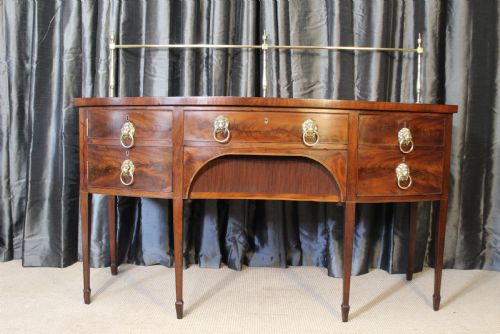


Brass Rail Buffet Table
A brass rail buffet table brings sophisticated dining display to a room, offering sturdy mahogany construction and useful serving space.
Brass Rail Buffet Table
When you search for a brass rail buffet table, you find a collection of antique sideboards, serving tables, and server buffets that incorporate a brass gallery or rail. These pieces range from the Georgian period and 18th century through the Regency and Victorian eras, up to later revival styles like Sheraton Revival.
The version you are most likely to meet on this page is a mahogany sideboard or serving table, often featuring satinwood and boxwood inlay alongside its characteristic brass gallery. They appear in various forms including serpentine fronts, bowfronts, and pedestal designs from different centuries.
How they were made
Cabinet makers utilised solid mahogany and applied delicate satinwood and boxwood inlay to create decorative contrast on the drawer fronts and surfaces. These timbers provided the structural strength required for heavy serving furniture while allowing for refined cabinet work.
Metalworkers fashioned the distinctive brass rails and galleries to secure dishes and prevent items from sliding off the top during service. This combination of cabinet making and brass work defined the utility and appearance of the serving tables.
The listings span multiple centuries, incorporating Georgian, Regency, Victorian, and 1890s revival periods using mahogany, satinwood, and brass.
What varies in quality
The sophistication of the inlay work and the execution of curved fronts, such as serpentine shapes and bowfronts, distinguish finer examples from simpler vernacular pieces. Cabinet makers who invested time in precise wood selection and harmonious proportions achieved superior results.
The weight, casting quality, and original retention of the brass rail or gallery affect the overall integrity of the piece. Well-integrated galleries demonstrate a higher grade of original design rather than later additions.
Robson and Sons·H Mower and Stephenson
The Brass Rail Buffet Table Glossary
- Brass gallery
- A low metal rail fitted to the top surface of a serving table or sideboard, designed to keep dishes secure.
- Serpentine front
- A furniture front that curves outward in the centre and curves inward at the ends, creating an undulating line.
- Bowfront
- A convex, outwardly curved front found on sideboards and serving tables, popular in late eighteenth century design.
- Satinwood inlay
- A contrasting light yellowish wood inserted into darker mahogany surfaces to form decorative borders or patterns.
Brass Rail Buffet Table: Frequently Asked Questions
What is a brass rail buffet table used for?
These tables served primarily as serving surfaces during formal dining, holding platters, dishes, and silverware within easy reach of the dining table.
The brass rail or gallery kept items secure on top while food and drink were organised during large gatherings.
How do I style a mahogany serving table?
Place the piece against a dining room wall where it can function as a practical surface for serving food or displaying decorative ceramics and silver.
The rich mahogany tones pair well with traditional dining room interiors and provide useful surface space without dominating the floor plan.
How can I tell a Georgian piece from a revival piece?
Georgian and eighteenth century pieces display the structural wear and timber patination consistent with active daily use over hundreds of years.
Revival pieces, such as those from the late nineteenth century, often use similar mahogany and inlay techniques but show different construction markers underneath.
Are these tables suitable for modern dining rooms?
They fit comfortably into contemporary homes as sideboards or serving consoles, offering deep storage drawers and expansive top surfaces.
The narrow profiles of serpentine and bowfront models allow them to sit against walls in hallways or dining spaces without obstructing movement.