
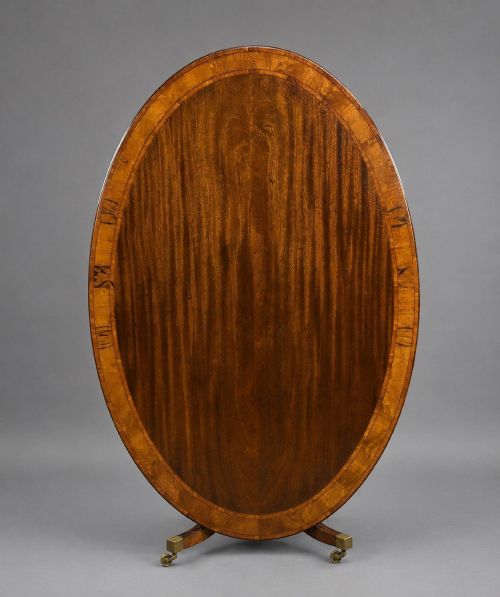
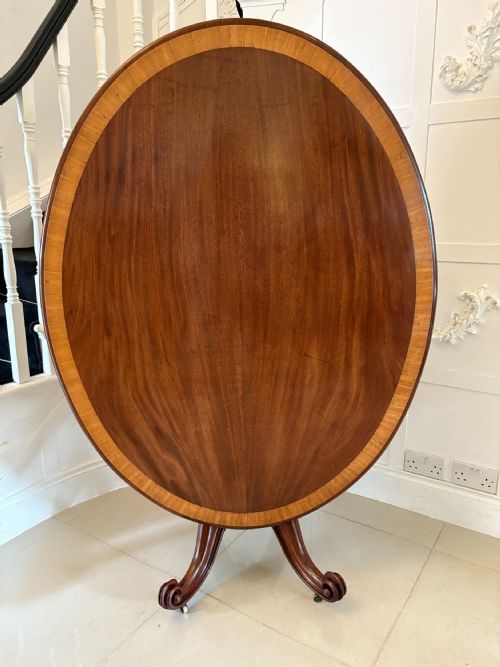


Satinwood Breakfast Table
These satinwood breakfast table pieces offer the warm glow of figured timber and crossbanding that collectors prize for a dining room.
Satinwood Breakfast Table
When you search for a satinwood breakfast table, you are looking at circular or oval tilt-top dining and occasional tables dating from the Georgian, Regency, and Victorian eras. These pieces combine rich mahogany or satin birch carcases with distinctive satinwood veneers and banding.
The version you are most likely to meet on this page is a Regency or George III example featuring satinwood crossbanding, often with a tilt-top mechanism designed to save space when not in use.
How they were made
Cabinet makers utilised solid timber carcases overlaid with fine veneers, applying satinwood for its pale, shimmering grain and contrasting it with darker rosewood, mahogany, or ebony banding. Brass fittings often reinforced the pedestals and castors.
Makers employed radial veneering techniques for circular tops, aligning the grain to draw the eye towards the centre, while tilt-top mechanisms utilised sturdy wooden catches and blocks to secure the surface.
Listings feature pieces spanning the Georgian period through to the Edwardian era, incorporating mahogany, satin birch, rosewood, and brass.
What varies in quality
Quality rests in the selection of the timber and the precision of the inlay, where the contrast between the pale satinwood and the surrounding mahogany creates depth. Superior examples display highly figured grain patterns across the entire top rather than relying on plain panels.
Construction methods also separate the output of different workshops, seen in the solidity of the pillar and tripod base and the seamless execution of radial veneer layouts.
The Satinwood Breakfast Table Glossary
- Crossbanding
- A border of veneer laid around the edge of a table top with the grain running perpendicular to the centre, often executed in satinwood.
- Tilt-top
- A hinged table top that pivots to a vertical position, allowing the piece to stand against a wall when not in use.
- Radial veneer
- Veneer pieces arranged in a circular starburst pattern radiating from a central point.
- Pembroke table
- A small table with hinged flaps on either side, frequently featuring satinwood inlay and used for breakfast or card games.
Satinwood Breakfast Table: Frequently Asked Questions
What is a satinwood breakfast table used for?
These tables served primarily for morning meals or light dining in smaller rooms before the dedicated dining room became standard in larger houses. Their tilt-top design also allowed them to function as side or hall tables when space was required.
Today, they suit living spaces and dining areas as accent pieces that provide a surface for lamps or books while retaining their original utilitarian charm.
How do I tell a Georgian table from a Victorian one?
Georgian and George III pieces generally display restrained proportions, fine stringing, and understated mahogany or satinwood inlay work. Victorian examples often feature heavier pedestals, bolder figuring in the satin birch or mahogany, and more elaborate castors.
Examining the construction of the underside and the nature of the timber helps distinguish the hand of an 18th-century cabinet maker from a later revivalist.
Why do some tables have tilt tops?
The tilt-top mechanism allowed large dining surfaces to be folded flat and stored against the wall of a parlour or dining room when meals concluded. This maximised floor space in period homes where rooms served multiple functions throughout the day.
Catch mechanisms and brass latches kept the top secure in both the horizontal and vertical positions during daily use.
How do I live with a satinwood table?
Living with these pieces involves protecting the polished satinwood and mahogany surfaces from direct heat, moisture, and strong sunlight that can fade the grain. Regular dusting with a soft cloth maintains the finish without harsh chemical polishes.
Allowing the timber to acclimate to a stable indoor environment prevents movement in the veneers and keeps the tilt mechanism functioning smoothly.