
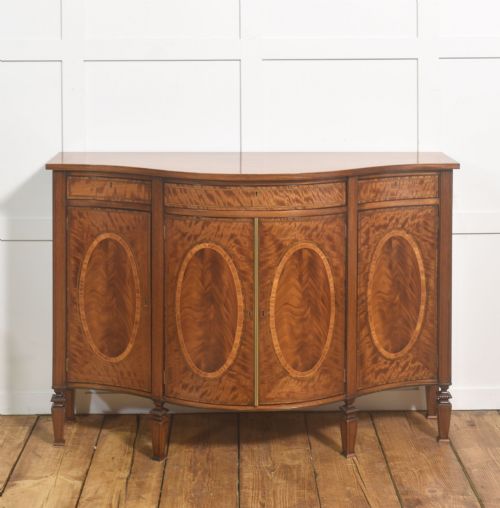
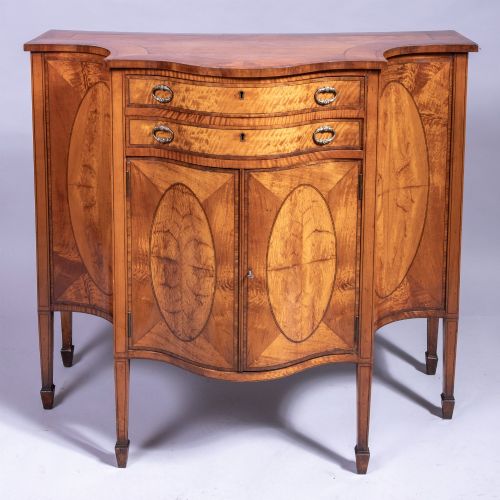

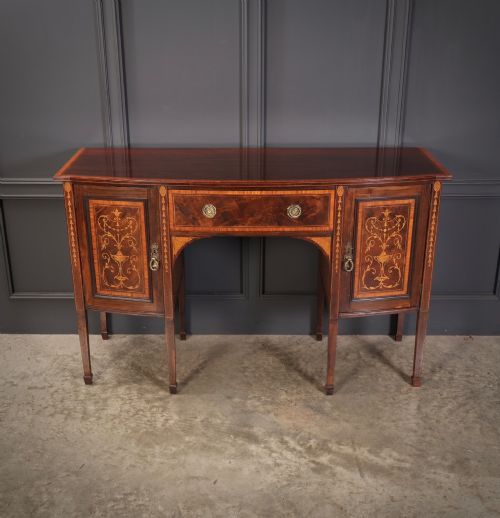

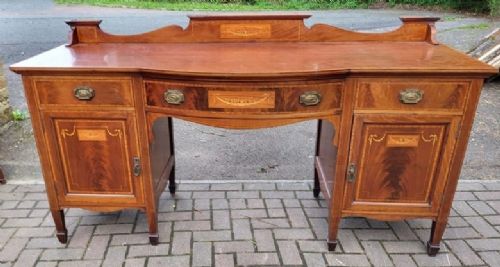


Satinwood Bowfront Sideboard
A satinwood bowfront sideboard brings luminous timber and curved grace to a dining room, offering both generous storage and striking neoclassical design.
Satinwood Bowfront Sideboard
A satinwood bowfront sideboard combines a sweeping curved front with the distinctive pale, shimmering tone of satinwood timber. These pieces emerge predominantly from the Georgian period through to the Edwardian era and the Sheraton Revival of the late nineteenth and early twentieth centuries.
The form functions primarily as a dining room server or side cabinet, featuring a prominent curved central facade flanked by cupboards and drawers. Most examples encountered here reflect the revival movements of the Victorian and Edwardian periods alongside genuine Georgian origins.
Makers construct these items as substantial case furniture designed to anchor a formal dining space. The integration of contrasting timbers creates a decorative surface that defines the character of the category.
How they were made
Craftsmen build the core structure using mahogany or pine, applying fine veneers of satinwood across the curved surfaces. They accentuate the bowed form with delicate stringing and crossbanding in boxwood, ebony, and rosewood.
Decoration relies heavily on marquetry inlays and hand-painted floral motifs rather than deep carving. Workshops shape the timber carefully to achieve the signature bowfront profile, securing the veneers with traditional animal glues.
Floral paintwork on Victorian satinwood ensures your dining room comes furnished with permanent spring blossoms that require zero watering.
What varies in quality
The distinction between standard and superior pieces rests upon the selection and figure of the timber veneer. Highly figured flame satinwood paired with crisp, intricate marquetry inlay indicates a workshop of higher skill.
Proportion and execution of the curved bowfront define the architectural success of the piece. Refined hand-painting and substantial brass hardware elevate the overall finish above simpler revival examples.
The Satinwood Bowfront Sideboard Glossary
- Bowfront
- A convex curved cabinet front that projects outward in a smooth arc. This shape softens the rigidity of a dining room.
- Satinwood
- A lustrous tropical hardwood with a pale golden sheen and a dense, reflective grain. It serves as the primary decorative veneer on these cabinets.
- Crossbanding
- A narrow strip of veneer laid around the border of a drawer or top with the grain running perpendicular to the main panel. This frames the primary timber.
- Marquetry
- Elaborate patterns formed by fitting together contrasting pieces of wood veneer. Artisans use this technique to create floral and neoclassical motifs.
- Sheraton Revival
- A late nineteenth and early twentieth century design movement that reinterprets the graceful neoclassical furniture of Thomas Sheraton. Pieces from this era often feature painted satinwood.
Satinwood Bowfront Sideboard: Frequently Asked Questions
How do I clean a satinwood sideboard?
Dust the surface regularly with a soft, dry cloth to prevent dirt accumulation. Avoid harsh chemical cleaners that can damage the delicate antique polish.
Apply a quality beeswax occasionally to nourish the veneer and maintain its natural lustre. Keep the cabinet away from direct sunlight and radiators to prevent the wood from drying out.
Where should I place a bowfront sideboard?
Position the piece against a principal wall in a dining room or living space where its curved profile can be admired. Ensure there is enough clearance for the drawers and cupboards to open fully.
Because satinwood is sensitive to extreme temperature changes, avoid placing the sideboard near active heat sources or damp exterior walls.
How can I tell Georgian from revival pieces?
Examine the construction methods, secondary timbers, and wear patterns on the interior carcass. Georgian originals utilise period-specific woods and hand-cut joinery consistent with the eighteenth century.
Revival pieces from the Edwardian era or late nineteenth century display machine-finished elements and standardised hardware while closely copying earlier neoclassical styles.
What is the difference between a sideboard and a serving table?
A sideboard typically incorporates integrated drawers and cupboards for storing dining silver and linen. The enclosed storage makes it a heavier, more substantial piece of furniture.
A serving table generally offers a more open framework with fewer cupboards, functioning primarily as a surface for presenting food and dishes during meals.