
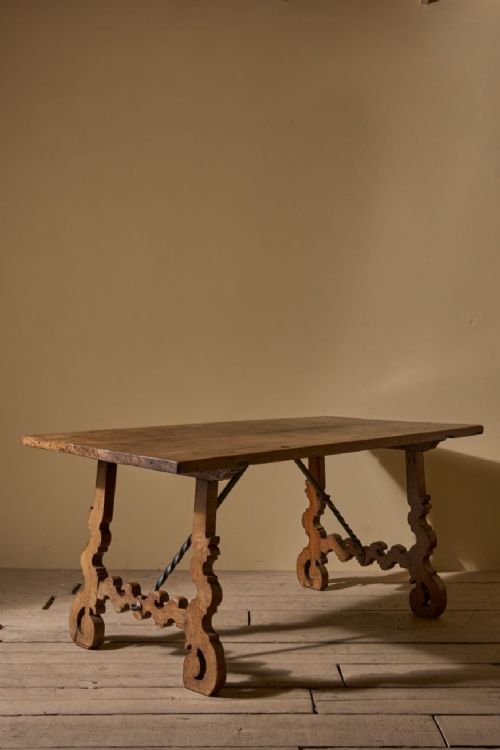
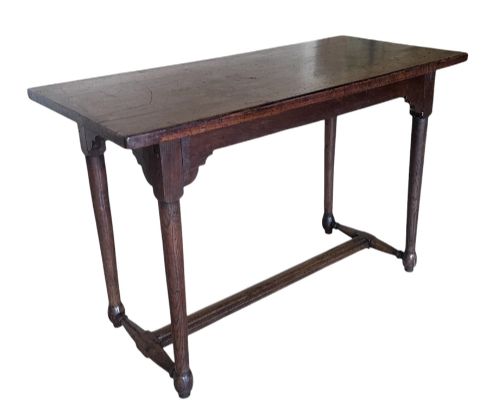
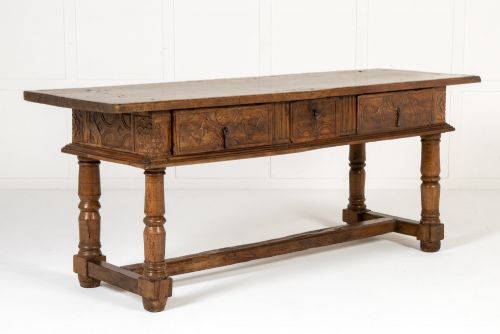

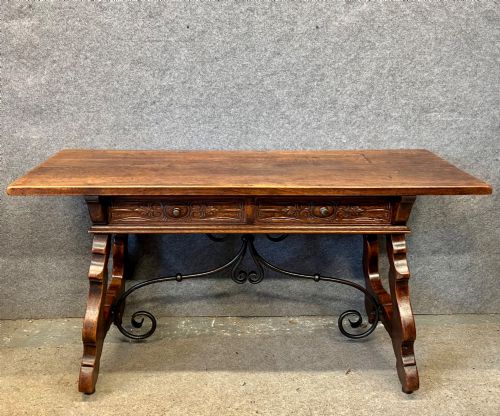


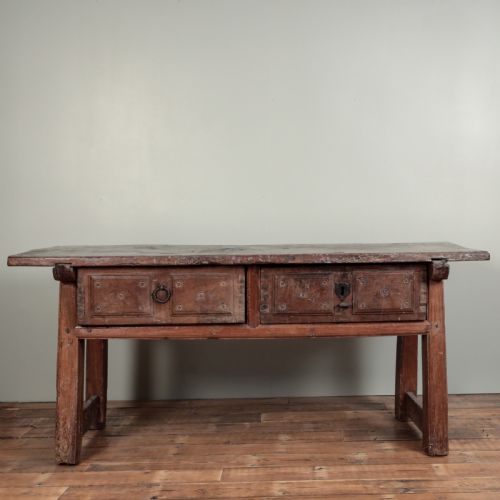


Rustic Spanish Side Table
A rustic spanish side table brings sturdy historic timber and forged ironwork straight into a modern interior.

Rustic Spanish Side Table
A rustic spanish side table is a heavy-framed surface originating from periods spanning the seventeenth century up to the early twentieth century. These furnishings appear primarily as side tables, console tables, centre tables, and occasional tables.
The versions most commonly met on this page include walnut and oak examples from the eighteenth and seventeenth centuries. Makers built these pieces for utilitarian use in farmhouses, provincial settings, and colonial interiors.
Formats range from austere oak servers to walnut tables with fruitwood or pine elements. Collectors also encounter occasional tables linked to specific regional styles such as Catalan shepherd pieces.
How they were made
Carpenters constructed these tables using solid hardwoods like walnut and oak, alongside pine, fruitwood, and general timber. Boards were joined to form thick tops supported by robust framework.
Surfaces show various states of finish, from darkened historic patinas to bleached oak treatments. Primitive construction methods remain visible in the unadorned joints and pegged assemblies.
Catalan shepherds once relied on humble occasional tables built for the field, carrying centuries of practical history into modern homes.
What varies in quality
The grade of timber dictates much of the distinction between pieces, with dense, figured walnut commanding more presence than simpler pine or mixed woods. The integrity of the original construction and surviving surface patination also separate standard examples from finer ones.
Proportion and scale play a role, as smaller occasional tables and grand seventeenth-century consoles each require balanced carpentry. The integration of authentic ironwork components enhances the structural harmony of the piece.
The Rustic Spanish Side Table Glossary
- Console table
- A table designed to stand against a wall, often featuring a linear top supported by heavy legs or brackets. These pieces function well in narrow hallways and reception rooms.
- Centre table
- A freestanding table intended to sit in the middle of a room rather than against a perimeter wall. Such pieces finished on all sides allow 360-degree viewing.
- Spanish Baroque
- An ornate and substantial design style prevalent in seventeenth-century Spain. It emphasises dramatic form and heavy structural timber.
- Fruitwood
- A dense timber harvested from fruit-bearing trees such as pear or cherry. Cabinetmakers utilised it for contrasting grain and durable small-scale elements.
- Bleached oak
- Oak timber treated to lighten its natural dark tone. This finish creates a softer, paler surface aesthetic.
Rustic Spanish Side Table: Frequently Asked Questions
How do I date a rustic spanish side table?
Dating relies on examining the timber species, joinery methods, and overall form relative to documented periods. Seventeenth and eighteenth-century examples display hand-cut pegs and denser heartwoods.
Later nineteenth-century and early twentieth-century interpretations often exhibit lighter oak treatments or simpler provincial construction techniques.
Where should I place a console table?
A console table works best against a solid wall in an entryway, hallway, or living space. Its shallow depth keeps floor space clear while offering a functional surface.
Pairing it with a wall hanging or mirror helps anchor the heavy timber proportions within the room.
What is the difference between walnut and oak pieces?
Walnut pieces generally display richer, darker grain patterns and a finer tactile finish. They typically date towards the seventeenth and eighteenth centuries in this category.
Oak examples provide a coarser texture and heavier visual weight, often associated with provincial farmhouse and server forms.
How do I care for antique wood surfaces?
Maintain antique timber by keeping it away from direct heat sources and drastic humidity shifts. Regular dusting with a dry cloth protects the historic patina.
Avoid modern chemical polishes that can penetrate and soften the aged surface layers.