
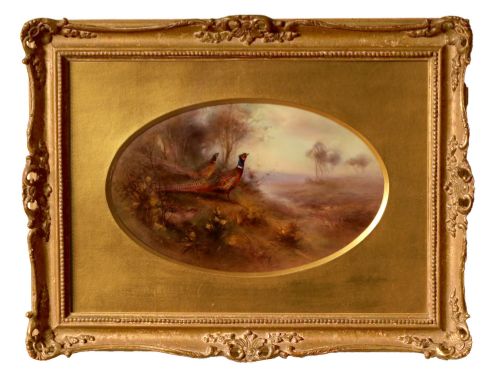


Royal Worcester Pheasant Painting
Royal Worcester pheasant painting brings finely detailed avian scenes onto porcelain plaques, cabinet plates, and vases that collectors prize for their artistry.
Royal Worcester Pheasant Painting
Royal Worcester pheasant painting encompasses hand-painted porcelain items such as plaques, cabinet plates, vases, and pot pourri urns produced across the Edwardian era and into the early decades of the twentieth century. These pieces display naturalistic game bird scenes rendered with careful attention to plumage and natural settings.
Collectors searching for royal worcester pheasant painting regularly encounter pieces bearing the signature of James Stinton, whose work dominates the available forms. Vases and framed plaques painted by Stinton represent the core of what appears on this page, alongside larger sets of game bird cabinet plates.
How they were made
Makers utilised fine porcelain as the ground for intricate enamel and hand-painted artistry depicting game birds in natural surroundings. Artisans applied precise brushwork to capture the fine feather details and subtle colours of the pheasants.
Many pieces incorporate gold leaf, gilding, or gilt accents on the ceramic body, while certain wall art items feature gilt wood frames. These metallic embellishments complement the painted scenes and highlight the rims, handles, or borders of the vessels.
What varies in quality
The standard of royal worcester pheasant painting rests upon the precision and delicacy of the brushwork executed by the artist. Signed pieces by established painters like James Stinton demonstrate a superior level of anatomical accuracy and feather detail.
The complexity of the form and the integration of supplementary decoration, such as rich gilding or matched sets of cabinet plates, elevate the distinction of the work. Simpler small vases show competent painting, while larger framed plaques and multi-piece sets display ambitious artistic scope.
James Stinton
The Royal Worcester Pheasant Painting Glossary
- Cabinet plate
- A decorative ceramic plate intended for display rather than dining use. These often feature detailed hand-painted scenes and gilt borders.
- Pot pourri urn
- A lidded vessel designed to hold dried scented plant material, featuring pierced sections to release fragrance. These often stand as decorative centrepieces.
- Gilding
- The application of gold leaf or gold powder to the surface of porcelain or wood. This technique adds metallic brilliance to highlights and borders.
- Plaque
- A flat panel of porcelain framed as a picture for wall hanging. These serve primarily to showcase detailed miniature paintings.
- Hadley Ware
- A line of ceramics produced by the factory known for specific body textures and decorative finishes. It appears on select decorative vessels from the period.
Royal Worcester Pheasant Painting: Frequently Asked Questions
Who painted these porcelain pieces?
Painters such as James Stinton decorated these porcelain items by hand, applying fine enamel colours to depict game birds accurately. Their signatures frequently appear on the ceramic surface.
Collectors look for these specific signatures as an indicator of the artist's hand behind the avian artwork.
What forms do these items take?
The inventory includes cabinet plates, framed wall plaques, goblets, and various sizes of vases and pot pourri urns. Each form provides a different surface for the detailed pheasant artwork.
Vessels range from small single vases to matched pairs and three-piece sets.
How should I display them?
Framed plaques suit wall hanging in well-lit spaces away from direct sunlight, while cabinet plates belong in secure display cabinets. Vases and urns function effectively as mantel or sideboard ornaments.
Careful placement protects both the hand-painted enamel surface and the delicate gilt highlights.
How are the periods identified?
Dating relies on factory marks stamped on the underside of the porcelain, alongside stylistic indicators from the Edwardian era and the 1900 to 1930 decades. These marks record the operational era of the pottery.
Matching the painted style with known artist active dates helps narrow the period of manufacture.