


Round Oak Wall Clock
A round oak wall clock brings honest presence to a room, offering the steady mechanical pulse of an antique timepiece.
Round Oak Wall Clock
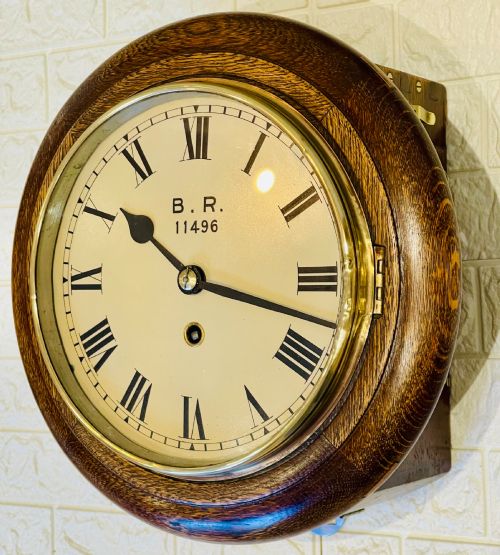
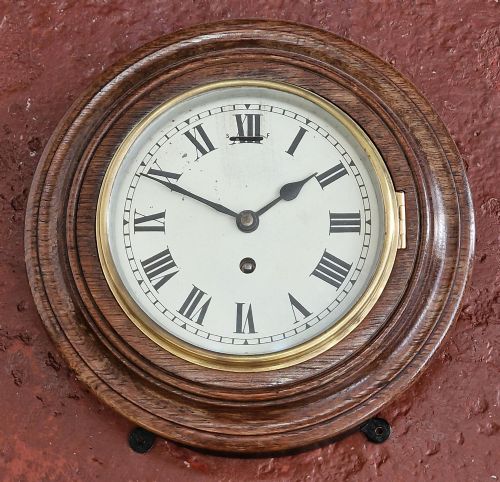
A round oak wall clock is a timepiece defined by a circular wooden case and a dial designed to be mounted directly onto a wall. These clocks appear in forms ranging from compact dial clocks with brass bezels to larger models with bell-striking movements or railway connections.
The examples gathered here span from the Victorian and Art Deco eras through to the mid-twentieth century. Buyers encounter pieces originating from English workshops, alongside international names such as Zenith with retail connections like Harrods.
Simpler dial clocks dominate the selection, often featuring fusee movements designed for precise timekeeping in public spaces or domestic halls. Golden oak and darker mature tones provide the primary visual character of the cases.
Materials and construction
Cabinetmakers shaped the robust circular frames from solid oak, sometimes utilising rich golden varieties or darker finishes that aged with depth. Brass forms the bezels and interior movement plates, while thick glass protects the painted enamel or metal dials.
Mechanical integrity relies on fusee movements and eight-day mechanisms that maintain even power delivery as the mainspring unwinds. Iron and steel components govern the strike trains and gear assemblies hidden behind the dial.
The current selection spans from 1870 Victorian pieces to mid-twentieth-century designs, uniting oak frames with brass and glass.
Distinctions in quality
Quality rests in the crispness of the timber turning and the precision of the interior fusee movement rather than the mere presence of decoration. Finer examples display clean dial lettering, well-fitted bezels, and authentic period hands that move with mechanical harmony.
Retailer provenance and railway service history add archival interest to specific pieces, distinguishing standard domestic timepieces from those commissioned for official or commercial networks.
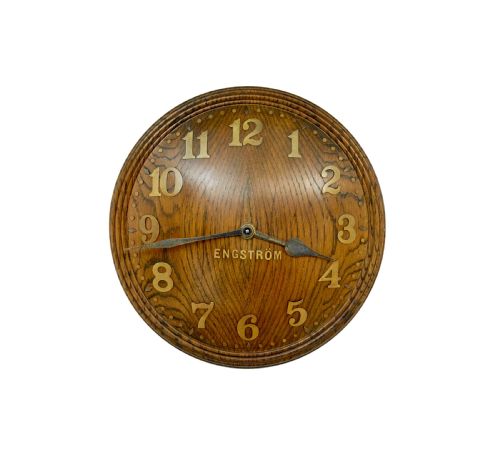
Zenith·Harrods·Engström
The Round Oak Wall Clock Glossary
- Fusee
- A conical pulley used in older clocks to maintain equal power as the mainspring winds down. This mechanism ensures steady timekeeping throughout the duration of the wind.
- Dial clock
- A wall clock dominated by a prominent face with minimal surrounding case work. These were standard in offices, stations, and schools.
- Bezel
- The metal ring, often brass, that holds the protective glass over the clock face. It usually hinges open to allow hand adjustment.
- Enamel
- A fused glassy substance applied to metal dials to provide a durable, crisp white surface for numerals. It offers longevity and a smooth sheen.
Round Oak Wall Clock: Frequently Asked Questions
How do fusee movements work?
A fusee movement uses a conical pulley connected to the mainspring by a fine chain. As the spring loses tension, the chain rides higher on the cone's wider radius to maintain consistent torque.
This clever mechanical arrangement ensures the clock keeps accurate time right up until the moment it needs rewinding.
Where were these clocks originally used?
Round oak wall clocks served as dependable timekeepers in railway stations, offices, and domestic hallways. Their clear dials allowed people to read the time quickly from across a busy room.
Over time, many migrated from public utility spaces into private homes as decorative and functional furnishings.
How do I wind a wall clock?
Winding involves inserting a matching key into the winding hole on the dial and turning it gently until resistance is felt. Care must be taken not to overwind the mainspring.
Regular winding at the same time each week keeps the mechanical movement running smoothly and accurately.
How do I date an oak wall clock?
Dating relies on examining the timber tone, case construction, dial materials, and the style of the numerals. Victorian and Edwardian examples often feature hand-painted enamel dials and heavy brass bezels.
Art Deco and mid-century pieces introduce cleaner lines and simplified lettering that reflect the design shifts of their respective decades.