



Rotating Book Tower
A rotating book tower is a clever piece of furniture designed to keep a generous library within arm's reach.
Rotating Book Tower
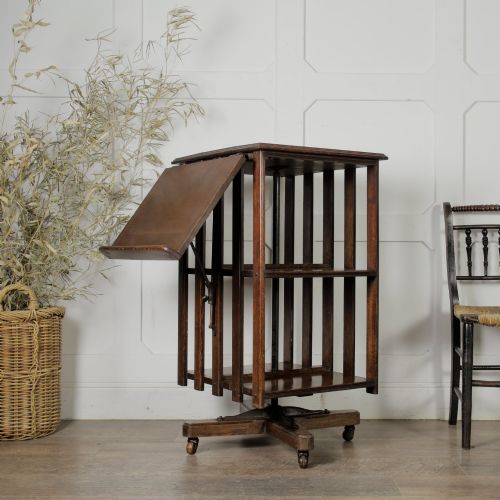
A rotating book tower, appearing in the records mainly as a revolving bookcase, is a compact piece built to hold volumes in a vertical tier that spins smoothly on a base. These pieces serve scholars and readers who need multiple reference texts accessible from a single seat without moving about the room.
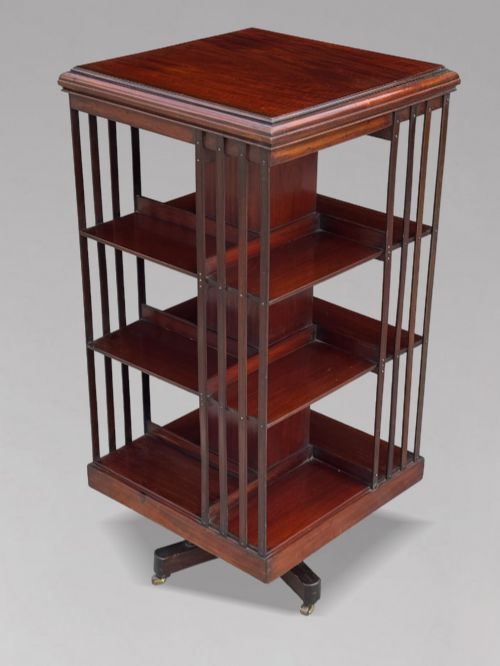
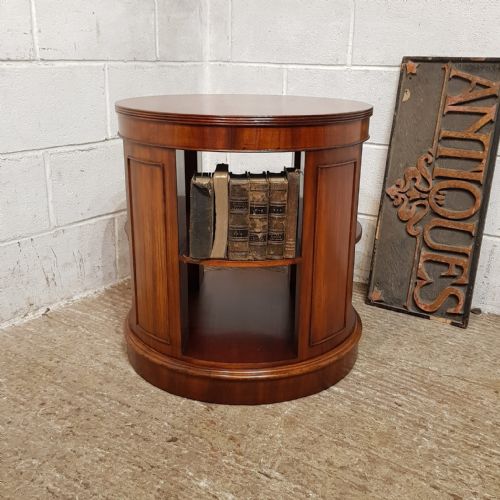
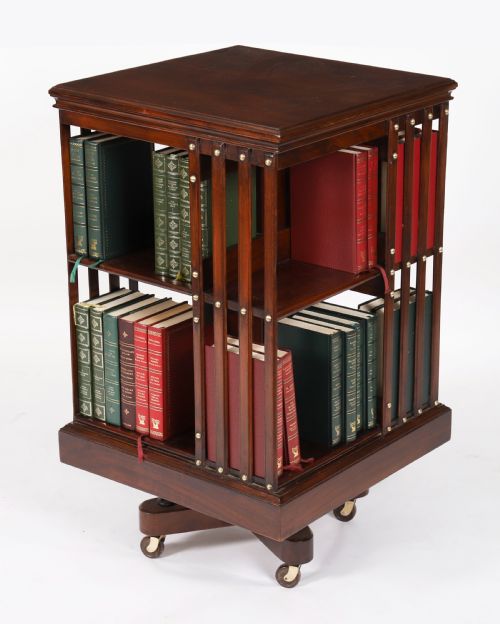
The versions most commonly met on this page date from the Edwardian era and the nineteenth century, taking the form of solid oak or mahogany cases. Makers constructed them in round and square shapes, sometimes standing low for a desk or table top, or rising as larger freestanding units.
How they were made
Cabinet makers built these towers using sturdy timbers including oak, mahogany, and walnut, selecting woods that could bear the weight of heavy volumes. They employed durable joinery to ensure the framework remained rigid while supporting the continuous motion of the rotating mechanism.
Metal components such as brass and cast iron formed the internal swivelling pivots and bearings concealed beneath the base. This combination of dense hardwood and metal engineering allowed the tiers to turn effortlessly under a heavy load of books.
What varies in quality
The refinement of the timber and the crispness of any inlay set the finer examples apart from standard utility pieces. Finer grain in the mahogany or walnut, alongside neat fruitwood inlay, marks out the work of better workshops.
The engineering of the revolving mechanism dictates how smoothly the tower operates over time. A superior pivot distributes weight evenly, allowing the tiers to spin without listing or catching on the base.
Maple and Company
The Rotating Book Tower Glossary
- Revolving bookcase
- A freestanding or table-top unit designed to rotate on a central axis for easy selection of texts. These items often feature slatted sides to keep volumes secure.
- Fruitwood inlay
- Decorative woodwork where contrasting light fruitwoods are set flush into the primary timber surface. This technique adds geometric or floral patterns to the panels.
- Sheraton-style
- A neoclassical furniture design characterised by straight lines, tapered legs, and delicate proportions. Pieces in this style often display classical symmetry.
- Anglo-Indian
- Furniture made in India by local artisans using traditional carving methods adapted to British forms. These pieces often feature dense surface decoration and exotic hardwoods.
Rotating Book Tower: Frequently Asked Questions
Where should I place a revolving bookcase?
These pieces suit corners or the side of a desk where access from multiple angles is useful. Their compact footprint allows them to sit beside a favourite reading chair without obstructing movement.
Because they rotate, they do not need to be pulled away from the wall to reach books stored on the reverse sides.
How do I care for the wood?
Keep the timber away from direct heat sources and strong sunlight to prevent the polish from fading or the wood from drying out. An occasional application of appropriate wax maintains the finish.
Avoid using excess moisture when dusting the carved details or inlaid sections.
How do I check the rotating mechanism?
Turn the tiers slowly to feel for any resistance or uneven tilting during movement. The rotation should feel balanced and steady without scraping against the base.
Most mechanisms are housed internally, so smooth operation is the primary indicator of good mechanical condition.
Can these towers hold heavy books?
The solid construction of oak and mahogany variants makes them suitable for standard reference volumes and hardbacks. The internal framing is built to support the substantial weight of a full tier of books.
Distributing heavier volumes evenly across the lower sections helps maintain stability during rotation.