

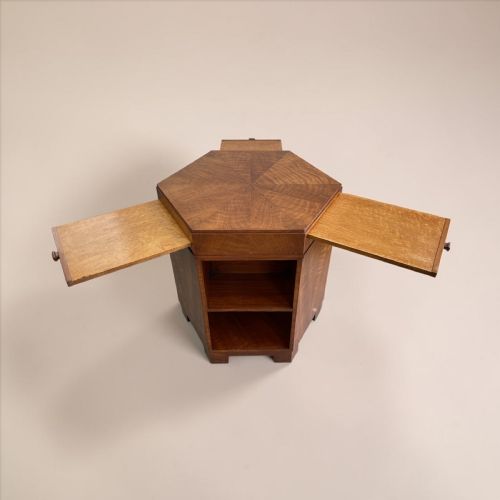
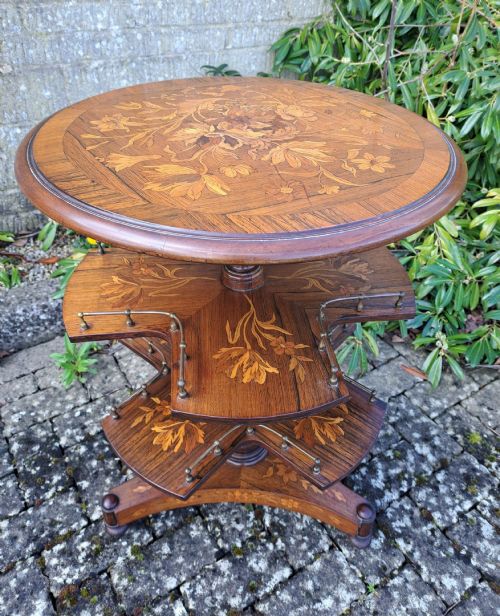
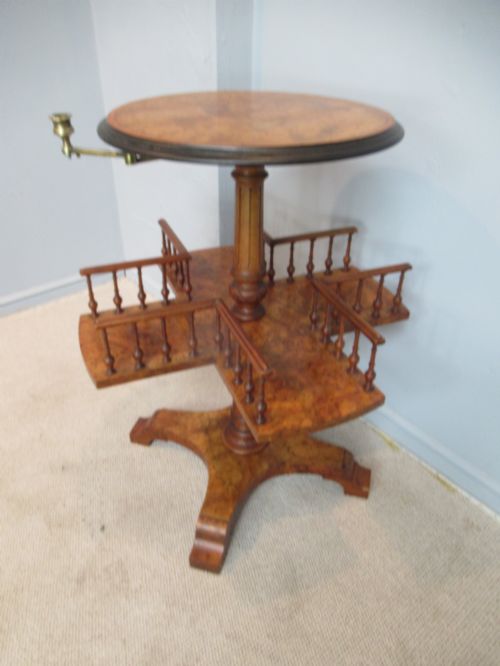


Walnut Revolving Bookcase
A walnut revolving bookcase brings practical desktop or floor storage with the smooth motion of a rotating library stand.
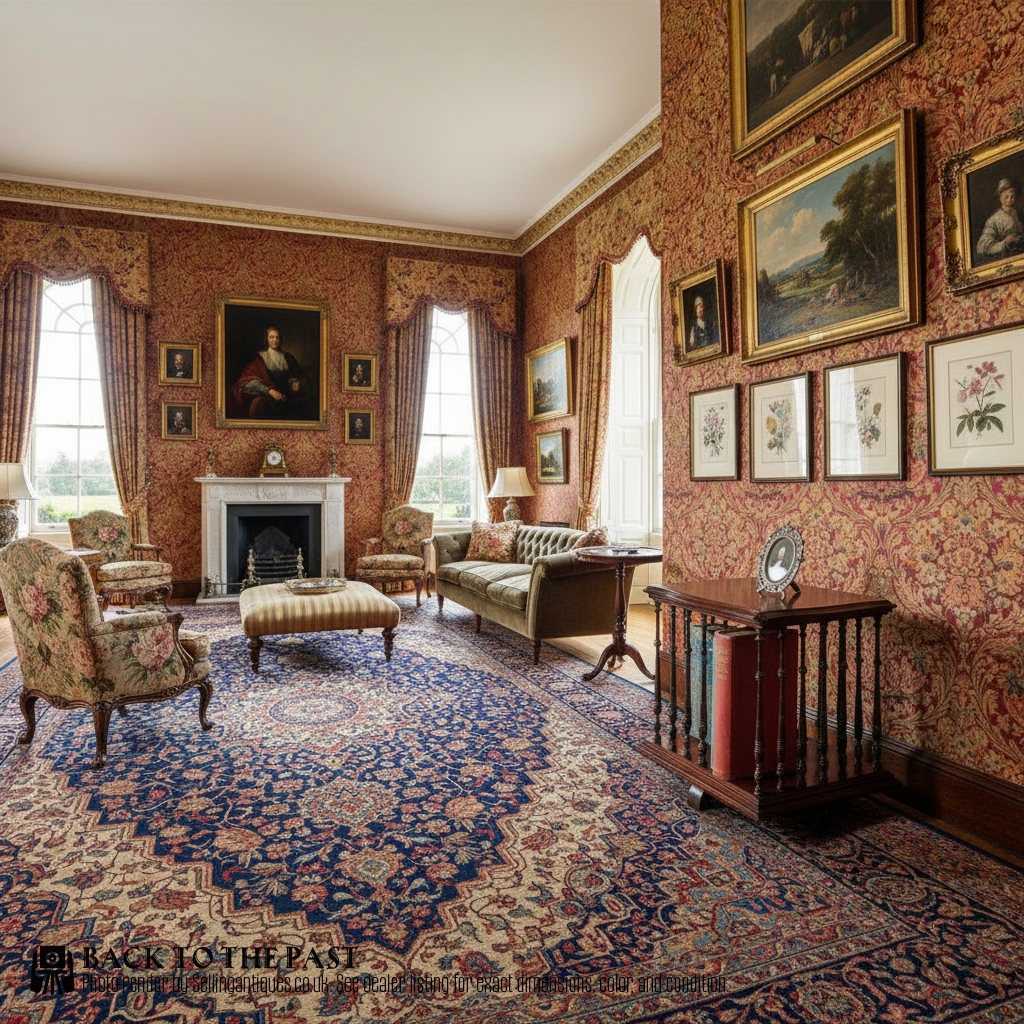
Walnut Revolving Bookcase
A walnut revolving bookcase is designed to hold volumes within arm's reach while turning smoothly on a central pivot and under-base mechanism. These pieces appear most frequently from the Edwardian and Victorian periods, alongside 1930 Art Deco examples and earlier Georgian forms.
The standard format is a square floor-standing unit with slatted or panelled sides, though buyers also encounter three-tier and four-tier variations as well as smaller desktop rotary book stands. Occasional library tables and bookstands with rotating functions also populate the category.
Edwardian and late Victorian examples dominate the selection, often constructed with crossbanded tops or inlaid marquetry details. Pieces range from simple utilitarian Edwardian models to grander Victorian burr walnut furniture bearing maker stamps.
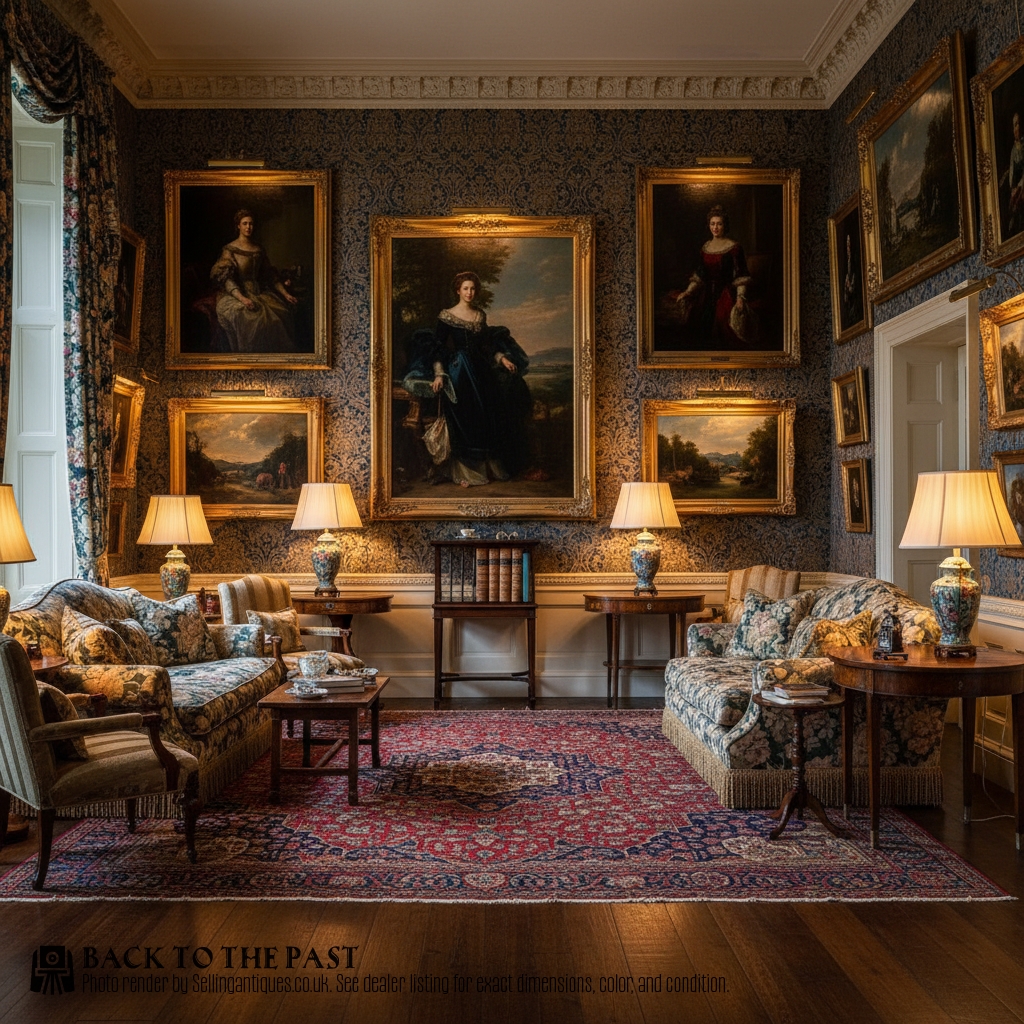
Materials and construction methods
Makers utilised solid walnut and burr walnut veneer over secondary timbers to achieve rich, figured grain patterns across the top and sides. Burr walnut veneer provided decorative swirling patterns that defined the visual character of finer library pieces.
Internal rotating mechanisms combined wood, brass, and iron components to ensure stable, balanced movement under the weight of heavy books. Gilt galleries in brass sometimes bordered the top surface, while marquetry inlay decorated specific Dutch and English library tables.
Walnut Revolving Bookcase Retail Price Guide 2026
Typical asking prices for walnut revolving bookcase among the pieces listed under this phrase on Sellingantiques today, from the lower quarter to the upper quarter. They describe what is for sale here now, not the wider market.
Listings span multiple eras from Georgian and Victorian times through the Edwardian period to 1930 Art Deco furniture.
Assessing quality and craftsmanship
Quality rests in the choice of timber and the complexity of the internal pivot mechanism. Pieces featuring highly figured burr walnut veneer and crisp marquetry inlay represent the upper tier of production.
Structural stability during rotation separates standard production items from finer workshop pieces. The inclusion of decorative brass galleries and multiple tiers adds to the substance of the furniture.
James Shoolbred And Co·Edwards And Roberts·Maple And Co
The Walnut Revolving Bookcase Glossary
- Burr walnut
- A prized wood veneer obtained from the growth excrescences of walnut trees, displaying intricate swirling grain patterns. It was frequently applied to the top surfaces of Victorian and Edwardian library pieces.
- Revolving mechanism
- The internal pivot and bearing system hidden beneath the bookcase that allows the upper tiers to turn freely. Iron and brass components ensure smooth rotation.
- Marquetry
- The art of applying small pieces of veneer to form decorative patterns and floral designs. Dutch marquetry appears on specific revolving library tables.
- Tier
- An individual level or stacked section of shelving within the bookcase structure. Units can be found in single, two, three, and four-tier formats.
- Gilt gallery
- A low decorative railing, often cast in brass and finished with gilding, fitted around the top edge of the bookcase to stop items from sliding off during rotation.
Walnut Revolving Bookcase: Frequently Asked Questions
How do I date a walnut revolving bookcase?
Dating relies on stylistic markers and construction methods. Edwardian and late Victorian pieces show distinct proportions and timber finishes compared to earlier Georgian examples or 1930 Art Deco designs.
Examining the turning mechanism and the type of veneer helps separate nineteenth-century workshop production from twentieth-century manufacture.
What is the difference between a table and a bookcase?
A revolving bookcase functions primarily for vertical book storage across multiple tiers with open compartments on all four sides. A library table incorporates a flat top surface for reading alongside storage space.
Some Art Deco and Georgian examples blur these categories by combining table surfaces with rotating book compartments underneath.
How do multi-tier revolving bookcases work?
Multi-tier models use a central vertical spindle and concealed bearing assembly that supports the stacked weight of several shelving levels. This allows the entire column of books to turn independently from the stable base.
Iron or brass hardware inside the pivot ensures the movement remains balanced even when the shelves are fully loaded.
Where were these pieces used historically?
These pieces served in studies, libraries, and parlours where immediate access to reference volumes or novels was required. Their compact footprint allowed them to sit beside armchairs or in the centre of a room.
Desktop versions provided similar convenience on top of large library tables and partner desks.