





Rosewood Piano Seat
A rosewood piano seat offers sturdy construction and rich timber grain, serving as both a functional music stool and a handsome period seating choice.
Rosewood Piano Seat
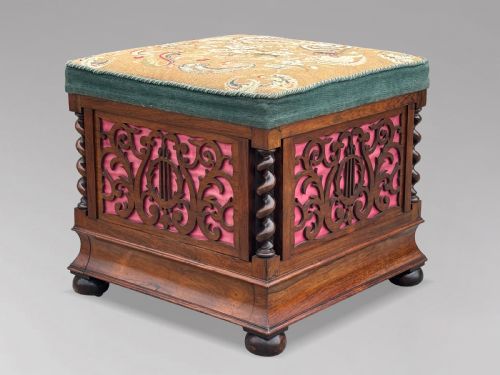
A rosewood piano seat brings functional seating to the instrument, appearing primarily in Victorian and Regency forms alongside Georgian examples. These pieces function equally well as dressing stools or window seats within the home.
Origins stretch across the nineteenth century, capturing the evolution from Regency brass-inlaid items to late Victorian Arts and Crafts variations. The selection spans straightforward music stools and oblong benches.
What varies in quality
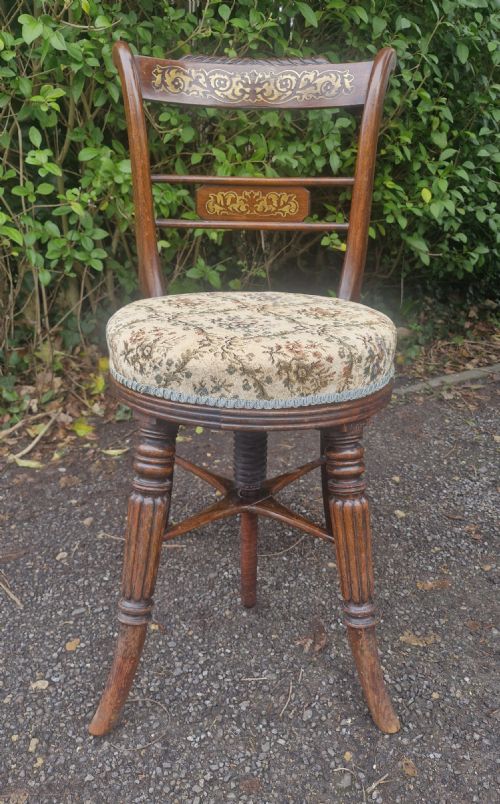
The sophistication of the adjustable mechanism dictates much of the distinction, where smooth rise and fall action or a steady revolving screw marks superior workshop execution. Solid timber framing with crisp carved details outweighs simpler turned supports.
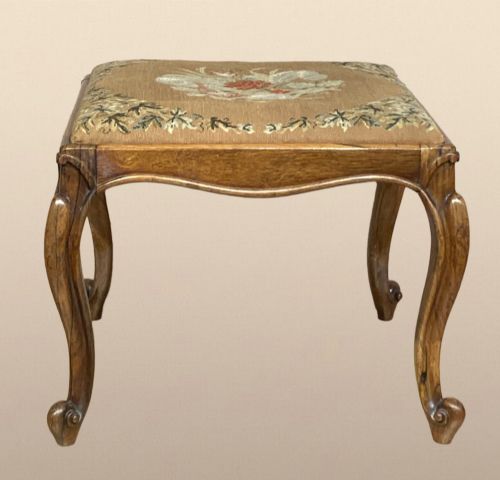
Condition of the original rosewood surface and the integrity of the upholstered textile influence overall desirability. Pieces retaining period fabrics or expert crewel work display greater adherence to original design standards.
Listings span the nineteenth century, capturing Georgian, Regency, William IV, and Victorian periods up to 1890.
Charles Nosotti·Charles Wadman
The Rosewood Piano Seat Glossary
- Rosewood
- A dense, dark timber prized for its prominent grain and deep colour, frequently utilised in fine nineteenth-century furniture. It takes a high polish and provides a durable frame for seating.
- Cabriole leg
- A furniture leg that curves outward and then tapers inward, mimicking an animal limb. This style appears frequently on Victorian examples.
- Rise and fall
- An adjustable mechanism operated by a screw or ratchet system to alter the seat height. This allows musicians to customise their seating position.
- X-frame
- A structural base formed by two intersecting members shaped like the letter X. It provides sturdy cross-bracing for stools and benches.
Rosewood Piano Seat: Frequently Asked Questions
How do I adjust the height?
Many examples feature a revolving top or a rise and fall screw mechanism hidden beneath the upholstery. Turning the seat adjusts the height to suit the player.
Simpler fixed-height forms rely on precise proportions established during manufacture rather than mechanical adjustment.
Can I use these as dressing stools?
These versatile seats function easily as dressing table stools or small window benches due to their compact dimensions. The upholstered tops provide comfortable temporary seating in various rooms.
Original designs frequently served multiple domestic purposes beyond the music room.
How do I identify a Victorian piece?
Victorian examples often display heavier proportions, carved cabriole legs, or characteristic revolving mechanisms. The timber grain and upholstery styles align with nineteenth-century manufacturing practices.
Later Victorian pieces introduce Arts and Crafts influences or simpler turned supports.
What maintenance does rosewood require?
The timber benefits from occasional gentle cleaning with a soft cloth to preserve the polished surface. Avoiding direct sunlight prevents fading of the rich rosewood grain.
Upholstery care depends entirely on the fabric type, whether velvet, tapestry, or standard textile.