





Rosewood Padded Seat
A rosewood padded seat brings rich timber and tactile upholstery together, offering a functional piece of period seating.
Rosewood Padded Seat
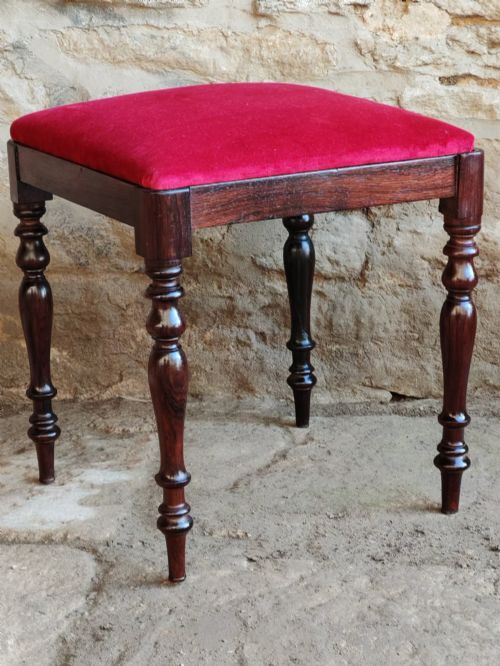
A rosewood padded seat encompasses various forms of upholstered resting furniture, predominantly appearing as stools, footstools, and ottomans alongside occasional sofas and armchairs. When exploring rosewood padded seat examples, buyers encounter pieces originating from the Regency, George IV, and Victorian eras, stretching from eighteen hundred into the late nineteenth century.
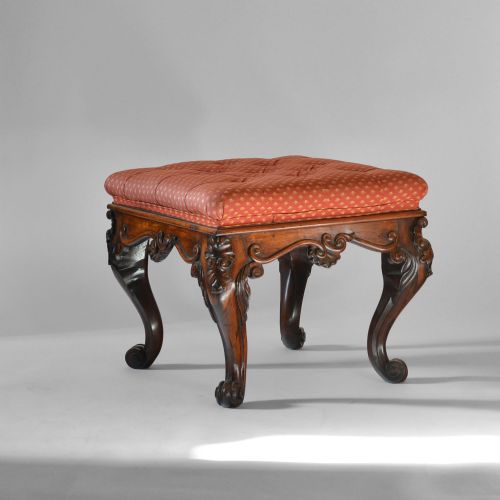
Stools and footstools dominate the selection, often featuring cabriole legs, X-frames, or box seat configurations designed for practical daily use. Makers utilised dense exotic timber alongside mahogany elements, pairing the dark wood frames with diverse textile coverings.
Origins vary between British workshops of the nineteenth century and Anglo-Indian production. Buyers find individual items as well as matched pairs suitable for placing beside period firesides or pianos.
How they were made
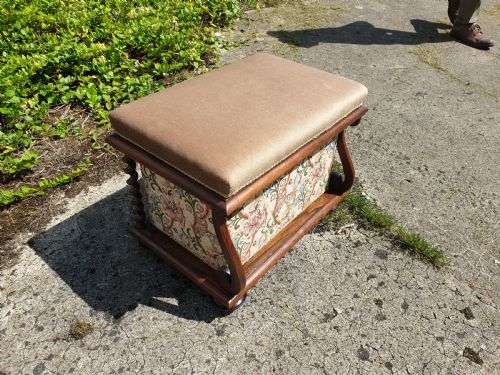
Upholstery techniques involved securing fabric, velvet, or tapestry over padded foundations using brass fixings or tension methods. Materials such as textile and floral trellis tapestry provided both comfort and decorative surface pattern.
Rosewood Padded Seat Retail Price Guide 2026
Typical asking prices for rosewood padded seat among the pieces listed under this phrase on Sellingantiques today, from the lower quarter to the upper quarter. They describe what is for sale here now, not the wider market.
What varies in quality
The sophistication of the timber grain and the crispness of any carved detailing dictate the visual standard of each frame. Richly figured rosewood surfaces reflect higher workshop standards than plain or heavily restored timbers.
Upholstery execution also defines distinction, ranging from simple modern cloth to period-appropriate tapestry and velvet coverings. Frames displaying integrated box storage or rising seat mechanisms demonstrate greater mechanical complexity.
The Rosewood Padded Seat Glossary
- Rosewood
- A dense, heavily grained dark timber prized for nineteenth century cabinet making. It polishes to a deep sheen and forms the primary structural material for these seats.
- Cabriole leg
- A furniture leg that curves outward and then tapers inward, mimicking animal limbs. This style appears frequently on Victorian stools within the listings.
- X-framed
- A structural design where intersecting members form an X shape to support the seat. This configuration provides distinct architectural rigidity.
- Ottoman
- A low upholstered seat or footstool without arms or a back. Larger versions offer substantial padded resting surfaces.
- Tapestry
- A heavy woven textile featuring pictorial or geometric designs. Examples often display floral trellis patterns on the upper surface.
Rosewood Padded Seat: Frequently Asked Questions
What periods do these seats cover?
The available pieces span the nineteenth century, covering Regency, George IV, and various Victorian phases. Dates range from eighteen hundred through to eighteen ninety.
Most items originate from the mid to late Victorian period, reflecting common manufacturing styles of that era.
Are pairs available?
Yes, matched pairs of Victorian stools appear within the selection alongside individual items. These provide symmetrical options for room placement.
Single armchairs and larger ottomans also feature as standalone furniture pieces.
What wood is used?
The primary timber across the listings is rosewood, known for its dense grain and dark coloration. Mahogany occasionally appears in related construction.
Surfaces are polished to highlight the natural figuration of the exotic timber.
How were they upholstered?
Upholstery materials include fabric, velvet, and tapestry, sometimes featuring floral trellis patterns. Padding sits atop rigid wooden frames secured with traditional methods.
Some variants incorporate box storage or rising seat mechanisms for functional utility.