

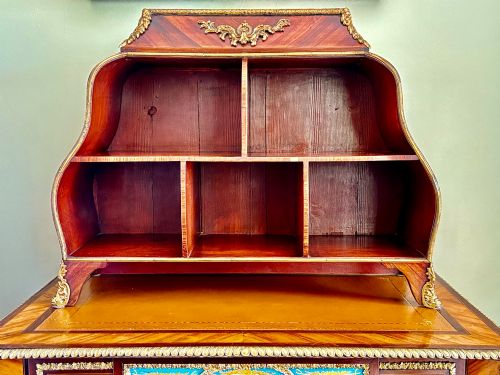
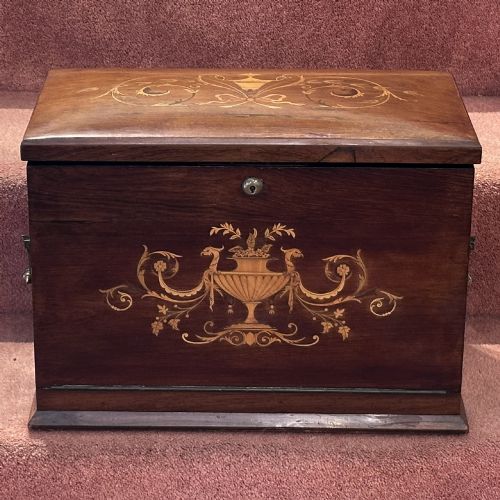


Rosewood Desk Tidy
These rosewood desk tidy pieces are compact desktop companions built to keep correspondence and ink organised with considerable elegance.
Rosewood Desk Tidy
A rosewood desk tidy encompasses a practical group of nineteenth-century desktop accessories designed to hold stationery, letters, books, and inkwells. You will most frequently meet Victorian and Regency examples, ranging from simple book racks to elaborate stationery boxes and campaign writing boxes.
The forms vary from open book carriers and desk trays to lidded correspondence boxes and desktop cartonniers. Many of these pieces date from the nineteenth century, including specific items from the Regency and Victorian periods.
Makers often combined functions, producing desk sets that integrated inkstands with letter storage or paired writing boxes with tidy trays. These objects served the writing tables of grand households and campaign tents alike.
Materials and construction
Cabinetmakers utilised rich rosewood as the primary timber, frequently enhancing the dark grain with contrasting satinwood, boxwood inlay, or intricate mother-of-pearl detailing. Metal mounts in brass and ormolu provided structural reinforcement and decorative framing for corners and hinges.
Glass found use in fitted inkwells housed within the desk sets, while secondary woods supported the internal partitions of stationery boxes and correspondence compartments. Construction relied on robust joinery to withstand the daily retrieval of heavy papers and books.
Rosewood Desk Tidy Retail Price Guide 2026
Typical asking prices for rosewood desk tidy among the pieces listed under this phrase on Sellingantiques today, from the lower quarter to the upper quarter. They describe what is for sale here now, not the wider market.
Listings feature nineteen-century pieces predominantly from the Regency and Victorian periods, incorporating brass, mother-of-pearl, and ormolu.
Judging quality and execution
The distinction between standard pieces and the finest work rests on the precision of the inlay and the selection of the rosewood timber. Finely figured grain patterns and meticulous boxwood or satinwood stringing elevate a piece above simpler utility items.
Hardware and fitments also dictate the tier of craftsmanship, where cast ormolu mounts, heavy brass handles, and perfectly fitted glass inkwells denote superior workshop production.
Gillows of Lancaster
The Rosewood Desk Tidy Glossary
- Cartonnier
- A desktop cabinet or tiered structure designed for holding loose papers, documents, and carton-bound files. These pieces often feature multiple compartments or fall fronts.
- Stationery box
- A specialised lidded container partitioned vertically or diagonally to hold writing paper and envelopes upright. They frequently incorporate sloping lids and fitted interiors.
- Ormolu
- Gilded bronze used for decorative mounts and feet on nineteenth-century furnishings. The technique involves applying a mercury-gold amalgam to cast bronze.
- Inlay
- A decorative technique where contrasting materials such as boxwood, satinwood, or mother-of-pearl are embedded into the surface of the rosewood. This creates geometric patterns or pictorial motifs.
- Campaign box
- A portable writing or stationery case built for travel, typically reinforced with brass corners and flush handles. These items were designed to endure the rigours of military or colonial movement.
Rosewood Desk Tidy: Frequently Asked Questions
How do I date a rosewood desk tidy?
Dating relies on stylistic clues and construction methods associated with the Regency, William IV, and Victorian eras. Brass inlay, specific ormolu mounts, and cabinetmaker labels often point to a precise decade within the nineteenth century.
Simpler book racks and robust campaign boxes frequently date from the mid-nineteenth century, while more heavily ornamented pieces align with later Victorian revival styles.
What is the difference between a desk tidy and a stationery box?
A desk tidy generally refers to open trays, inkstands, and book carriers designed for immediate desk organisation. Stationery boxes are enclosed containers specifically built with internal slots to store writing paper upright.
Both forms utilise rosewood and similar decorative inlays, but their function on the writing table differs between active retrieval and enclosed storage.
Are inkwells usually original to these pieces?
Many surviving desk sets and tidy trays retain their original cut-glass inkwells, often fitted with brass or silver-plated collars. Because inkwells sustained heavy use and potential damage, replacements are occasionally found.
Examining the fit within the wooden aperture helps determine whether the glass components belong to the original manufacture of the desk accessory.
How should I care for antique rosewood?
Rosewood benefits from stable environmental conditions away from direct sunlight and heat sources, which can dry out the timber and cause splits. Regular dusting with a soft, dry cloth preserves the polished surface.
Occasional application of appropriate furniture wax maintains the lustre of the wood without building up heavy residues on delicate inlay or brass mounts.