




Rococo Fireplace Surround
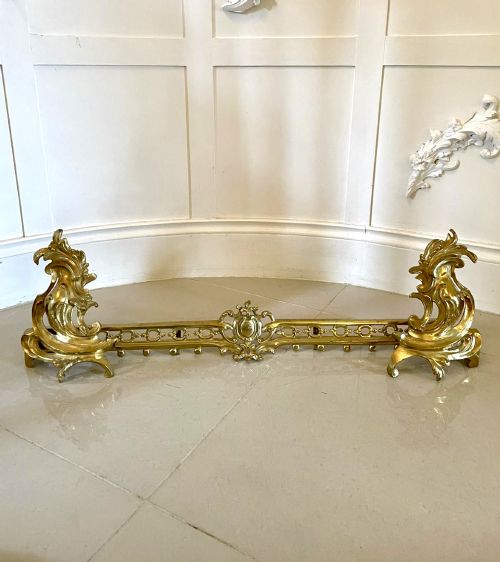
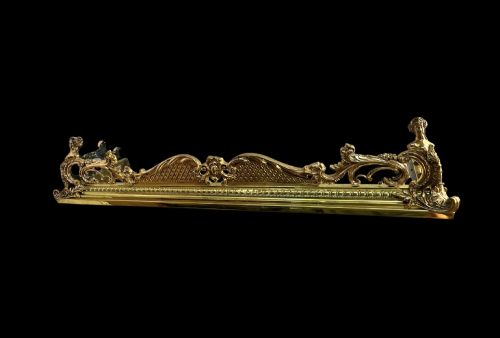
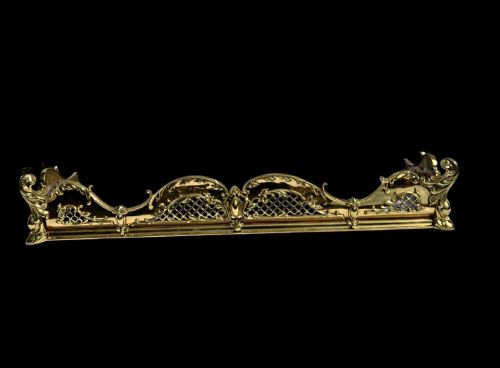
These rococo fireplace surround pieces bring swirling French charm to a hearth through ornate metalwork and adjustable brass fenders.
Rococo Fireplace Surround
A rococo fireplace surround centres on decorative hearth metalwork, most commonly seen here as extending and adjustable brass or bronze fenders from the nineteenth century. These items frame the hearth opening, often accompanied by matching chenets or fireguards designed in the French Louis XV style.
The pieces available draw heavily on Victorian revivals of French chateau aesthetics, utilising ornate cast brass, ormolu, and gilded bronze. Buyers frequently encounter adjustable forms that allow the metalwork to fit various hearth widths while maintaining asymmetrical scrollwork.
Beyond standard fenders, the selection includes matched chenet and andiron sets featuring parcel gilt cherub details and steel fireguard components. Each item reflects nineteenth-century craftsmanship aimed at bringing continental opulence into British domestic interiors.
Construction and materials
Makers utilised cast brass, bronze, and steel to build durable hearth furniture, frequently applying gilding or ormolu finishes to achieve a rich metallic sheen. These metals were cast into intricate moulds showing characteristic asymmetrical scrolls and foliage.
Extending mechanisms were engineered into the brass frames using sliding steel or brass bars, allowing the fender width to adjust. Artisans combined cast elements with parcel gilt details on figures such as cherubs to create depth and contrast.
Rococo Fireplace Surround Retail Price Guide 2026
Typical asking prices for rococo fireplace surround among the pieces listed under this phrase on Sellingantiques today, from the lower quarter to the upper quarter. They describe what is for sale here now, not the wider market.
Several fenders include gilded cherubs keeping watch over the hearth.
Assessing quality and craftsmanship
Superior examples display crisp casting definition in the scrollwork and foliage, where every curve remains sharp and well-defined rather than soft or smoothed over. The weight of the metal and the smoothness of any extending mechanism indicate the level of care taken during manufacture.
The quality of the gilding or ormolu surface separates standard production from finer pieces, showing even coverage and enduring lustre across complex three-dimensional forms. Integrated figural elements like cherubs show finer facial detailing and careful parcel gilding on higher-grade pieces.
The Rococo Fireplace Surround Glossary
- Fender
- A low metal guard placed in front of an open fireplace to contain sparks and rolling embers. These often extend to fit specific hearth dimensions.
- Chenet
- An alternative term for an andiron, used here as decorative metal supports placed on the hearth. They frequently match the design style of the surrounding fender.
- Ormolu
- Finely ground high-carat gold applied to a bronze or brass base object. This technique imparts a rich, golden finish characteristic of French decorative metalwork.
- Louis XV style
- A design aesthetic originating in eighteenth-century France and revived during the Victorian era. It relies on asymmetry, C-scrolls, and natural motifs.
- Fireguard
- A protective metal screen or barrier placed before the fire. In nineteenth-century examples, these are often integrated with extending fender bases.
Rococo Fireplace Surround: Frequently Asked Questions
How do adjustable fenders work?
Adjustable fenders feature interlocking or sliding metal sections that allow the overall width to expand or contract. This mechanism enabled nineteenth-century households to fit the metalwork precisely to different hearth openings.
Buyers should check that the sliding movement operates smoothly without binding. The hidden inner bars are typically made of steel or brass to provide structural support while concealed.
What is the difference between brass and ormolu?
Brass is an alloy of copper and zinc used widely for its durability and warm metallic tone. Ormolu refers specifically to gilded bronze or brass items finished with a layer of finely pounded gold.
Ormolu pieces generally exhibit a deeper, richer golden hue that resists tarnishing compared to plain polished brass. Both materials featured prominently in nineteenth-century interpretations of French design.
How do I clean gilded brass metalwork?
Gilded brass and ormolu require gentle dusting with a soft, dry brush to remove surface particles. Strong chemical polishes must be avoided because they strip away the thin gilt layer permanently.
Warm soapy water on a damp cloth can remove stubborn grime if dried immediately with a soft cloth. Preserving the original surface patina is essential for maintaining the historical character of nineteenth-century hearth accessories.
Are chenets used with fenders?
Chenets often sit inside or alongside fireplace fenders to support logs and complete the hearth arrangement. In many nineteenth-century suites, the fenders and chenets were manufactured as a matched set sharing identical rococo motifs.
Using them together creates a unified decorative display in front of the fireplace opening. The chenets add vertical interest while the fender frames the base of the hearth.
How do I identify a Victorian rococo piece?
Victorian rococo pieces combine eighteenth-century French scrollwork with nineteenth-century manufacturing methods like heavy sand casting. Look for characteristic asymmetrical C-scrolls, shell motifs, and naturalistic floral elements rendered in cast brass or bronze.
Date markers often appear through construction methods, such as the specific style of screw threads and sliding extension bars used in mid to late nineteenth-century workshops.