




Rococo Court Figures
Rococo court figures bring theatrical French style and elaborate aristocratic charm to a mantelpiece.
Rococo Court Figures
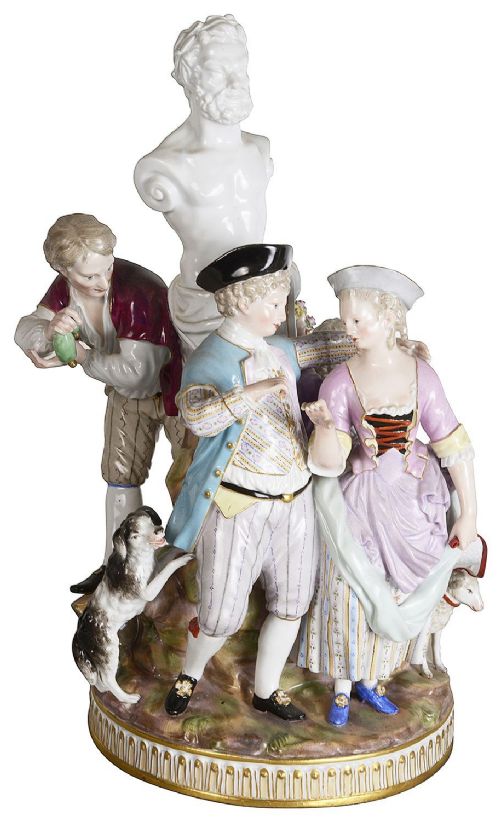
Rococo court figures capture the extravagant fashion and playful leisure of eighteenth-century European high society in ceramic form. You encounter pairs of courting couples, musical groups, and aristocratic ladies attended by gallants.
The pieces appearing on this page span the eighteenth, nineteenth, and early twentieth centuries, drawing heavily on Rococo Revival and Victorian interpretations of French court aesthetics. Formats range from single decorative figurines to intricate multi-figure porcelain groups.
How they were made
Makers shaped these decorative figurines primarily from hard-paste porcelain and standard porcelain, occasionally employing parian biscuit for a matte, marble-like finish. Moulding and manual modelling allowed artisans to achieve the flowing garments and elaborate hairstyles characteristic of the style.
Decoration relied on fine enamel painting, applied gilding, and gold leaf accents to highlight the intricate textiles and accessories of court dress. Faience also appears among the materials, offering a different ceramic texture for these gallant figures.
Object forms span individual decorative figurines, matched pairs, and larger multi-figure porcelain groups engaged in musical or domestic activities.
What varies in quality
The precision of the modelling distinguishes standard production from exceptional work, particularly in the rendering of facial expressions and hand gestures. Finer examples show crisp definition in lace details, musical instruments, and background elements like classical busts.
The application of enamel colours and the richness of the gilding further separate the tiers of craftsmanship. Pairs that retain their original harmony and balanced composition command stronger visual presence.
Bourdois & Bloch·La Coutille Factory·Volkstedt·Meissen·Derby·Triebner Ens & Co·Ludwigsburg
The Rococo Court Figures Glossary
- Hard-paste porcelain
- A durable ceramic composition fired at high temperatures, providing a dense body and a smooth vitreous glaze.
- Rococo Revival
- A nineteenth-century design movement that revived the asymmetrical scrolls, natural motifs, and playful elegance of the original eighteenth-century French style.
- Parian biscuit
- An unglazed, fine-grained porcelain resembling white marble, often used for nineteenth-century portrait busts and sculptural figures.
- Faience
- Tin-glazed earthenware produced across Europe, offering an opaque white surface for painted decoration.
- Enamel
- Vitreous pigments fused to the porcelain surface through firing, creating durable and colourful surface designs.
Rococo Court Figures: Frequently Asked Questions
How were they used historically?
Wealthy households placed these porcelain groups on dining tables as part of elaborate dessert services, where they sparked conversation among guests. Later, collectors moved them to display cabinets and mantelpieces as purely decorative objects.
They functioned as miniature theatrical scenes that reflected the owners' taste for European court culture and refined pastoral living. Their presence in a room signalled sophistication and an appreciation for fine craftsmanship.
How do I date a porcelain figure?
Dating relies heavily on factory marks stamped or painted on the underside, alongside the style of the clothing and the quality of the ceramic paste. Eighteenth-century pieces often display different paste characteristics and hand-painted underglaze marks compared to nineteenth-century revival pieces.
Comparing the modelling style to known factory output helps narrow down the period of manufacture. Revival pieces from the Victorian era often show heavier gilding and different base treatments.
How do I style them at home?
Display these figures on stable surfaces away from high-traffic areas to protect delicate elements like lace, fingers, and musical instruments. Placing them on mantelpieces or inside glass-fronted cabinets highlights their intricate enamel work and three-dimensional composition.
They pair well with traditional wooden furniture and classic interiors where their historical character can stand out. Keeping them out of direct sunlight preserves the vibrancy of the enamel colours.