
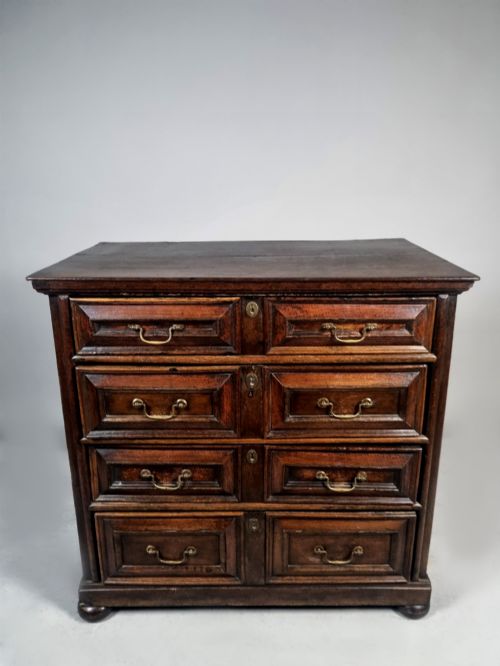
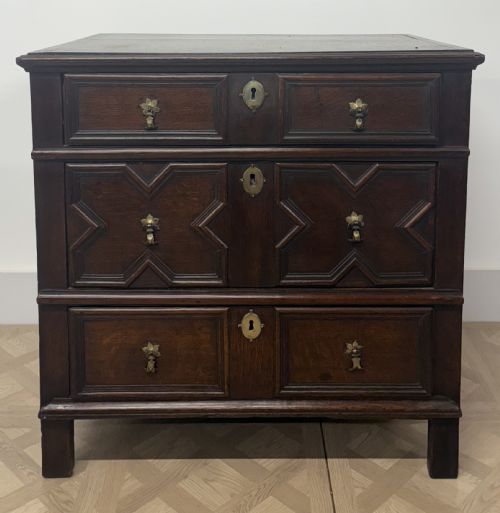
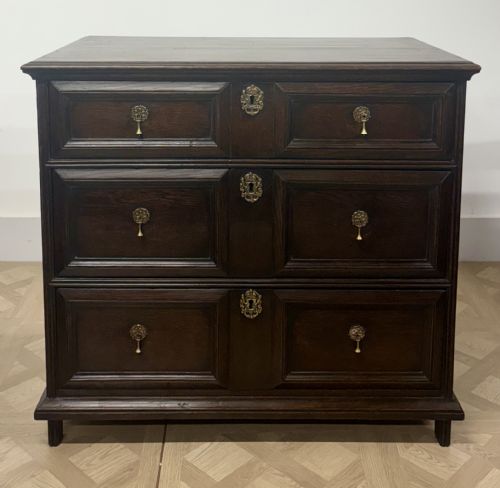
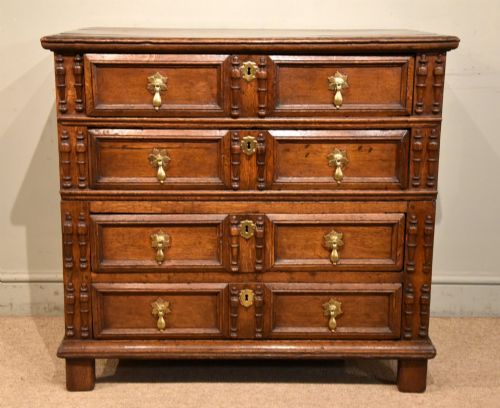


Restoration Era Oak Chest
A restoration era oak chest brings seventeenth-century character into a room through heavy timber, panel work, and deep mouldings.
Restoration Era Oak Chest
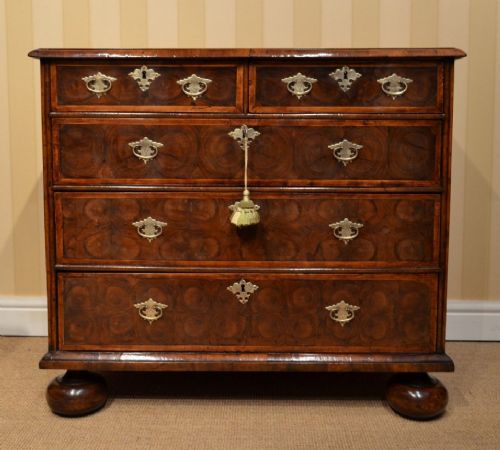
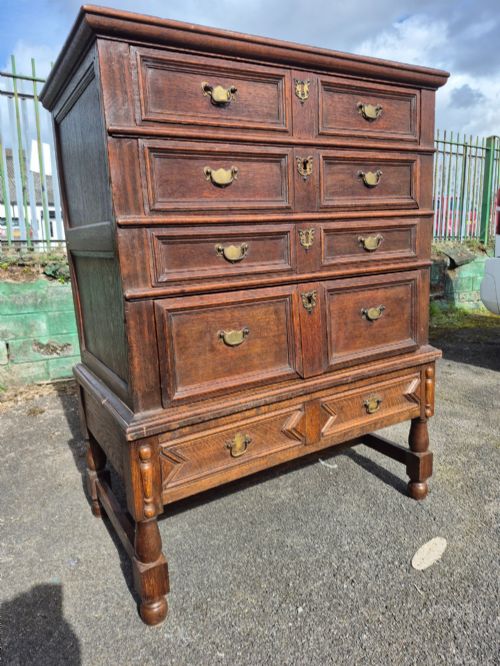
A restoration era oak chest is a seventeenth-century storage piece primarily constructed from oak, though examples also incorporate walnut, fruitwood, and oyster veneer. These items appear as chests of drawers, two-part chests, chests on stands, and occasionally as court cupboards spanning the Charles II, William and Mary, and Jacobean styles.
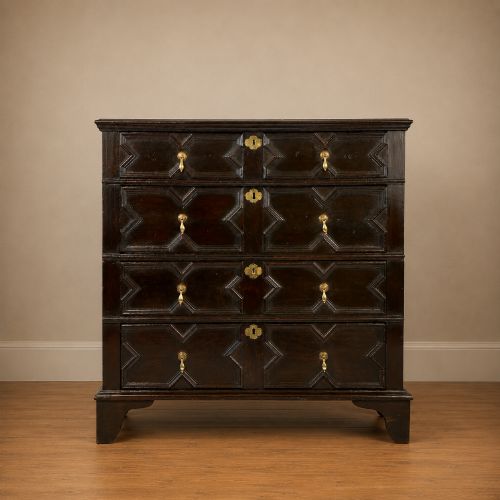
Buyers browsing this selection will most frequently encounter seventeenth-century chests of drawers featuring geometric mouldings and panel construction. The forms range from simple single-section boxes to imposing two-part chests and elevated chests on stands dating from around sixteen-hundred onwards.
What varies in quality
The sophistication of the geometric mouldings and the precision of the oyster veneer patterns dictate the visual tier of each piece. Elaborate multi-part drawer configurations and the integration of contrasting timbers like walnut and fruitwood elevate the stature of an individual chest.
Structural integrity depends upon the retention of original timber, bases, and stands, particularly on two-part chests and chests on stands. The finesse of the hand-carved details and the preservation of early brass hardware further distinguish finer examples from simpler provincial work.
Listings feature seventeenth century pieces in Charles II and William and Mary styles, constructed from oak, walnut, fruitwood, and oyster veneer.
The Restoration Era Oak Chest Glossary
- Oyster veneer
- Small circular or oval slices cut across the branches of a tree, laid side by side to create a patterned surface.
- Geometric mouldings
- Raised wooden strips applied in repeating angular patterns across drawer fronts and panels to create depth and shadow.
- Two-part chest
- A cabinet constructed in two separate stacking sections, allowing easier movement of heavy timber furniture.
- Chest on stand
- A storage chest elevated on an open frame with legs, lifting the main body off the floor.
- Court cupboard
- A large enclosed storage piece with shelves and doors, used for displaying plate and storing household goods.
Restoration Era Oak Chest: Frequently Asked Questions
What is a restoration era oak chest?
A restoration era oak chest is a seventeenth-century storage piece made primarily of solid oak, often featuring geometric mouldings and brass hardware.
These items were built during the reigns of Charles II and William and Mary, encompassing chests of drawers, two-part chests, and court cupboards.
How do I date an oak chest?
Dating relies on construction methods, timber choices, and decorative styles such as Jacobean carving or Charles II geometric mouldings.
Examining the drawer construction, backboards, and secondary timbers like walnut and fruitwood helps place the piece within the seventeenth century.
Are these chests made of solid oak?
Most examples use solid oak for the primary structural frame and panels, while secondary timbers appear alongside decorative elements.
Cabinet makers frequently incorporated walnut and fruitwood, and applied oyster veneer across drawer fronts and visible surfaces.
How do I care for antique oak furniture?
Maintain antique oak by keeping it away from direct heat sources and sudden humidity changes that cause timber to split.
Apply traditional wax sparingly to nourish the wood and protect the surface finish without sealing the grain.