




Regency Weather Instrument
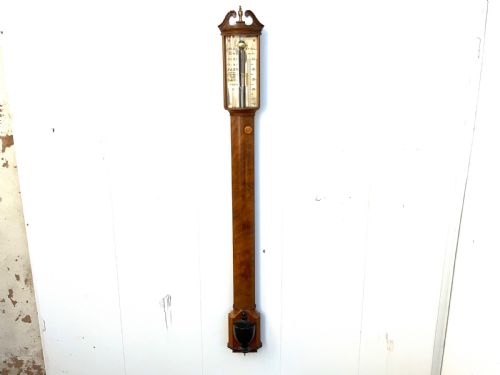
A regency weather instrument measures atmospheric pressure with mercury in cases of mahogany, rosewood or satinwood.
Regency Weather Instrument
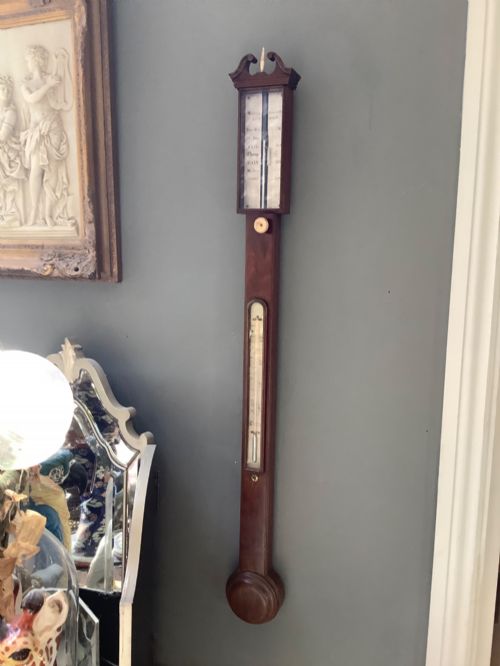
A regency weather instrument is an atmospheric gauge built to record barometric pressure in a domestic interior. You will find stick barometers and wheel barometers most often on this page, housed in tall wooden cases designed to hang on a wall.
Most examples date from the nineteenth century, spanning the Georgian, Regency, and early Victorian periods. Makers favoured rich timbers such as mahogany and rosewood, sometimes inlaid with satinwood or fitted with bird's-eye grain.
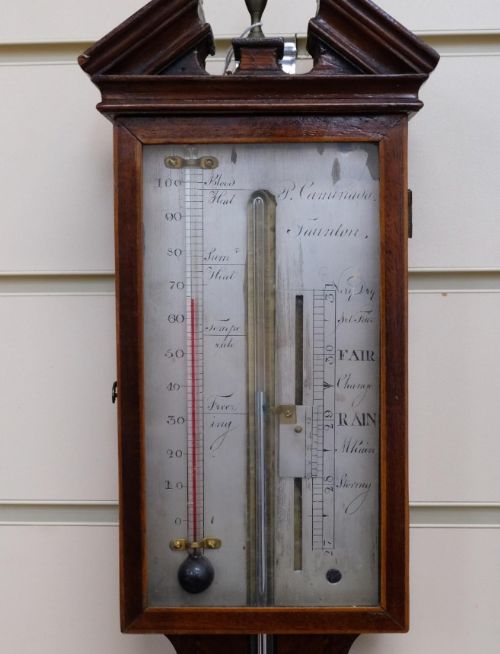
The mercury tube or wheel dial sits behind glass, paired with a silvered brass scale for reading pressure changes. Instrument makers signed their work directly onto the face or dial, recording towns across Britain and Ireland.
Materials and construction
Cabinet makers built the tall cases from solid mahogany, rosewood, and satinwood, often shaping the front into a bowed profile to catch the light. They inserted silvered brass or silvered metal plates inscribed with weather nomenclature and maker details.
Instrument makers sealed liquid mercury inside glass tubes to respond to atmospheric weight, connecting them to visible dials or exposed index scales. Brass fittings, bone vernier knobs, and cast bezels completed the functional elements.
Regency Weather Instrument Retail Price Guide 2026
Typical asking prices for regency weather instrument among the pieces listed under this phrase on Sellingantiques today, from the lower quarter to the upper quarter. They describe what is for sale here now, not the wider market.
Makers worked across London, provincial English towns, and Dublin during the nineteenth century.
The markers of quality
The distinction between a standard production piece and a finer domestic instrument lies in the execution of the timber case and the clarity of the engraved dial. Crisp corner stringing, figured veneers, and robust brass bezels separate workshop output from everyday utilitarian objects.
Signed dials by known London or provincial opticians elevate an instrument, as does the retention of original mercury tubes and untouched glass. The sharpness of the silvered brass plate and the precision of the engraved graduations indicate the maker's original investment in the piece.
P. Caminada·Dollond of London·Ganthony of London·Molton of Norwich·Bate of London·L Casatelli of Liverpool·Roncoroni·H Marks·Sandrino of Liverpool·Vecchio & Co·Alexander Adie·Bassi·J C Moretti·F Salteri & Co·Dominic Gatty·Corti of Exeter·Malacrida of Dublin·Schiavi of Chesham·George Dollond
The Regency Weather Instrument Glossary
- Stick barometer
- A tall, narrow instrument where the mercury column moves vertically against an exposed scale. These provide a direct reading of barometric height without mechanical linkages.
- Wheel barometer
- A round dial instrument that uses a float on the mercury to turn a pointer via a silk thread and pulley system. This layout allows for easier reading from across a room.
- Silvered brass
- A metal alloy treated with silver powder to create a bright, reflective surface for engraving calibrations. Makers used this for the register plates where the weather terms appear.
- Vernier
- A small auxiliary scale that slides against the main barometer scale to measure fractional divisions accurately. It helps the user read minute shifts in pressure.
- Bow front
- A convex curved front profile applied to the wooden case of a stick barometer. This shape softens the geometry of the wall-hung trunk.
Regency Weather Instrument: Frequently Asked Questions
How do stick and wheel barometers differ?
Stick barometers display a vertical column of mercury showing direct atmospheric pressure against an exposed scale. Wheel barometers translate that movement through a pulley to sweep a hand across a circular dial.
Both serve the same meteorological function, but the wheel format offers a more decorative face for a principal room.
Where should I hang a barometer?
These instruments belong on interior walls away from direct sunlight, central heating radiators, and damp exterior doors. Stable room temperatures ensure the wood case does not warp and the internal mechanism remains undisturbed.
Position them at eye level so the scale and pointer can be read easily.
Are these instruments still accurate today?
Many retain their original mercury contents and continue to respond to atmospheric pressure shifts in real time. Their primary appeal, however, lies in their historical craftsmanship and decorative presence.
Calibration can be checked against modern local weather data if the mercury column is intact.
How do I identify the period of an instrument?
Look to the timber choice, dial typography, and case silhouette to date the piece. Georgian and Regency examples often feature figured mahogany cases with simple bone adjusters and hand-engraved brass plates.
Nineteenth-century pieces frequently display maker signatures and regional workshop locations directly on the face.