
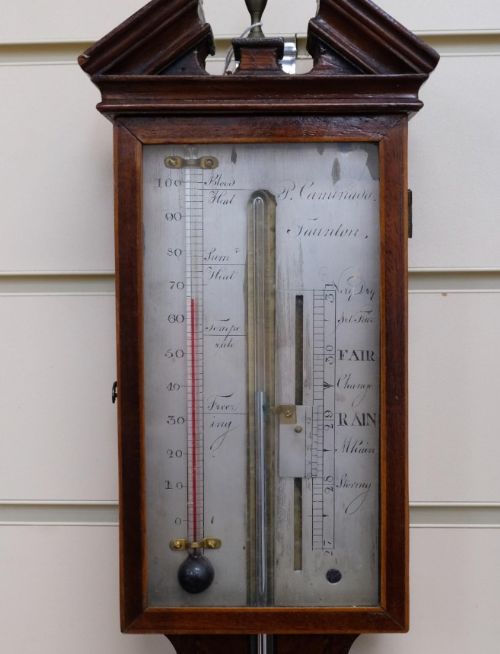
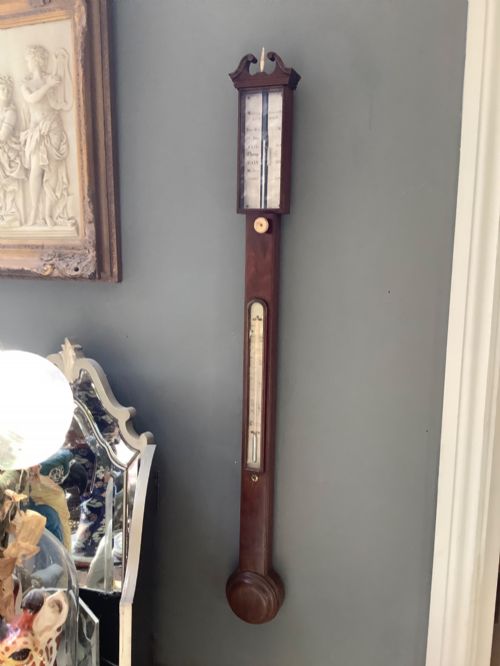


Regency Wall Barometer
These regency wall barometer pieces bring practical science and fine cabinet-making into the home, offering a reliable guide to the weather inside a handsome wooden case.
Regency Wall Barometer
A regency wall barometer is a scientific instrument housed in a domestic timber case, designed to measure atmospheric pressure for daily weather observation.
The pieces listed here appear chiefly in forms such as the slender stick barometer and the broader wheel barometer, frequently incorporating dials and occasionally clocks.
Makers from London and regional centres across Britain built these instruments during the Georgian, Regency, and early nineteenth century periods, often using rich timbers.
How they were made
Cabinet-makers constructed the cases using solid mahogany and rosewood, sometimes adding boxwood stringing, brass fittings, and bone adjusters.
Graduated scales were engraved onto silvered metal or silvered brass plates, which were then fitted behind protective glass panels to display the barometric readings.
Regency Wall Barometer Retail Price Guide 2026
Typical asking prices for regency wall barometer among the pieces listed under this phrase on Sellingantiques today, from the lower quarter to the upper quarter. They describe what is for sale here now, not the wider market.
Weather-watching instrument makers frequently doubled as mirror makers, ensuring your pressure reading came with a reflection.
What varies in quality
The calibre of a regency wall barometer depends on the crispness of the cabinet-making, from simple moulded frames to sophisticated bow fronts and detailed inlay.
Signatures engraved by established opticians and instrument makers indicate a higher level of workshop precision in the movement and scale division.
P. Caminada·Dollond of London·Ganthony of London·JB Bergna·Molton of Norwich·Bate of London·L Casatelli·Roncoroni·H Marks·Sandrino of Liverpool·Vecchio and Co·Alexander Adie·Bassi·J C Moretti·F Salteri and Co·Dominic Gatty·Corti of Exeter·Malacrida of Dublin·Russell of Liverpool·George Dollond·Schiavi of Chesham
The Regency Wall Barometer Glossary
- Stick barometer
- A vertical instrument utilising a mercury column in a long tube to measure atmospheric pressure. This form shows direct barometric changes without mechanical multiplication.
- Wheel barometer
- A circular instrument featuring a dial that translates mercury movement via a float and pulley. This style often includes a hygrometer, thermometer, or spirit level.
- Silvered metal
- A brass plate treated to give a bright, reflective silver finish before engraving. Graduations and maker names are cut sharply into this surface.
- Bow front
- A convex case front that projects outward from the wall. This curved profile adds depth and sophistication to the timber housing.
Regency Wall Barometer: Frequently Asked Questions
What is a stick barometer?
A stick barometer is a tall, narrow instrument that houses a vertical mercury tube. It shows direct atmospheric pressure changes through the exposed glass column.
These pieces hung in hallways and libraries where occupants could check the weather before travelling.
How does a wheel barometer work?
A wheel barometer uses a float resting on the mercury inside a siphon tube. A silk thread and pulley connect this float to a needle on a circular dial.
Changes in pressure turn the needle around the graduated face, making the reading easier to see from across the room.
Where were these barometers made?
Makers constructed these instruments in workshops across London and various British provincial towns. Many makers originated from Italian immigrant families who settled in Britain to practise instrument making.
Their names appear engraved on the metal plates or painted on the dial faces.
What woods are used in the cases?
Cabinet-makers utilised dense tropical hardwoods such as mahogany and rosewood to construct stable housings for the delicate glass tubes. Boxwood often provided contrasting stringing and inlay details.
These timbers protected the internal mechanics while offering a formal appearance suitable for period interiors.