
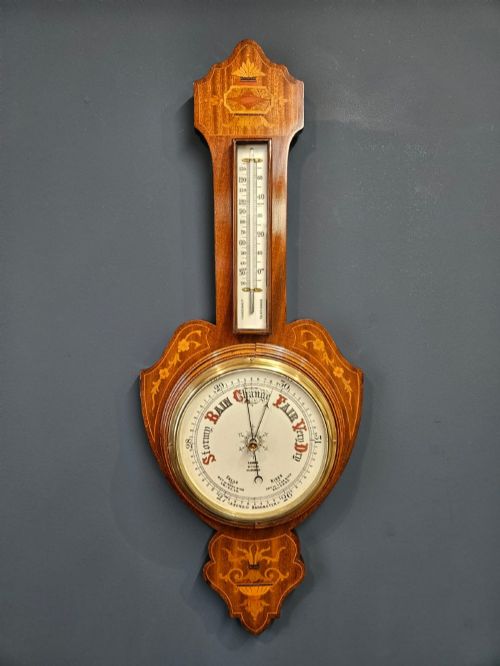
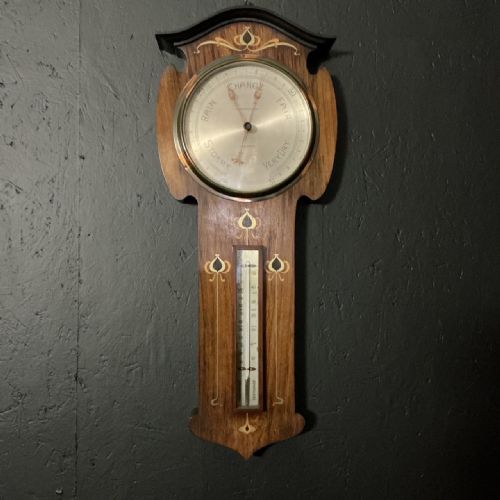

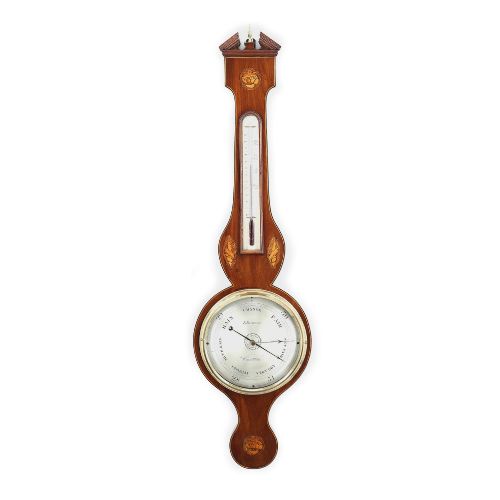
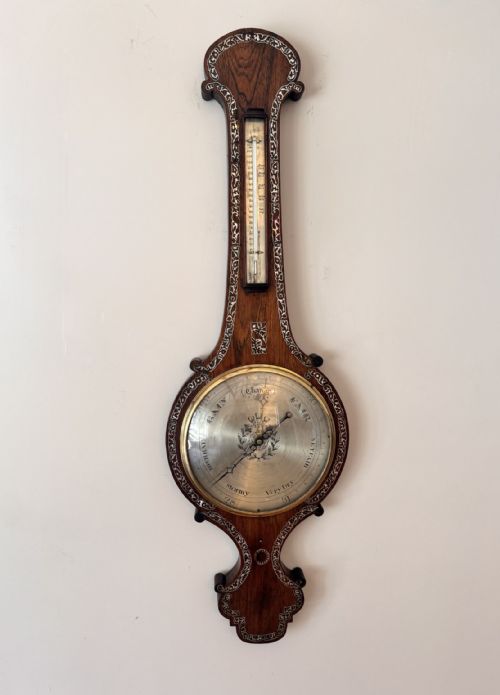


Inlaid Wooden Barometer
An inlaid wooden barometer brings both accurate weather forecasting and fine cabinet-making into a room, serving as a striking focal point on any wall.
Inlaid Wooden Barometer
An inlaid wooden barometer combines scientific utility with decorative woodworking, taking forms such as the traditional banjo or wheel barometer. These instruments measure atmospheric pressure to help predict weather changes while adding warmth and visual interest to an interior space.
Buyers encountering this selection will most frequently find examples originating from the nineteenth century, including Victorian, Regency, and Edwardian periods. These pieces range from classical Georgian-inspired designs to later Arts and Crafts and Art Deco interpretations.
Makers housed these sensitive mechanisms within carefully shaped wooden bodies, often pairing functional dials with thermometers and hygrometers. The inclusion of decorative inlay transforms a simple scientific tool into a sophisticated piece of decorative furniture.
Materials and Construction
Cabinet-makers relied heavily on solid mahogany and rosewood as the primary structural woods for these instruments, often applying fine wood veneers and satinwood stringing to create decorative borders. Contrasting timber tones highlighted the characteristic curved outlines of banjo and wheel barometers.
Artisans applied intricate wood inlay and marquetry, sometimes incorporating mother of pearl details to catch the light around the central dials. The dials themselves were protected behind convex glass and mounted within cast brass bezels, securing the delicate internal movements.
Inlaid Wooden Barometer Retail Price Guide 2026
Typical asking prices for inlaid wooden barometer among the pieces listed under this phrase on Sellingantiques today, from the lower quarter to the upper quarter. They describe what is for sale here now, not the wider market.
Listings feature works spanning the nineteenth century and early twentieth century, including Regency, Victorian, Edwardian, Arts and Crafts, and Art Deco styles.
Determinants of Quality
The distinction between standard examples and finer works rests primarily in the crispness of the cabinet-making and the complexity of the marquetry. Superior pieces exhibit precise wood inlay work, balanced proportions, and well-figured mahogany or rosewood veneers.
Signatures upon the dial from established makers elevate a barometer significantly, reflecting the skill of the original optician or instrument maker. Furthermore, the survival of original brass fittings, mercury tubes, and thermometer scales dictates the overall integrity of the piece.
B Besozzi of Weymouth·Molton of Norwich·L Casatelli of Liverpool·Vecchio and Co of Shaftsbury·A Rivolta·J Groce York·F Salteri and Co Nottingham
The Inlaid Wooden Barometer Glossary
- Aneroid barometer
- A type of barometer that measures atmospheric pressure using a small, flexible metal box called an aneroid cell, avoiding the use of liquid mercury. This design became popular in the later nineteenth and early twentieth centuries.
- Banjo barometer
- A wall barometer shaped roughly like a banjo, featuring a circular dial at the top and an elongated trunk containing a thermometer or spirit level below. This form dominated nineteenth-century domestic interiors.
- Marquetry
- The art and craft of applying pieces of veneer to a structure to form decorative patterns and pictures. Makers utilised contrasting woods and mother of pearl to create elaborate Neo-Classical motifs.
- Satinwood
- A durable, yellowish wood often used for contrasting stringing and geometric inlay on darker timbers like mahogany and rosewood. It provides a bright, reflective highlight against deeper grain patterns.
- Stringing
- A narrow strip of contrasting wood inlaid into the surface of a furniture piece to form fine borders and outlines. This technique defines the panels on many wheel barometers.
Inlaid Wooden Barometer: Frequently Asked Questions
What is a banjo barometer?
A banjo barometer is a domestic wall instrument shaped like the musical instrument, featuring a large dial at the top for pressure readings and a long stem below that often houses a thermometer.
This silhouette became the standard form for British homes throughout the nineteenth century, blending practicality with decorative woodwork.
How do I read an aneroid barometer?
An aneroid barometer uses a pointer linked to a sealed metal capsule that expands or contracts as air pressure shifts. Turning the small brass knob on the glass face moves the needle to mark your current reading.
Comparing this setting against future movements of the main hand indicates whether the weather is likely to improve or deteriorate.
Where should I hang a wooden barometer?
Mount your barometer on an interior wall away from direct sunlight, radiators, and heavy draughts to ensure accurate pressure measurements. Rapid temperature fluctuations can affect the internal mechanism and distort readings.
Choose a stable partition where the instrument can serve as a visual feature at eye level.
How do I date a barometer?
Dating relies on stylistic clues such as the silhouette, the timber used, and the complexity of the wood inlay or marquetry. Regency and early nineteenth-century pieces often feature clean mahogany cases, while Edwardian versions incorporate lighter satinwood details.
Maker signatures on the dial also provide a direct link to the operational years of the original workshop.