


Regency Style Window Seat
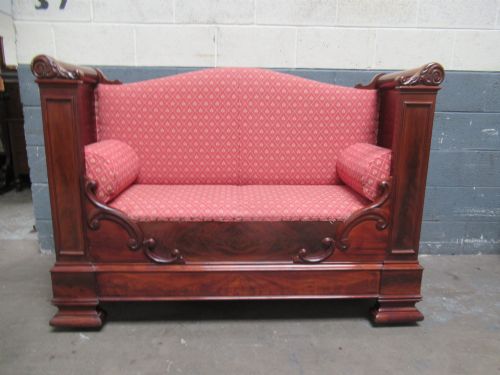
These pieces are a regency style window seat, offering long-form seating designed specifically for placement beneath household windows.
Regency Style Window Seat
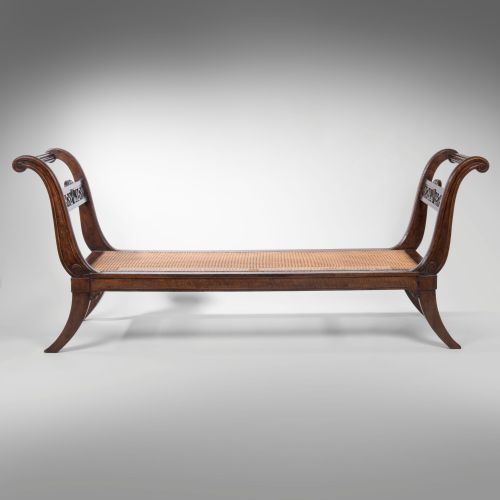
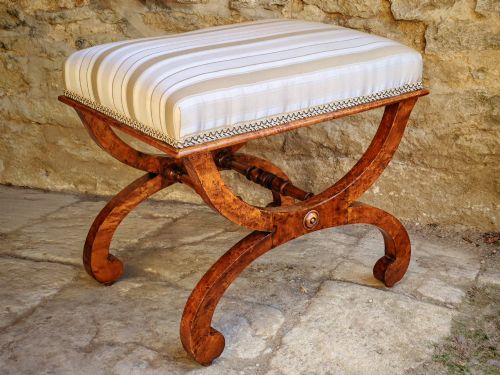
A regency style window seat sits low against the wall beneath glass, providing a narrow bench form that avoids blocking natural light. The listings show forms spanning benches, settees, and X-frame stools originating across the nineteenth century and subsequent revival periods.
Makers shaped these seats in mahogany, walnut, satinwood, and giltwood, frequently incorporating cane panels or modern upholstery. You will encounter both authentic period examples and later nineteenth and twentieth-century interpretations.
The silhouettes draw heavily on neoclassical lines, featuring fluted legs, curule X-frames, and scroll ends. These long benches and stools bridge the gap between chairs and settees, scaled explicitly for transitional corridors and reception rooms.
Quality and execution
The distinction lies in the crispness of the carved ornament and the selection of timber veneers. Superior examples display deeply undercut foliage and finely turned legs rather than shallow, cast ornament.
Structural joinery defines the longevity of these long seats, particularly where X-frames or scroll ends join the main rail. Finer pieces maintain rigid frames without relying on secondary corner blocks to mask loose joints.
Some nineteenth-century makers curved the wooden ends specifically to cradle a morning reader's head.
Gillows
The Regency Style Window Seat Glossary
- Curule stool
- A seat featuring intersecting concave legs shaped like an X, derived from ancient Roman magistrate chairs. This form provides inherent cross-bracing strength.
- Giltwood
- Timber coated with gold leaf over a prepared gesso and bole ground. This finish reflects candlelight and daylight in formal reception rooms.
- Caning
- Woven rattan strips forming a porous, flexible panel for seats and backs. It lightens the visual weight of heavy hardwood frames.
- Satinwood
- A pale, lustrous exotic timber utilised for fine cabinetwork and painted decorative furniture. Its natural sheen suits neoclassical designs.
Regency Style Window Seat: Frequently Asked Questions
Where should I put a window seat?
These long benches suit placement beneath low windows, along hallways, or at the foot of a bed.
Their narrow depth allows them to occupy transitional spaces where standard armchairs would obstruct movement.
How do I identify the period?
Examine the timber species, joinery methods, and the sharpness of any carved decoration on the frame.
Revival pieces from later centuries often employ different secondary woods and mechanical fasteners compared to earlier work.
Are these seats comfortable?
Upholstered and padded versions offer soft seating, while caned and solid wood frames are firmer.
Many historic examples were designed for brief periods of repose rather than long lounging.
What is an X frame?
An X frame consists of two curved or straight members crossing in an X shape beneath the seat rail.
This ancient structural layout provides both architectural support and a distinct neoclassical silhouette.