


Regency Style Eagle Mirror
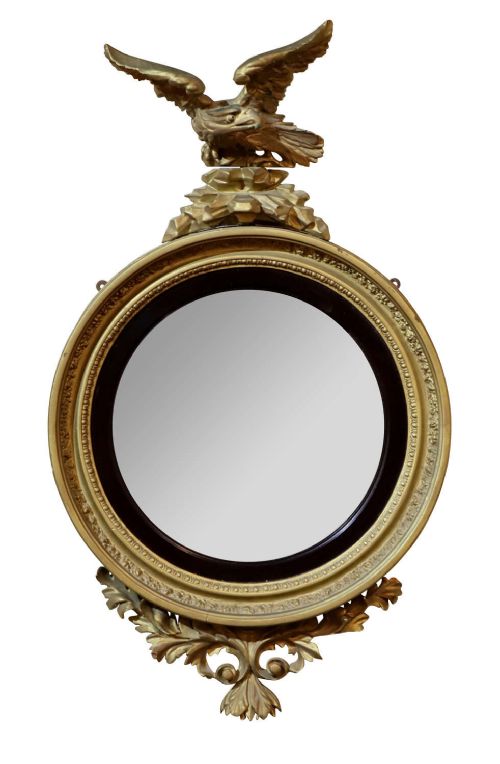
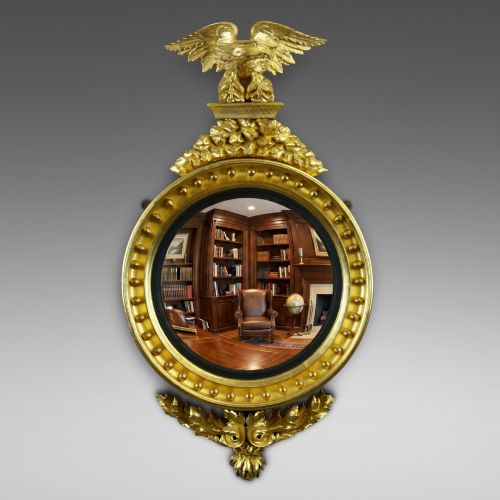
A regency style eagle mirror brings fierce presence and classical balance to a room, led by the unmistakable carved bird atop a convex glass.
Regency Style Eagle Mirror
A regency style eagle mirror typically takes the form of a circular convex glass set within a round frame, crowned by a carved bird with outstretched wings. These pieces span the nineteenth century, early twentieth century, and Victorian periods, drawing directly upon Regency design vocabulary.
The most common version met on this page is the giltwood convex wall mirror surmounted by an eagle, often accompanied by candle sconces or carved foliate details. Wall mirrors and overmantel mirrors dominate the forms, while pairs of mirror back wall sconces appear alongside single round pieces.
Makers and craftsmen working in the Regency and later revival periods utilised traditional proportions to give these circular glasses their characteristic depth. Whether dating from 1830 or the late nineteenth century, each example relies on the interplay between the curved reflecting surface and the commanding bird crest.
How they were made
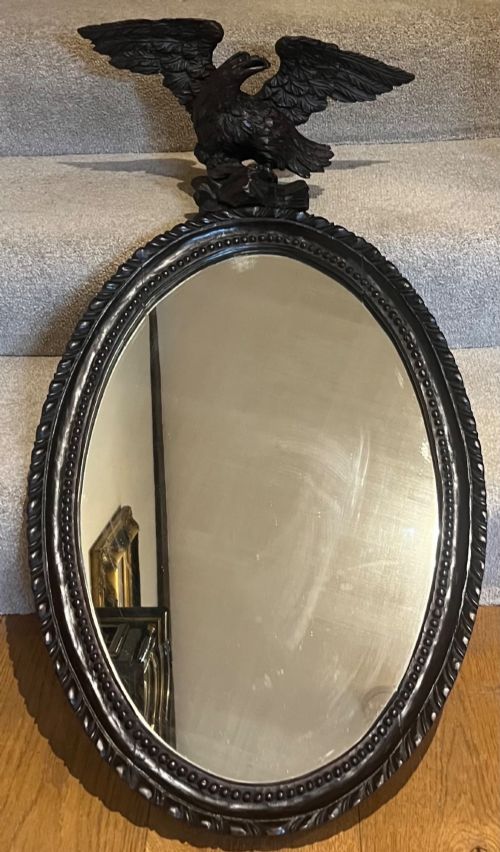
Makers constructed these frames from carved wood, timber, and gesso before applying a rich layer of giltwood to achieve a luminous golden finish. Some variants incorporate ebonised wood details to contrast sharply against the bright gilding of the main frame.
The optical core relies upon a mirrored glass or convex glass shaped to catch and distort the room in a wide-angle reflection. Artisans mounted the carved eagle surmount securely to the top of the circular moulding, often integrating metal structural elements behind the heavy timber.
Every convex mirror on this site comes with a built-in audience of one eagle staring intensely into the middle distance.
What varies in quality
The distinction between ordinary and exceptional examples rests upon the depth and vigour of the wood carving, particularly in the feathers and beak of the eagle surmount. Crisp hand-carved details show a master's touch, whereas lesser pieces rely on heavy gesso moulding that softens the underlying form.
Surface preservation dictates the standing of a mirror, where undisturbed original gilding and clear mirror glass hold greater visual coherence. The integration of the frame components demonstrates structural ambition, distinguishing standard wall mirrors from massive overmantel pier mirrors.
The Regency Style Eagle Mirror Glossary
- Convex mirror
- A round mirror with an outward-curving glass surface that reflects a wide, fish-eye view of the entire room. This spherical form concentrates light and creates a distinctive decorative focal point.
- Giltwood
- Timber coated with a thin layer of gold leaf or gilt paint over a prepared gesso ground. It provides a brilliant, reflective metallic surface that defines classic antique mirror frames.
- Gesso
- A plaster-like mixture applied to wood frames to create a smooth surface for gilding and intricate low-relief moulding. Skilled carvers incised details directly into this layer before the gold leaf was laid.
- Surmount
- An ornamental feature placed at the very top of a mirror frame, such as the carved eagle found on Regency convex glasses. It draws the eye upward and balances the circular weight below.
- Overmantel mirror
- A large horizontal mirror designed specifically to hang on the wall directly above a fireplace mantelpiece. These pieces often feature extended carved surrounds to anchor large rooms.
Regency Style Eagle Mirror: Frequently Asked Questions
Where should I hang a convex mirror?
These mirrors work best on a focal wall opposite a window or doorway, where the curved glass can capture and project light across the entire space. Because of their wide-angle reflection, they suit hallways, dining rooms, and sitting rooms.
Ensure the wall can support the weight of the timber and gesso frame before hanging. Placing the glass at eye level maximises its visual impact in a room.
Are these mirrors original Regency or later revivals?
Dating depends on the timber, the composition of the gesso, and the manufacturing marks hidden behind the backing boards. The evidence here includes pieces from the early nineteenth century alongside Victorian and 1920s revivals.
Revival pieces from the late nineteenth and early twentieth centuries faithfully copied the earlier Regency style using traditional materials. Examining the wear on the wood and the oxidation of the mirror glass helps establish the age.
What is the purpose of the eagle surmount?
The eagle served as a powerful patriotic and classical motif in Regency design, symbolising strength, majesty, and vision. Placed atop a circular mirror, the bird balances the symmetry of the round frame.
Spread wings also served to visually widen the silhouette of the piece, drawing attention upward and anchoring the mirror to the wall above.