
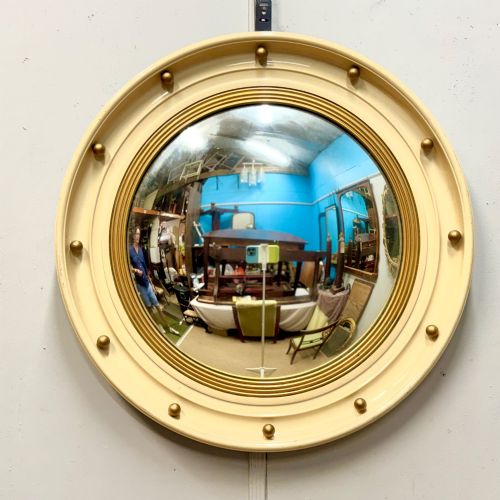
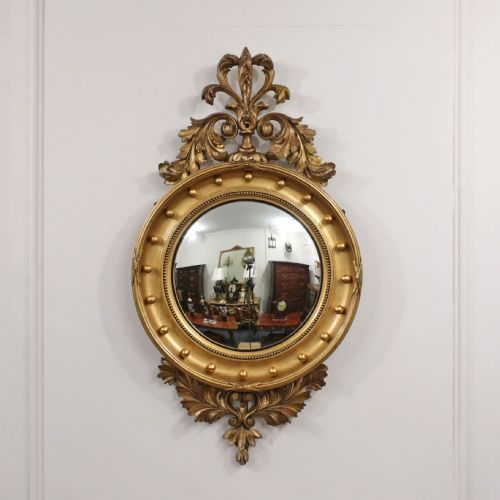
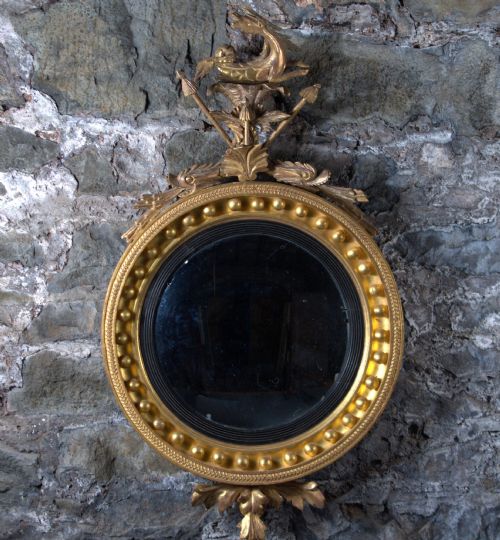


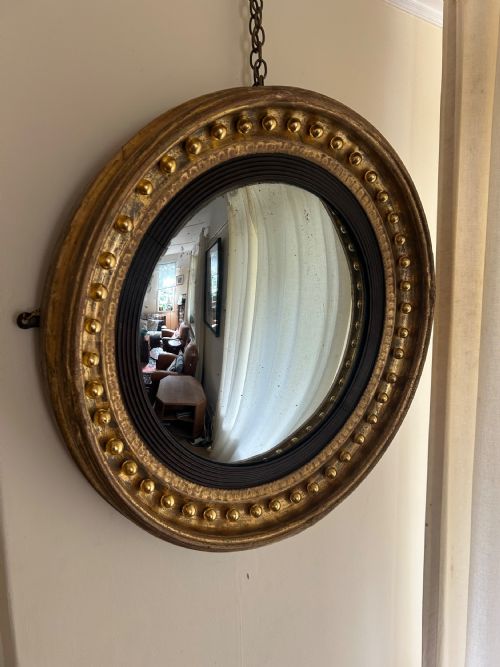
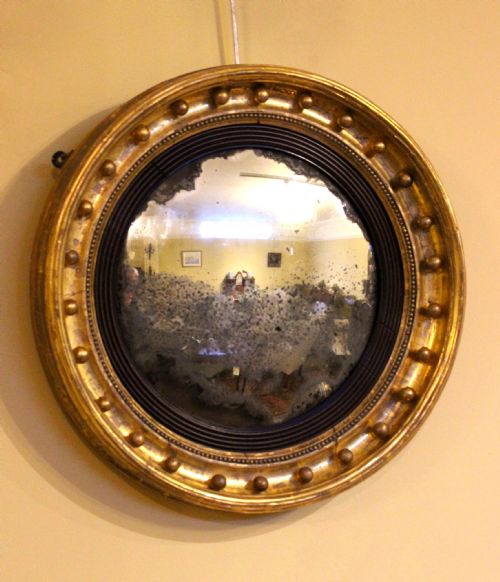


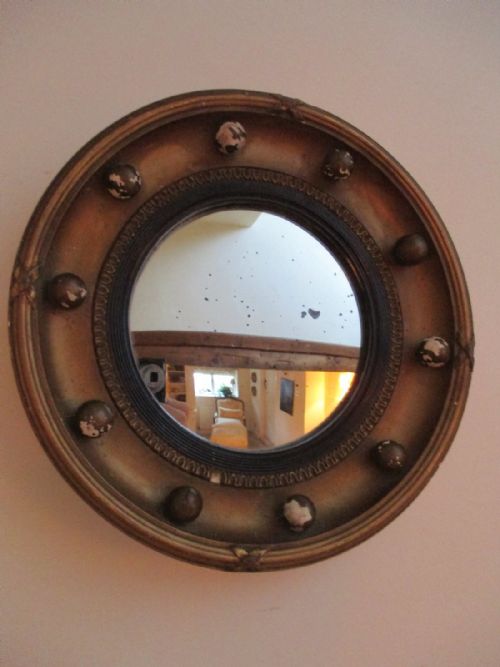
Spherical Ball Convex Mirror
A spherical ball convex mirror brings a dramatic, fish-eye perspective and brilliant reflected light to any interior.
Spherical Ball Convex Mirror
A spherical ball convex mirror offers a sweeping, wide-angle view of a room through its curved glass surface. When you search for a spherical ball convex mirror, you encounter circular wall pieces that traditionally served both a practical purpose and a decorative role in grand interiors.
The selections available here span from the Regency period through to the turn of the twentieth century. These wall mirrors appear primarily in round formats, framed in giltwood, ebonised wood, and timber with gesso enrichment.
Regency originals sit alongside Regency revival pieces and items dated around nineteen hundred. Such mirrors often include distinct frame details like dragons or ebonised sight rings alongside their characteristic deep-set convex plates.
How they were made
Glassmakers blew curved or spherical glass blanks to create the distinctive convex plates housed within these frames. Craftsmen then silvered the rear of the curved glass to produce a clear, distorted reflection.
Woodworkers turned timber and mahogany to form the circular chassis of the mirror. Giltwood and gesso finishes were applied over the wooden base, often utilising gold leaf to achieve a brilliant metallic sheen.
Makers integrated ebonised wood details to create stark contrast against the gilt surfaces. Frames frequently incorporated carved motifs, such as dragons or decorative roundels, fixed securely around the perimeter of the circular glass.
Some nineteenth-century frames feature fierce wooden dragons peering out from the edges, standing guard over your panoramic reflection.
What varies in quality
The crispness and depth of the carved wood or gesso ornamentation dictate the visual strength of the frame. Superior examples display sharply defined details on motifs like dragons or foliage, whereas lesser pieces show softer, shallower moulding.
The quality of the gilding and the preservation of the original glass surface determine the overall character of the object. Finer mirrors retain their original fire gilding and clear convex glass without excessive clouding or foxing.
The Spherical Ball Convex Mirror Glossary
- Convex mirror
- A mirror with a curved, outward-bulging glass surface that reflects a wide-angle, panoramic view of the surrounding space. These are frequently referred to as butler's mirrors or security mirrors.
- Giltwood
- Timber that has been coated with a thin layer of gold leaf or gold paint over a prepared gesso ground. This technique provides a luminous, durable finish characteristic of fine antique frames.
- Gesso
- A plaster-like mixture applied to wood frames to create a smooth surface for subsequent gilding or painting. It allows craftsmen to model intricate relief ornamentation prior to applying gold leaf.
- Ebonised wood
- Timber treated with stain, dye, or paint to imitate the dark, dense appearance of ebony. This dark finish creates a sharp visual border around the reflective glass.
- Regency
- An English design period spanning the early nineteenth century defined by classical restraint and neoclassical motifs. Pieces from this era often feature bold architectural lines and sophisticated surface gilding.
Spherical Ball Convex Mirror: Frequently Asked Questions
How do I date a convex mirror?
Dating relies on examining the construction methods of the wooden frame, the composition of the gesso, and the characteristics of the glass plate. Regency examples typically display specific neoclassical carving styles and hand-beaten gilt surfaces.
Later pieces from the nineteenth century or around nineteen hundred often exhibit different joining techniques and variations in the depth of the frame mouldings.
Where should I hang a convex mirror?
These mirrors work best on a principal wall in a reception room, hallway, or dining space where their wide-angle reflection can be fully appreciated. Hanging them at eye level allows viewers to experience the distinctive curved perspective.
Because they naturally draw light into a space, placing them opposite a window or near a light source maximises their illumination effect.
Why are some frames ebonised?
Ebonised sight rings or frame sections were utilised to provide a strong visual contrast against bright gilt surfaces. This dark border frames the reflective glass sharply and enhances the depth of the piece.
The technique reflects the nineteenth-century preference for varied textures and contrasting tones within decorative woodwork.