
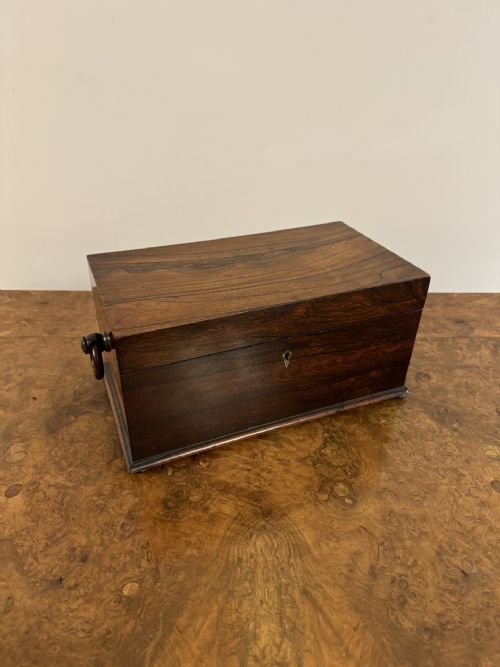
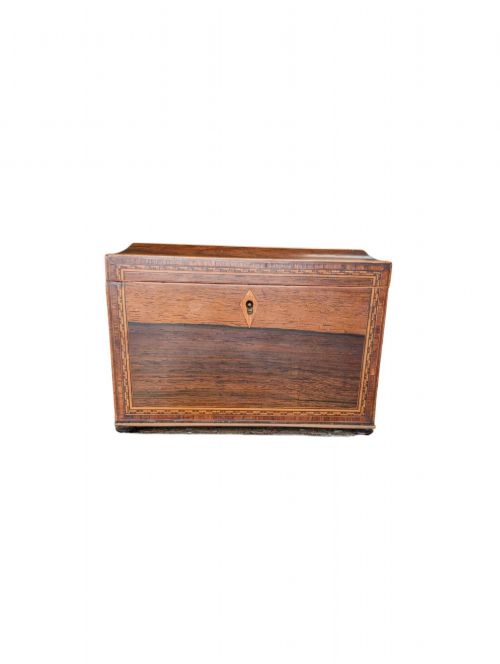
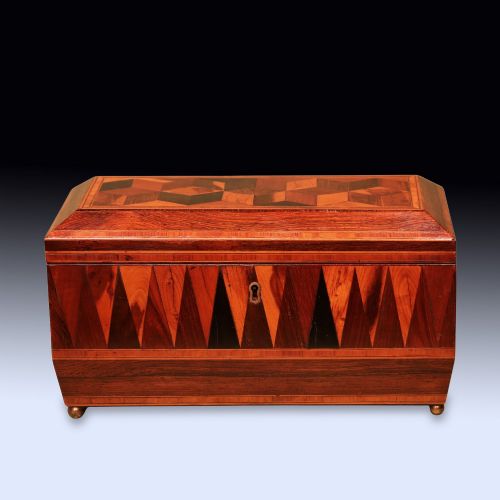


Regency Rosewood Tea Caddy
A regency rosewood tea caddy brings the rich grain and formal elegance of the early nineteenth century into a modern drawing room.
Regency Rosewood Tea Caddy
A regency rosewood tea caddy is a lidded box designed to store loose leaf tea safely away from light and moisture. These pieces typically date from the Regency, Georgian, and William IV periods, spanning the early to mid-nineteenth century.
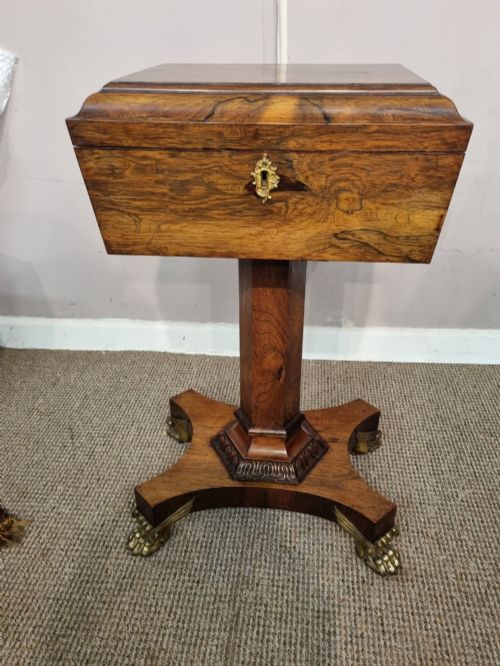
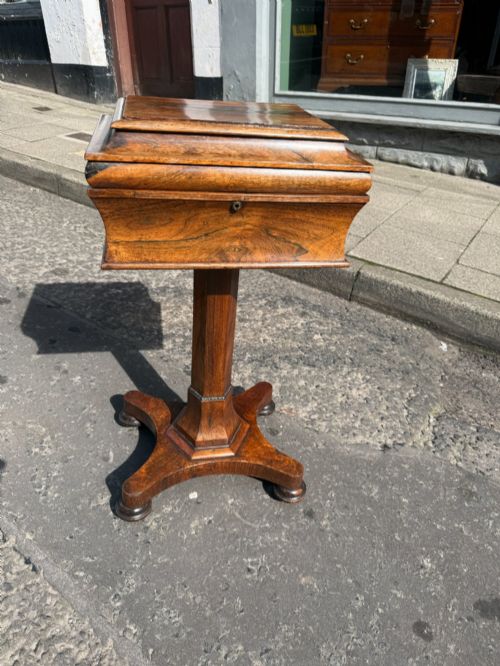
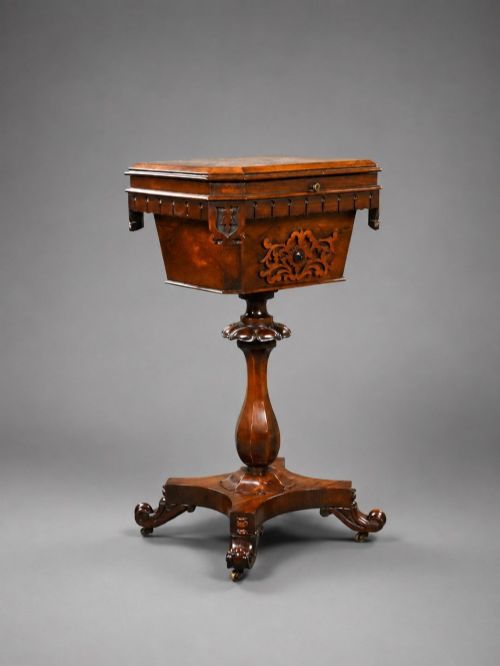
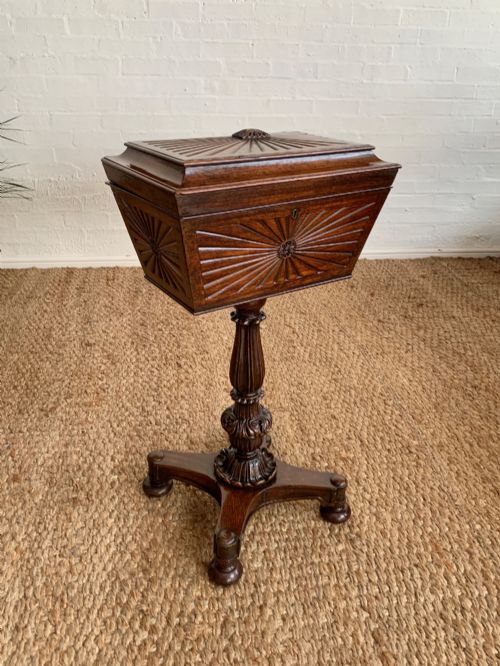
The selections on this page appear most frequently in the sarcophagus form, often featuring stepped lids, ring handles, and resting on carved feet. Alongside standard table caddies, the evidence includes larger standing teapoys and miniature sideboards designed for drawing rooms.
Interior layouts vary widely, though many retain lidded canisters, mixing bowls, and compartments for green and black tea leaves. The combination of dense tropical timber and precise cabinetmaking defines the core of what collectors find in these listings.
Materials and construction
Makers utilised dark, heavily grained rosewood as the primary carcass timber, often selecting veneers to run smoothly across the curved contours of sarcophagus and bombe shapes. Cabinetmakers then set contrasting details into the timber, employing boxwood, satinwood, and mother of pearl to build geometric lines and foliate motifs.
Brass inlay forms a distinct visual element across many pieces, appearing as delicate stringing, escutcheons, and lion mask ring handles. Interior components often include glass mixing bowls and bone or ivory fittings, completing the fitted wooden compartments designed to keep dry leaves fresh.
Listings span multiple decades from the Georgian era through the Victorian period, showcasing boxwood, mother of pearl, and brass details.
Evaluating craftsmanship and survival
Quality rests in the precision of the cabinetwork and the intact survival of internal fittings. Superior examples maintain original mixing bowls, matching tea canisters with working lids, and tight mitre joints along the carcass edges.
The refinement of the surface decoration separates standard boxes from finer work. Crisp brass stringing, well-defined wood inlay, and symmetrical grain matching indicate a higher tier of nineteenth-century workshop production.
Thomas of London
The Regency Rosewood Tea Caddy Glossary
- Sarcophagus form
- A box design tapering inwards toward the base and top with a domed lid, imitating classical stone tombs popular during the Regency period.
- Teapoy
- A larger tea caddy mounted on a central pillar with tripod or platform feet, functioning as a standalone table in the drawing room.
- Brass inlay
- Thin strips of brass set flush into channels cut into the rosewood surface to create geometric borders and floral patterns.
- Mixing bowl
- A central glass vessel fitted inside the caddy, used historically for blending different varieties of loose tea leaves before brewing.
Regency Rosewood Tea Caddy: Frequently Asked Questions
What was inside a tea caddy?
These boxes contained two or more lidded compartments for different varieties of tea, alongside a central glass bowl used for blending leaves.
Many also retained small spaces for sugar and spoons, keeping all components of tea preparation together in one secure container.
How do I date a tea caddy?
Dating relies on architectural shapes, timber choices, and specific decorative motifs associated with the early nineteenth century.
Sarcophagus bodies, heavy brass lion mask handles, and Tunbridge ware details point directly toward the Regency and William IV periods.
Are teapoys different from caddies?
Teapoys are substantially larger than standard table caddies and stand on their own pillar supports rather than resting on furniture.
Some examples include work tables or sewing boxes built into the standing frame, expanding their function beyond simple tea storage.
How should I clean rosewood?
Maintenance requires dry dusting with a soft cloth to protect the polished wood surface and delicate inlay work.
Harsh chemical polishes and excessive moisture can damage nineteenth-century veneers and loosen brass stringing over time.