


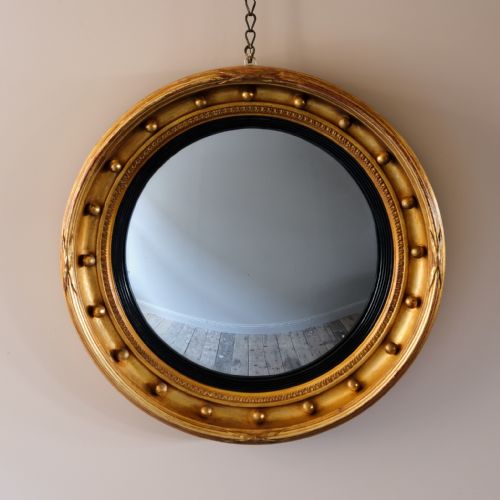


Regency Revival Mirror
A regency revival mirror brings neoclassical drama and bright gilding into a modern interior.
Regency Revival Mirror
When you search for a regency revival mirror, you are looking at decorative wall pieces that draw upon the classical taste of the early nineteenth century. These items include large overmantel mirrors, pier mirrors, and convex plates designed to reflect light and structure a room.
The versions you are most likely to meet on this page span from the nineteenth century into the twentieth century, including Edwardian and later interpretations of earlier designs. They frequently incorporate stylistic elements such as Egyptian revival motifs, giltwood frames, and classical proportions.
How they were made
Makers built these frames using woods such as mahogany, rosewood, ebonised wood, and walnut, often applying gesso to create crisp moulded ornamentation before gilding. Gold leaf and water gilding provided the bright reflective surfaces characteristic of the best examples.
Brass details and classical columns added architectural weight to pier and overmantel forms, while specialised glass plates provided the deep, distorted reflection seen in convex mirrors.
Regency Revival Mirror Retail Price Guide 2026
Typical asking prices for regency revival mirror among the pieces listed under this phrase on Sellingantiques today, from the lower quarter to the upper quarter. They describe what is for sale here now, not the wider market.
Listings feature periods from the eighteenth century to the twentieth century, with materials including giltwood, gesso, brass, and rosewood.
What varies in quality
Quality in these pieces depends upon the crispness of the carved or moulded gesso decoration and the depth of the gilding. Hand-water-gilded surfaces display a richer warmth and smoother adherence than later painted or foil-applied alternatives.
The integrity of the frame construction and the originality of the mirror glass itself dictate the overall standing of the piece. Crisp architectural detailing, such as well-defined columns and intact classical ornaments, separates superior examples from simpler reproductions.
Sir Willian Trotter·Town and Emanuel
The Regency Revival Mirror Glossary
- Giltwood
- Wood that has been coated with gold leaf. This finish gives the frame its characteristic bright metallic lustre.
- Gesso
- A plaster-like mixture applied to wood frames and carved or moulded into relief details. It provides a smooth base for subsequent gilding.
- Convex mirror
- A round mirror with a bulging glass plate that creates a wide-angle reflection of the entire room. These were popular in both the Regency period and later revivals.
- Overmantel mirror
- A large horizontal mirror designed to hang directly above a fireplace mantelpiece. They often feature multi-plate designs or tripartite glass sections.
- Pier mirror
- A tall, narrow mirror designed to hang on the wall space between two windows. They frequently match console tables placed below them.
Regency Revival Mirror: Frequently Asked Questions
Where should I hang a regency revival mirror?
These mirrors work best anchored above a fireplace mantel or mounted on a principal wall where they can capture and reflect natural light.
Their large scale and reflective glass help to open up smaller spaces while adding architectural presence to the room.
How do I tell an original regency piece from a revival?
Look closely at the construction methods, backboards, and the composition of the gesso and glass plates.
Revival pieces often date from the late nineteenth or early twentieth century, showing different secondary woods and fastener types compared to early nineteenth-century originals.
What is an Egyptian revival mirror?
This style incorporates specific decorative motifs inspired by ancient Egypt, such as sphinxes, winged sun discs, and classical columns.
Popularized during the Regency era and revived later, these pieces bring a distinct archaeological flavour to classical interior design.
How do I clean an antique giltwood frame?
Dust the surface very gently with a soft, dry brush to remove loose particles without disturbing the delicate gold leaf.
Avoid using any water, liquid cleaners, or chemical solvents, as these can permanently damage the water gilding and gesso beneath.