
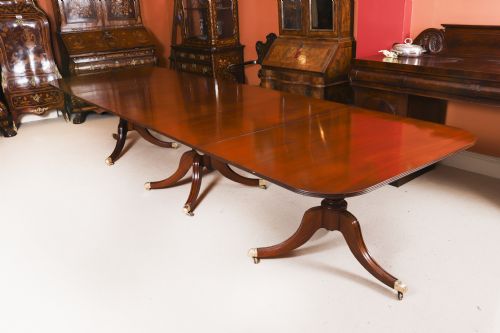


Regency Revival Dining Table
A regency revival dining table brings neoclassical elegance and substantial seating to large dining rooms through finely figured mahogany and pedestal designs.
Regency Revival Dining Table
When you search for a regency revival dining table, you encounter large extending dining tables and circular centre tables built in imitation of early nineteenth-century furniture. These pieces date from the late nineteenth century into the early twentieth century, spanning periods around eighteen eighty, nineteen hundred, nineteen ten, and nineteen twenty.
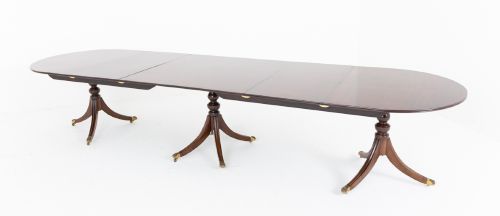
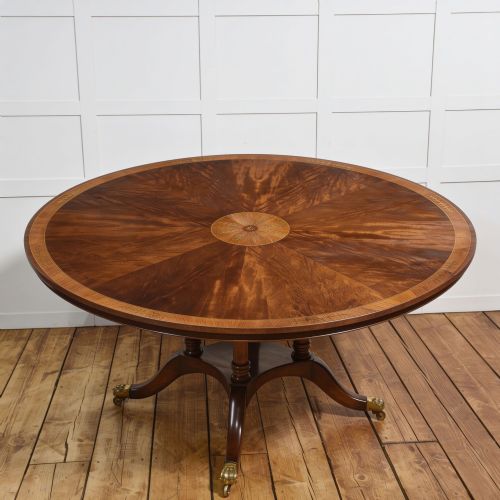
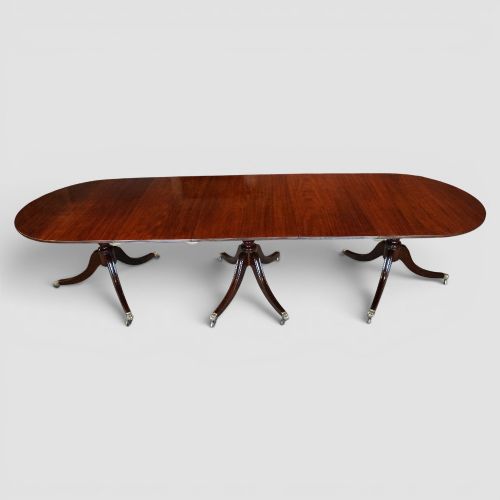
The dominant form on this page is the multi-pedestal dining table, often featuring two or three pillars to support long stretches of timber. Buyers also find circular dining tables and centre tables suitable for formal reception spaces.
Makers of these tables drew on stylistic cues from the Regency era, producing pieces that accommodate modern dining requirements while maintaining classic proportions. Mahogany forms the primary material, alongside complementary timbers such as satinwood and rosewood.
Materials and construction
Cabinet makers built these tables predominantly using solid and veneered mahogany, often selecting flame mahogany or figured grain to create visual depth on the top surfaces. Workshops also employed secondary timbers like oak, alongside decorative accents in satinwood and rosewood.
Makers integrated cast brass elements, including brass inlays, paw feet, and castor mounts on the pedestal bases. Multiple pedestals allowed craftsmen to support extended lengths of timber while providing stability for large dining configurations.
Regency Revival Dining Table Retail Price Guide 2026
Typical asking prices for regency revival dining table among the pieces listed under this phrase on Sellingantiques today, from the lower quarter to the upper quarter. They describe what is for sale here now, not the wider market.
Listings feature mahogany, satinwood, rosewood, and brass materials across pieces dated between eighteen eighty and nineteen twenty.
What separates different examples
The quality of a regency revival dining table rests upon the choice of timber and the precision of the cabinet work. Tables utilising highly figured flame mahogany or intricate brass inlay demonstrate greater workshop investment than plain mahogany variants.
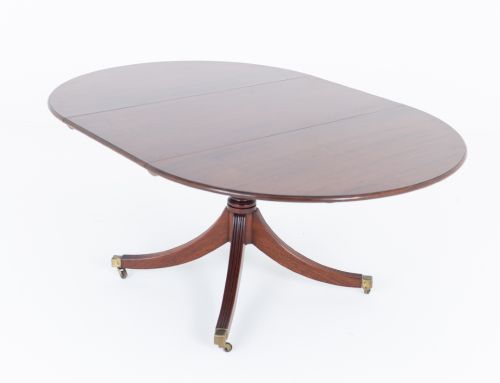
The structural complexity of the base also distinguishes pieces, with triple pedestal formats and solid timber construction representing higher ambition than simpler twin pedestal designs.
Whytock & Reid
The Regency Revival Dining Table Glossary
- Flame mahogany
- A veneer cut from the fork of the mahogany tree, producing a distinctive fire-like pattern across the tabletop. This timber choice denotes high-status cabinet work.
- Pedestal
- A central column support resting on splayed legs, commonly used in multiple numbers to hold up long dining tables. This construction allows greater legroom for diners.
- Centre table
- A freestanding table designed to stand away from walls in the middle of a room, utilised for display or occasional dining. These often feature circular tops.
- Brass inlay
- Fine strips of brass embedded into the timber surface to create geometric or neoclassical motifs. This technique emulates luxury Regency period decoration.
Regency Revival Dining Table: Frequently Asked Questions
How many people can these seat?
These tables accommodate large dinner parties, with multi-pedestal formats frequently extending to seat between ten and twenty-four guests comfortably.
The inclusion of multiple pillars and drop-in leaves allows the overall length to adjust according to the number of diners present.
How do I date these tables?
Dating relies on construction details, timber characteristics, and known periods of revival production spanning from the late nineteenth century through nineteen twenty.
Makers working in this style reproduced Regency proportions using turn-of-the-century workshop practices and machinery.
Where should a centre table go?
A centre table stands as a freestanding focal point in the middle of a principal room or large hallway, rather than pushed against a wall.
These smaller circular tables provide an architectural anchor for large open spaces.