
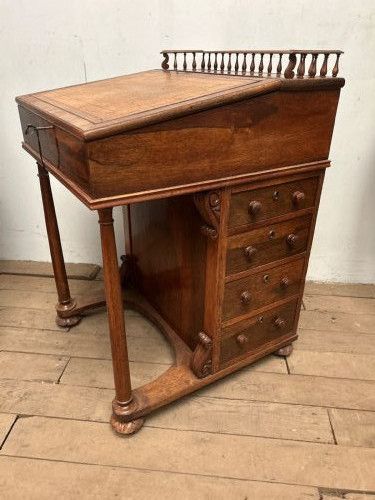


Regency Period Davenport Desk
A regency period davenport desk offers compact writing storage with concealed drawers, bringing Georgian elegance into smaller rooms.
Regency Period Davenport Desk
A regency period davenport desk combines a sloping writing surface with a set of side drawers, designed as a compact writing station for the home. Most pieces seen here date from the Regency and late Georgian eras, spanning the early to mid-nineteenth century.
The form typically appears in rosewood, mahogany, and burr walnut, often featuring four drawers and sliding top mechanisms. Buyers encounter these versatile writing tables built in diminutive proportions suitable for intimate studies or drawing rooms.
How they were made
Cabinetmakers utilised rich timber veneers such as rosewood, satinwood, and coromandel over robust underlying carcases. Brass mounts and leather writing inserts provided functional contrast and durable working surfaces.
Fine joinery governs the construction of the sliding tops and banks of side drawers. Timber selection relied heavily on figured grains like burr walnut and burr elm to catch the light.
Some desks hide secret compartments beneath their sliding tops for confidential letters and ink.
What varies in quality
Quality separates ordinary utility pieces from works carrying maker attribution, such as pieces by Gillows. The choice of primary timber sets the tone, with richly figured rosewood and coromandel standing above standard mahogany.
Refinement of proportion and mechanical complexity define the upper tier. Desks featuring sliding top mechanisms and diminutive dimensions show greater ambition in original design.
Gillows·Gillow
The Regency Period Davenport Desk Glossary
- Davenport
- A small pedestal desk featuring a sloping, hinged writing surface and drawers accessed from the side. The form became popular in the early nineteenth century for ladies' correspondence.
- Sliding top
- A writing surface that moves forward on tracks to allow a more comfortable seating position. This mechanism hides small compartments beneath.
- Rosewood
- A dense, heavily figured timber with dark brown and purple streaks utilised extensively in Regency cabinetmaking. It takes a high polish and forms the primary material for many desks on this page.
- Coromandel
- An exotic, heavily variegated Asian hardwood prized for its striking dark grain patterns. Cabinetmakers reserved it for high-status surfaces.
- Pedestal
- The supporting box base containing drawers, which elevates the writing slope on one side of the desk.
Regency Period Davenport Desk: Frequently Asked Questions
What is a Davenport desk?
A Davenport desk is a compact writing cabinet featuring a sloping top above a bank of side drawers. It provides a dedicated writing space while occupying minimal floor area.
originating in the Regency period, these pieces served as writing tables for correspondence in drawing rooms and parlours.
How do I use one today?
These desks function well as laptop stations or writing tables in modern living rooms and bedrooms. Their compact dimensions allow them to fit into corners where standard tables cannot go.
The internal compartments and side drawers offer practical storage for stationery and small items.
What woods were used?
Cabinetmakers utilised dense timbers such as rosewood, mahogany, and coromandel for the main bodies. Decorative veneers like satinwood, burr walnut, and burr elm provided striking grain patterns.
Brass hardware frequently complemented these rich primary woods.
How do I spot a Regency piece?
Regency pieces display classic restraint, clean architectural lines, and premium exotic veneers without heavy Victorian carving. Look for hallmarks of the early nineteenth century such as rosewood construction and brass detailing.
Proportions remain diminutive compared to later Victorian iterations.