

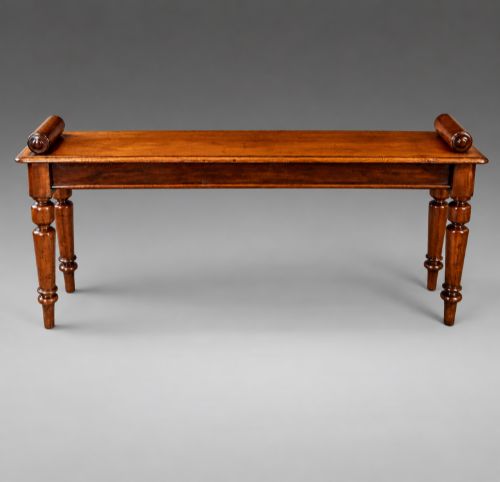
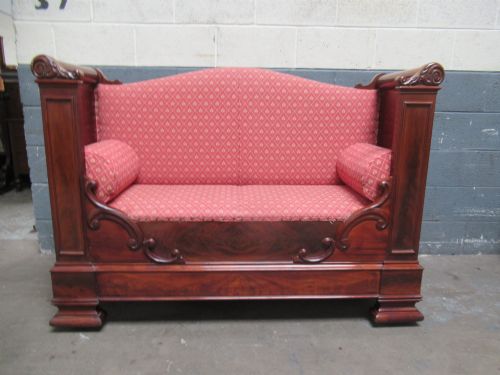
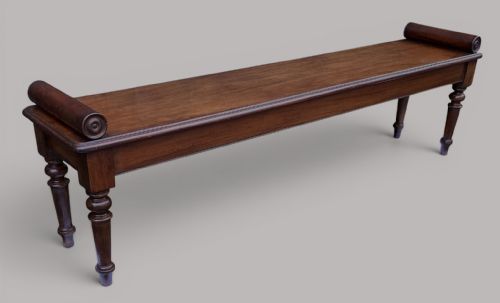


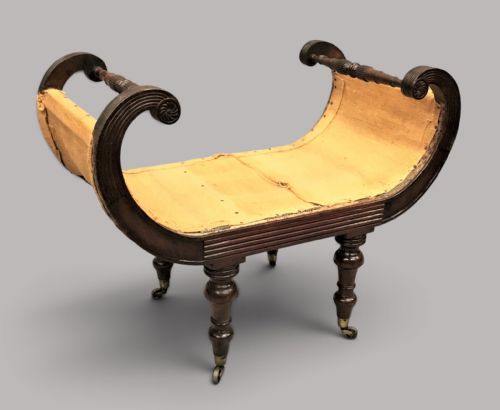


Regency Mahogany Hall Bench
A regency mahogany hall bench offers architectural presence and practical seating, combining rich timber with classical lines.
Regency Mahogany Hall Bench
A regency mahogany hall bench serves as a substantial seating piece, frequently encountered as long benches, window seats, or hall seats from the nineteenth century.
The selections span genuine Regency and George IV periods alongside later revivals from the Victorian era, showcasing forms with roll-end supports or X-frames.
These items originate primarily from English country houses and town residences, designed to sit neatly within corridors, reception halls, or beneath tall windows.
Materials and construction methods
Cabinet makers utilised solid mahogany and flame mahogany veneer over secondary timbers to achieve deep, lustrous surfaces on frames and legs.
Upholstery details incorporate materials such as leather, damask, fabric, and cane work, often paired with turned or fluted wooden legs.
Structural embellishments frequently include carved woodwork and brass components, securing joints and defining the classical proportions of the seat.
Regency Mahogany Hall Bench Retail Price Guide 2026
Typical asking prices for regency mahogany hall bench among the pieces listed under this phrase on Sellingantiques today, from the lower quarter to the upper quarter. They describe what is for sale here now, not the wider market.
The listings span the nineteenth century, including Georgian and Regency periods alongside Victorian revivals.
Factors of craftsmanship and distinction
The refinement of the carved details and the selection of figured flame mahogany veneer separate standard pieces from exceptional examples.
Proportions dictate visual success, with superior pieces maintaining balanced dimensions across extra-long formats or complex frame configurations.
The integrity of the original timber frame and the sophistication of joinery mark the difference between workshop production and simpler output.
Gillows·Marsh and Tatham
The Regency Mahogany Hall Bench Glossary
- Regency
- A stylistic period spanning the early nineteenth century defined by classical restraint and archaeological influence. It draws heavily on Greek, Roman, and Egyptian design motifs.
- Flame mahogany
- A veneer cut from the fork of the mahogany tree where the grain pattern resembles flickering flames. This decorative surface treatment denotes higher status furniture.
- Roll-end support
- A scrolled or cylindrical wooden terminal elevating the ends of a bench or window seat. This feature echoes ancient klismos chair designs.
- X-frame
- A structural support formed by intersecting diagonal timbers resembling the letter X. It provides both rigid load-bearing strength and distinct architectural rhythm.
- Cabriole leg
- A furniture leg that curves outward at the knee and tapers inward at the ankle. It terminates in a pad, claw, or simple foot.
Regency Mahogany Hall Bench: Frequently Asked Questions
Where should I place a regency mahogany hall bench?
These long seats suit spacious entrance halls, wide corridors, or position directly beneath large bay windows.
Their narrow depth allows them to line a wall without obstructing foot traffic while providing substantial seating capacity.
How do I distinguish a genuine Regency piece from a revival?
Examination of the timber patination, secondary woods, and hand-cut joinery reveals the true age of the framework.
Revival pieces from later periods often display different tool marks, machine-sawn components, and denser structural weight.
Did these benches originally feature upholstery?
Many examples were built with drop-in seats or fixed squab cushions covered in leather, horsehair, or damask.
Some variants remained entirely exposed polished wood, functioning strictly as solid timber hall seats.
What is the difference between a hall bench and a window seat?
Hall benches generally provide rigid timber seating for passage areas, whereas window seats frequently incorporate upholstered surfaces.
In practice, makers and historic inventories often used the terms interchangeably due to overlapping forms.