
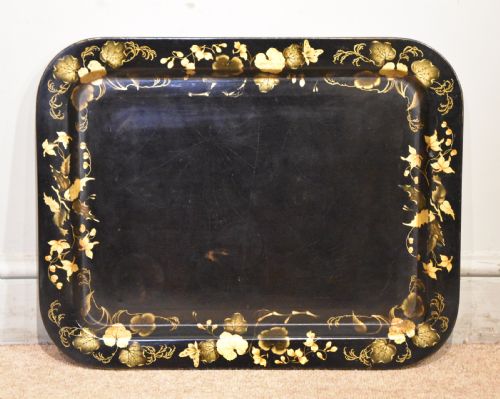
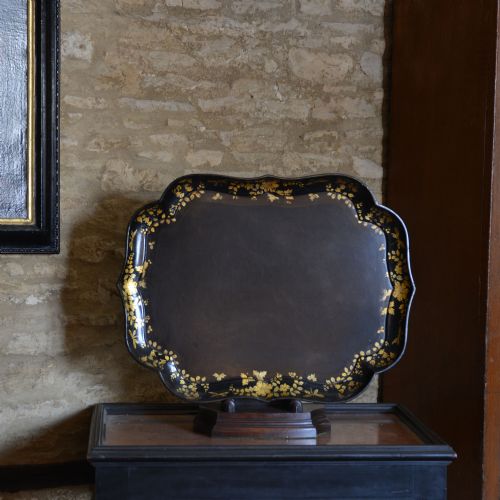
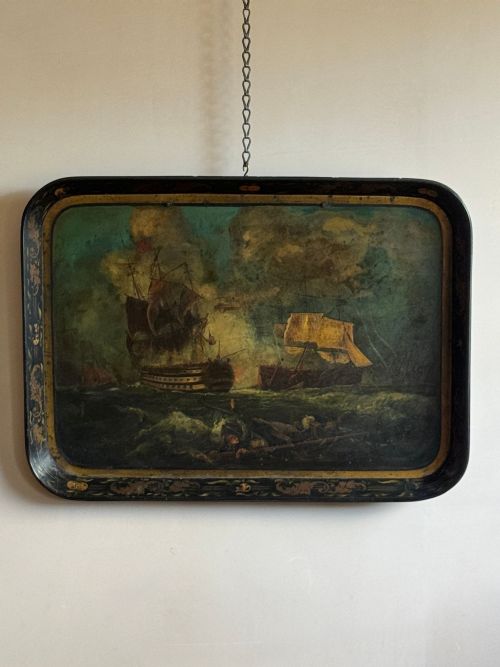


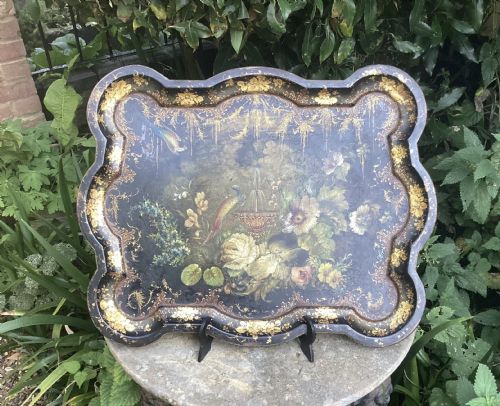


Regency Japanned Tea Tray
A regency japanned tea tray brings brilliant lacquerwork and gilt surface detail into a room, offering both decorative depth and a solid serving surface.
Regency Japanned Tea Tray
A regency japanned tea tray is a firm surface originally designed for serving tea or displaying vessels, drawing on historic Asian lacquer traditions adapted by British makers. These pieces span the Regency, Georgian, and wider nineteenth-century periods, capturing an era of bold entertaining and rich interior ornamentation.
The objects on this page appear as traditional serving trays or as occasional tray tables mounted on stands. Common forms include large oval shapes and deep toleware formats, constructed from lightweight papier-mâché or sheet metal.
Makers such as Jennens and Bettridge and Clay dominate the higher end of these works, whilst unassigned pieces maintain the same material language. Buyers meet both standalone trays and examples converted later onto wooden stands for use as side tables.
How they were made
Makers utilised layered papier-mâché or sheet metal to form the rigid base of a regency japanned tea tray. These substrates received successive coats of dark lacquer to build a smooth, durable foundation.
Surface decoration relied on oil paint, gold leaf, and gilt paint applied by hand. Artisans built up Chinoiserie scenes and decorative borders through careful brushwork and metal leaf application over the dark background.
Some trays have survived centuries of tea service simply because they looked too grand to risk dropping down the stairs.
What varies in quality
The success of a regency japanned tea tray rests on the crispness of the hand-painted details and the stability of the underlying lacquer. Superior examples display intricate gilt embellishment and deep, lustrous surfaces that retain their original tonal contrast.
Proportion and scale also separate standard items from exceptional ones. Trays of large proportions with well-preserved maker signatures or distinct structural integrity command stronger visual presence in a room.
Jennens & Bettridge·Clay
The Regency Japanned Tea Tray Glossary
- Japanned
- European imitation of East Asian lacquerwork, created by applying dark varnishes and painted designs to wood, metal, or papier-mâché. This technique allowed Georgian and Regency craftsmen to replicate imported oriental wares.
- Papier-mâché
- A composite material made from paper pulp or layers of paper bound with glue, resin, and sometimes clay. Pressed and dried, it provided a lightweight yet remarkably strong base for heavy lacquer and gilt decoration.
- Toleware
- Enamelled or japanned metalware, typically fashioned from sheet iron or tinplate. Pontypool and other centres produced these durable domestic objects with painted finishes.
- Gilt
- Covered thinly with gold leaf or gold paint to give a lustrous metallic finish. This highlights raised borders and painted focal points on dark surfaces.
Regency Japanned Tea Tray: Frequently Asked Questions
How were these trays originally used?
These pieces served households by carrying heavy tea services from the kitchen to the parlour. Servants used the deep ledges and sturdy papier-mâché or metal bases to transport porcelain pots and cups safely.
Beyond functional service, hosts displayed them on stands or tables when not carrying tea, utilising the painted decoration as a decorative focal point in formal rooms.
Are these trays suitable for daily use?
Modern living subjects antique lacquer and paint to risks from moisture, heat, and sharp impacts. Placing hot liquids directly on aged varnish can soften the historic finish.
Many collectors prefer to mount them on dedicated stands or place them on low tables as display pieces. Gentle dusting preserves the delicate gold leaf and painted scenes without wearing down the surface.
How do I distinguish papier-mâché from metal toleware?
Papier-mâché offers a warmer touch and a slightly lighter weight relative to its size, built from dense layers of paper and binder. Toleware utilises sheet metal, presenting a cooler feel and a magnetic pull if iron forms the base.
Both materials received similar dark lacquer grounds, meaning visual inspection of the edges and underside usually reveals the true substrate.
What is the difference between a tray and a tray table?
A tray functions as a movable vessel, lifted by handles or carried across rooms for service. A tray table combines the original tray top with a supporting wooden frame or stand.
Many pieces survive mounted permanently or resting securely on custom bases, converting a portable serving dish into a stable occasional table.