


Regency Drop Dial
These regency drop dial clocks are architectural wall timepieces built to keep reliable time in prominent spaces.

Regency Drop Dial
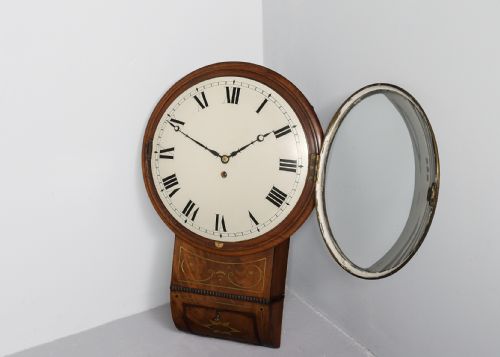
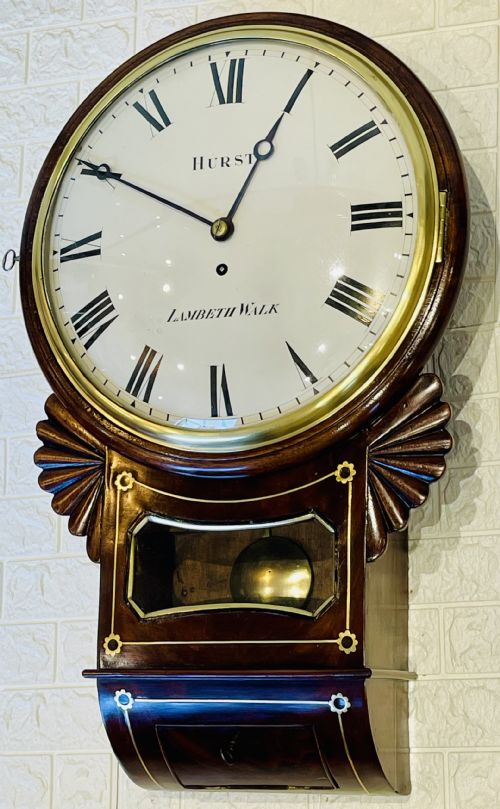
A regency drop dial is a wall-mounted timepiece featuring a circular dial above a shorter, hanging trunk or case designed to house the pendulum. Most examples found here date from the nineteenth century, spanning the Georgian, Regency, and Victorian periods.
These clocks typically display mahogany, rosewood, or flame mahogany veneer timber cases. Dials appear in painted wood or convex configurations, sometimes accented with brass inlay or brass stringing.
Origins stretch from London workshops to regional makers in Bristol, Bridgwater, and Leicester. Forms range from compact eight-day timepieces to twin-fusee bell-striking wall clocks.
How they were made
Cabinets rely on solid mahogany and rosewood bodies enriched with flame mahogany veneers and precise brass stringing or inlay. Timber cases are constructed with side access doors in the drop trunk to allow adjustment of the pendulum and movement.
Movements utilise fusee mechanisms designed to equalise the pull of the mainspring as it unwinds, ensuring consistent timekeeping across an eight-day duration. Dials are painted wooden surfaces or curved convex faces protected by hinged bezels.
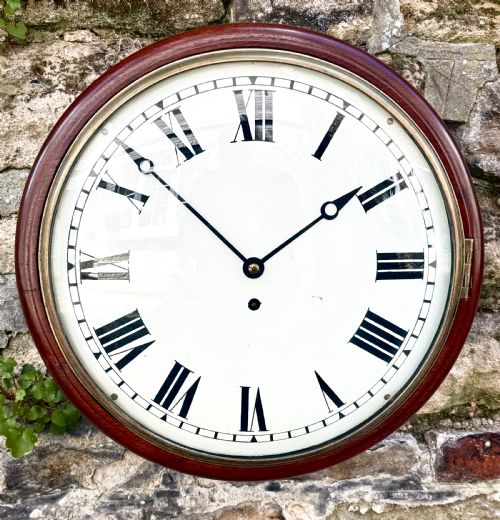
Some railway station clocks carry cryptic initials on the dial, whispering of busy nineteenth-century timetables and missed connections.
What varies in quality
Quality rests in the precision of the dial painting, the crispness of the cabinet joinery, and the provenance recorded on the dial face. Maker signatures from established London or provincial workshops elevate an example above anonymous regional work.
The refinement of the brass inlay, the choice of figured flame mahogany veneer, and the presence of complex twin-fusee or striking movements distinguish finer pieces from standard timepieces.
Kleyser of London·John Thwaites·Mark Bartley·J. Beckett of London·Halliday & Rich of Bridgwater·James Tupman·Thomas Lindey of Bristol·Viner of London·Edwin Fisher·George Younge of London
The Regency Drop Dial Glossary
- Drop dial
- A clock with a circular dial mounted to a shorter lower case that drops down to enclose the pendulum. This form was widely utilised in public buildings, offices, and large domestic hallways.
- Fusee
- A conical pulley connected to the mainspring by a cord or chain, designed to maintain even power as the spring unwinds. It represents a hallmark of better clockmaking.
- Convex dial
- A clock face that curves outward toward the viewer. This shape reduced glare from windows and gas lighting in period interiors.
- Tavern clock
- A large wall clock originally produced for public spaces and coaching inns. They feature prominent dials and extended wooden cases.
Regency Drop Dial: Frequently Asked Questions
Where were these clocks hung?
These wall clocks were primarily positioned in hallways, offices, and public spaces where reliable timekeeping was essential for daily schedules.
Their substantial timber cases and clear dials made them practical focal points in large rooms.
How do fusee movements work?
A fusee movement uses a conical drum and a cord or chain to regulate the force delivered from the mainspring. As the spring loses tension, the cord rides wider on the cone to maintain consistent power.
This mechanical arrangement helps the clock maintain accurate time over an eight-day run.
What timber cases are used?
Most examples utilise mahogany or rosewood, frequently enhanced with figured flame mahogany veneers. Brass stringing and inlay often accent the wooden borders.
These materials provided both structural stability and a dignified appearance suited to period interiors.
How do convex dials differ?
A convex dial curves outward toward the glass bezel rather than sitting flat. This curvature prevented reflections from room lighting or windows.
Clockmakers utilised this design feature to improve legibility from various angles across a room.