


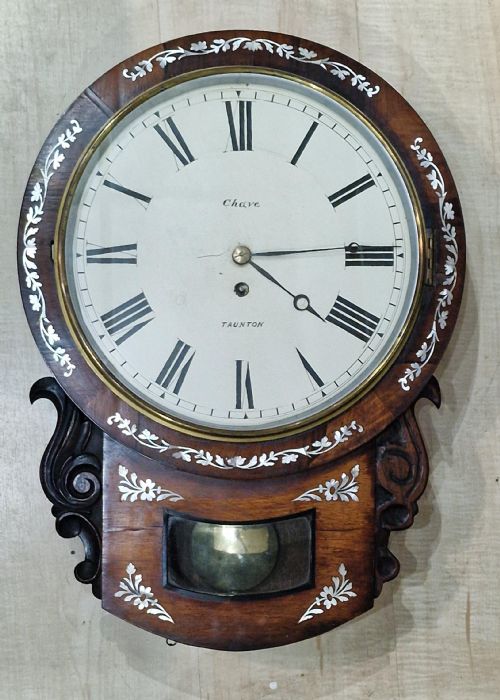


Brass Inlay Wall Clock
A brass inlay wall clock brings mechanical precision and rich timber into a room, uniting the utility of the dial with the warmth of metal and wood.
Brass Inlay Wall Clock
A brass inlay wall clock brings mechanical timekeeping into domestic and public spaces, appearing in forms ranging from octagonal dial clocks to French boulle examples. The pieces on this page span the Georgian, Regency, and Victorian periods, with nineteenth-century examples forming the core of the selection.
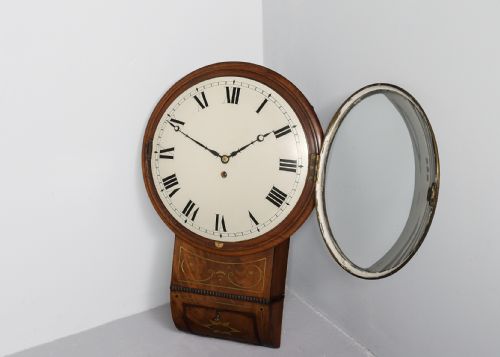
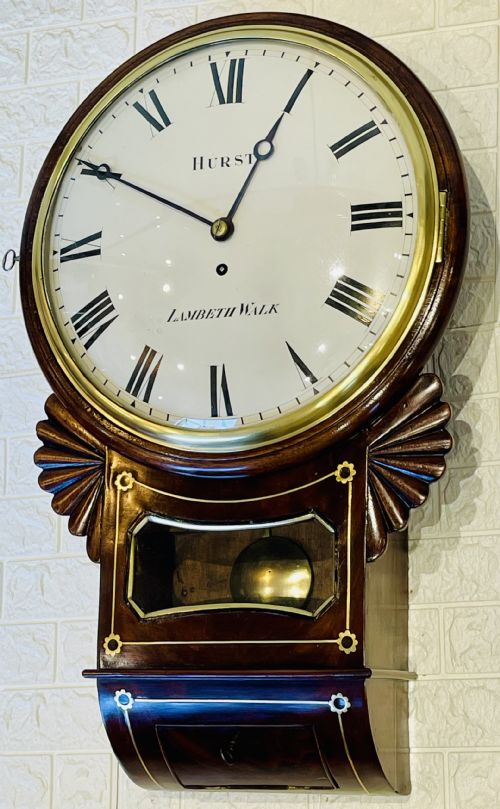
Buyers most frequently encounter fusee drop-dial wall clocks housed in mahogany or rosewood cases. These pieces combine practical timekeeping with decorative brass work, often featuring convex enamel dials designed for easy reading from below.
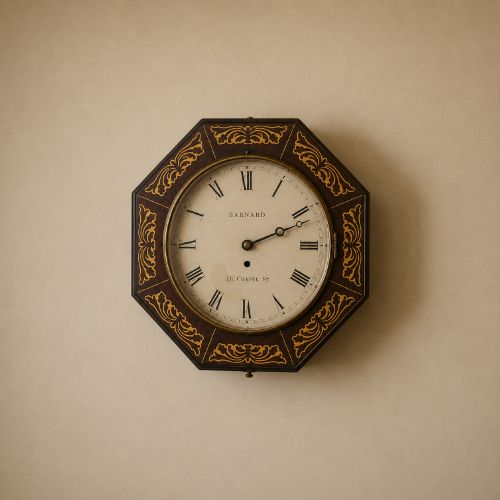
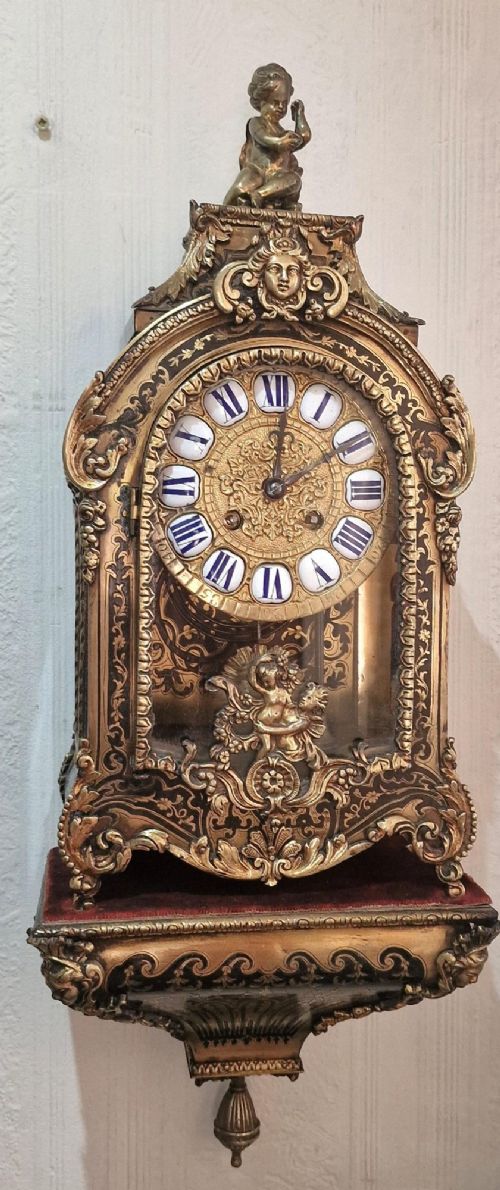
Originating from English provincial makers and London workshops alike, alongside French ateliers, these clocks reflect diverse regional styles. One encounters everything from crisp octagonal frames to elaborate marquetry wall brackets.
Materials and construction
Cabinetmakers constructed the main cases using dense timbers like mahogany and rosewood, frequently incorporating ebonised finishes. Brass inlay, mother-of-pearl, and metal wire were then set directly into the wood to create geometric or floral patterns.
Movements rely on fusee mechanisms to maintain even tension as the mainspring unwinds, ensuring accurate timekeeping across eight-day runs. Dials are typically formed of painted enamel protected by heavy glass within cast brass bezels.
Materials recorded on this page include mahogany, rosewood, tortoiseshell, mother of pearl, and ormolu.
Separating the ordinary from the exceptional
The precision of the brass inlay work dictates much of the visual merit, where tight, flush fitting against the timber separates master craftsmanship from simpler production. Movement quality also varies significantly, marked by the sophistication of twin-fusee bell-striking mechanisms versus basic timepieces.
Case timber selection and proportion define the upper tier of the range, particularly when figured mahogany or rich rosewood is paired with crisp dial surrounds and signed movements from established makers.
Barnard·Chave Taunton·Samuel Chave Taunton·Halliday & Rich, Bridgwater·HENRI MARC OF PARIS·Cording of London·Joseph Mansfield·Thomas Connold of Alysham·Ganthony of London·Kleyser of London·Haley & Milner·Mark Bartley Bristol·Sansom
The Brass Inlay Wall Clock Glossary
- Fusee
- A conical pulley used in clock movements to equalise the torque of the mainspring as it runs down. This mechanism ensures consistent force is delivered to the escapement for better accuracy.
- Drop dial
- A wall clock featuring a circular dial mounted above an extended trunk or box that houses the pendulum. The lower case often has a side or bottom access door.
- Boulle
- A form of marquetry using tortoiseshell and brass inlaid in contrasting patterns, named after the French cabinetmaker André-Charles Boulle. It appears on decorative French wall clocks and brackets.
- Bracket clock
- A portable spring-driven clock originally designed to sit on a wall bracket or table. Many examples from the Georgian and Regency periods feature striking trains.
Brass Inlay Wall Clock: Frequently Asked Questions
What is a fusee wall clock?
A fusee wall clock uses a conical drum linked to the mainspring by a chain or cord, delivering even power to the movement as the spring unwinds.
This system ensures the clock maintains steady timekeeping throughout its running period without losing accuracy as it winds down.
How do I wind a wall clock?
Most of these clocks require a key inserted into the dial face to tension the mainspring every eight days. Care must be taken not to overwind the movement.
Some twin-fusee models require separate winding for the timekeeping train and the striking train.
Where were these clocks placed?
Wall clocks were positioned in hallways, kitchens, and formal rooms where households needed reliable timekeeping visible from a distance. Drop-dial variants were particularly favoured in offices and public buildings.
Bracket clocks often occupied dedicated wooden wall brackets or prominent mantel spaces.
How do I identify a Regency clock?
Regency clocks typically feature clean classical proportions, often utilising mahogany cases with restrained brass inlay or brass bezel surrounds. Dial designs tend to be crisp and uncluttered.
Maker signatures on the dial or movement backplate often help confirm the period of production.