
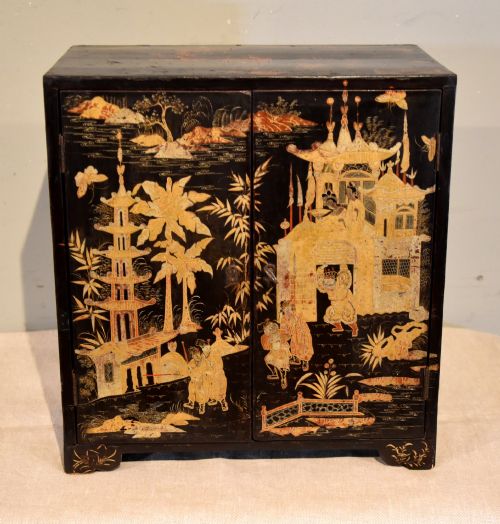
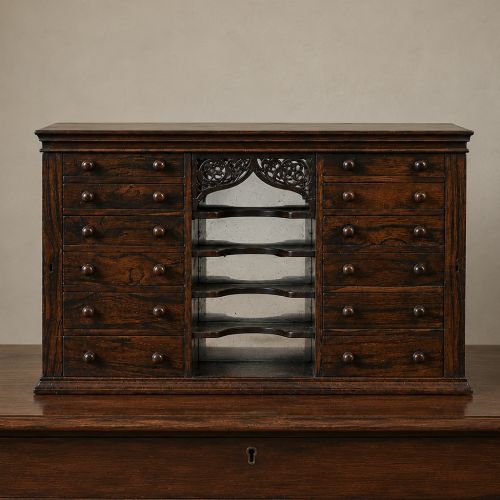


Regency Desktop Cabinet
A regency desktop cabinet brings compact elegance to a workspace, offering refined storage fashioned from figured timbers.
Regency Desktop Cabinet
A regency desktop cabinet is a small-scale piece designed to sit upon a table, desk, or chest to house valuables, documents, or collections. The pieces on this page span the Regency, Georgian, and William IV periods, alongside nineteenth-century examples and a dated piece from nineteen hundred.
The forms vary from miniature chests of drawers and collector cases to tabletop repositories, bachelor book cabinets, and cabinets on stands. Mahogany and rosewood dominate the material record, accompanied by satinwood, boxwood, iron, brass, and mirror glass.
Buyers encounter styles ranging through Regency Chinoiserie, Grand Regency, and William IV designs. These compact receptacles served gentlemen as cigar humidors, coin or specimen storage, and portable repositories for writing paraphernalia.
How they were made
Cabinetmakers utilised dense tropical hardwoods, chiefly mahogany and rosewood, constructing sturdy carcasses that often featured satinwood or boxwood decorative elements. Timber selection prioritised rich grain patterns suitable for small-scale display.
Decoration relied on applied metalwork and specialised surface detailing rather than bulky carving, incorporating gilt-brass mounts, tooled leather, and mother-of-pearl inlay. Mirrored glass also appeared in specific Wellington chest variants, adding depth to the compact forms.
Listings feature mahogany, rosewood, and satinwood alongside brass mounts and mirror glass.
What varies in quality
Quality rests upon the crispness of the cabinetmaking and the selection of figured veneers. Finer examples display meticulous matching of rosewood or mahogany grains across drawer fronts and carcass sides.
Secondary enrichment elevates certain pieces above standard storage forms, distinguishing plain utility items from luxurious gentlemens cabinets through the finesse of brass mounts, inlay work, and leather tooling.
The Regency Desktop Cabinet Glossary
- Regency
- A British design period spanning the early nineteenth century, characterised by classical restraint and rich cabinet timbers. It draws inspiration from ancient Roman, Greek, and Egyptian motifs.
- Wellington chest
- A tall, narrow chest of drawers secured by a locking hinged pilaster bar on one side. This form provides covert security for private papers or small valuables.
- Humidor
- A specialised moisture-controlled box or cabinet designed for storing cigars. In antique examples, these interiors are typically lined with fine woods.
- Chinoiserie
- A European artistic style reflecting Chinese aesthetic influences, popular in furniture decoration during the eighteenth and nineteenth centuries. It often employs lacquer and painted motifs.
- Satinwood
- A durable, lustrous timber native to India and Ceylon, prized for its golden yellow sheen and smooth grain. Cabinetmakers used it for stringing, banding, and veneering small surfaces.
Regency Desktop Cabinet: Frequently Asked Questions
What is a regency desktop cabinet used for?
These miniature pieces were originally built to organise letters, documents, coins, and personal accessories on top of a larger desk or table. Gentlemen also utilised them as portable repositories and cigar humidors.
Today, they serve equally well on modern surfaces to store precious trinkets, stationery, or small collections while adding period character to a room.
How do I identify a regency desktop cabinet?
Look for compact proportions designed specifically for tabletop placement, combined with signature timbers such as mahogany and rosewood. Decorative accents often include brass hardware, stringing, or mother-of-pearl inlay.
Stylistic markers range from restrained classical lines to Regency Chinoiserie ornament and William IV architectural details.
Are these cabinets portable?
Most of these pieces were engineered to be moved between rooms or transported as needed, though their dense hardwood construction makes them reassuringly heavy. Their small scale distinguishes them from full-sized floor standing furniture.
Handles or recessed brass side brackets occasionally appear on specific variants to assist with this movement.
What materials are typical for these cabinets?
The primary structure relies on dense hardwoods, with mahogany and rosewood appearing most frequently across the surviving examples. Satinwood and boxwood frequently provide contrasting inlay and detail work.
Additional materials include gilt-brass mounts, iron hardware, tooled leather surfaces, and mirror glass panels.