

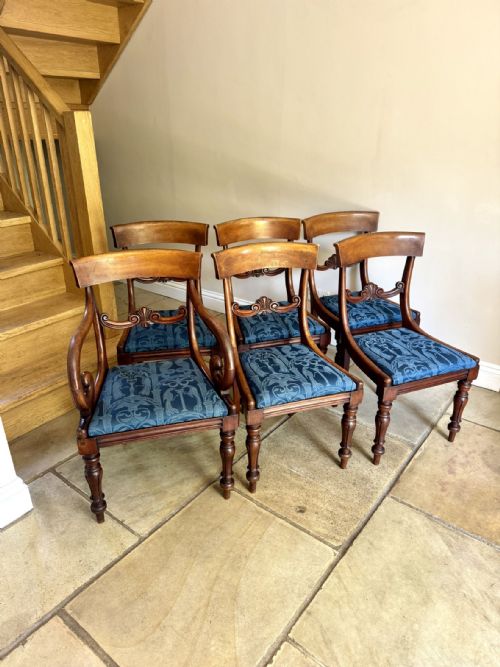


Regency Curved Back Chair
A regency curved back chair offers the clean lines and elegant proportions that define the early nineteenth century.
Regency Curved Back Chair
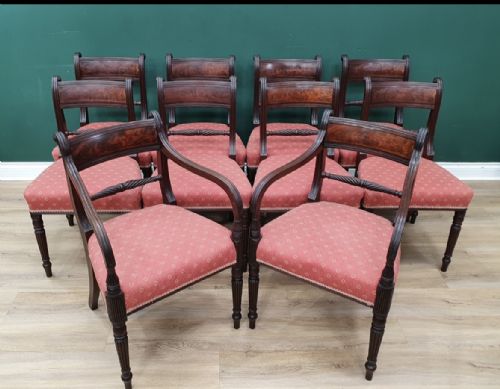
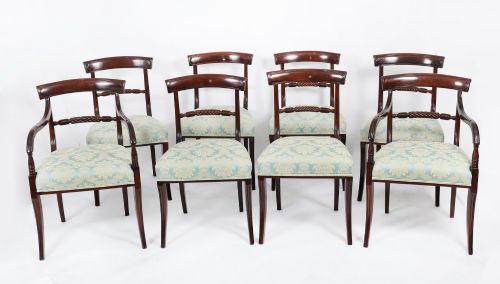
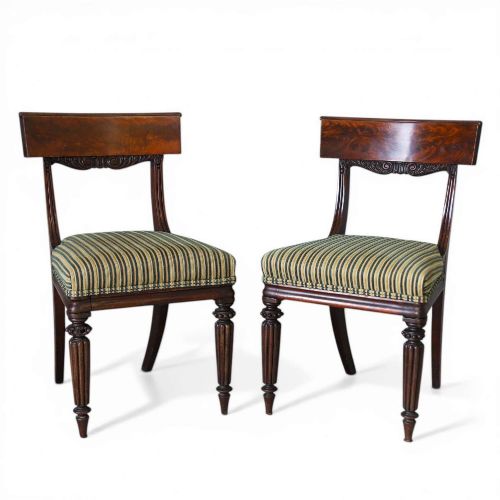
A regency curved back chair represents a distinct form of seating originating from the late Georgian and Regency periods, stretching into the William IV era. You will frequently encounter dining chairs, armchairs, and library chairs built with this characteristic curved profile.
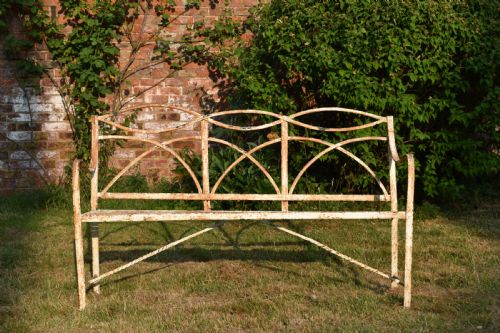
The selections available here span single side chairs, carvers, and larger dining sets alongside garden benches, desk chairs, and child armchairs. Materials range from traditional mahogany and flame mahogany to beech, rosewood, and wrought iron.
While forms vary from simple side seating to exhibition quality sets, the overarching style remains rooted in the early nineteenth century. Collectors value these pieces for their architectural silhouette and period integrity.
Materials and construction methods
Cabinetmakers of the period relied heavily on solid mahogany, flame mahogany, and rosewood, shaping the timber to form the characteristic curved backs and sabre legs. Brass inlay occasionally accents the primary wood structure to provide subtle contrast.
Seating portions utilise traditional upholstery fabric, leather, velvet, or caning supported by sturdy frames. Beech also appears in specific chair sets, while exterior garden pieces utilise wrought iron for durability.
Current listings feature materials including mahogany, flame mahogany, rosewood, beech, wrought iron, leather, velvet, and brass.
Distinctions in quality and execution
The grade of a piece often rests upon the selection of timber, such as highly figured flame mahogany versus plain grain. Finer examples display meticulous brass inlay and crisply carved details rather than simple turnings.
Structural integrity and the retention of original timber components dictate the standing of a chair within its period. Matched sets command attention for their uniformity across multiple dining or library seats.
The Regency Curved Back Chair Glossary
- Regency
- A stylistic period spanning the early nineteenth century defined by classical restraint and Grecian influence. It follows the Georgian era and precedes William IV.
- Sabre leg
- A curved furniture leg that tapers toward the foot, mimicking the shape of a cavalry sword. This form appears frequently on chairs from the period.
- Bergere
- An enclosed upholstered armchair with wooden framing exposed around the sides and back. Caning is often incorporated into the construction.
- Carver
- An armchair designed to match a set of single dining chairs, traditionally placed at the head of the table. These often feature pronounced arm rests.
- Strapwork
- Ornamental flat bands or interlaced patterns resembling leather straps. It is utilised on benches and seating frames for linear decoration.
Regency Curved Back Chair: Frequently Asked Questions
How do I identify a genuine period chair?
Look for traditional timber construction methods, period-appropriate secondary woods, and signs of age in the joinery and finish. The silhouette should align with early nineteenth-century design vocabulary.
Compare the proportions and decorative details, such as sabre legs or brass inlay, against established examples from the Regency and William IV eras.
Can I use these chairs for daily dining?
Many antique dining sets remain structurally robust enough for regular use, provided the frames and joints have been properly maintained. Professional assessment ensures stability before daily placement.
Upholstery can be updated to suit modern interiors while preserving the historic wooden frame underneath.
What is the difference between Regency and William IV styles?
Regency pieces typically exhibit leaner, classical lines influenced by Greek and Roman antiquities. The subsequent William IV period introduces heavier, more robust proportions and bolder carvings.
Both styles share overlapping motifs, but William IV furniture often feels substantially weightier in hand.
How should I care for mahogany and rosewood surfaces?
Maintain the timber by dusting with a soft cloth and avoiding direct sunlight or extreme temperature fluctuations that can dry out the wood. Natural wax polishes help nourish the grain over time.
Avoid commercial liquid cleaners containing silicone, which can penetrate and damage historic finishes.