


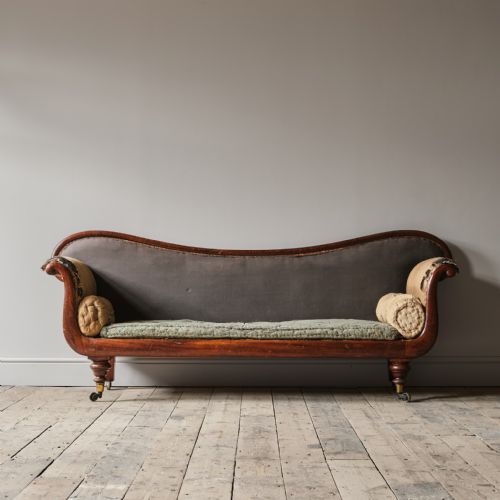


Regency Country House Sofa
A regency country house sofa is a substantial piece built for comfort and presence, bringing period character and generous proportions into a room.
Regency Country House Sofa
A regency country house sofa provides deep seating and sturdy support, embodying the domestic comfort demanded in large nineteenth-century residences. These pieces often arrive with broad wooden frames and long bodies designed to furnish principal reception rooms.
The versions most frequently met on this page span the nineteenth century, including the Regency and Early Victorian periods. They appear under styles such as Grand Regency, English Provincial, and English Country House, reflecting both formal urban design and relaxed rural tastes.
Makers and workshops of the era produced these settees to anchor large interiors, combining architectural timber frames with upholstered bodies. Their forms range from simple drop leaf tables and hall pieces to expansive seven-foot button-back settees.
How They Were Made
Makers constructed the structural frames of these sofas using dense hardwoods such as mahogany, rosewood, simulated rosewood, walnut, and fruitwood. Selected timber sections provided the necessary strength for long spans and heavy daily use.
Surface detailing incorporated brass mounts, giltwood, and carved woodwork to catch the light in large rooms. Upholstered sections relied on foundational materials like hessian and fabric to support the interior padding and final covering.
Listings feature nineteenth-century furniture built from mahogany, rosewood, walnut, and fruitwood.
What Varies in Quality
The refinement of the timber and the crispness of the carving dictate the distinction between standard examples and those of higher standing. Selected grain patterns in rosewood and mahogany demonstrate careful material selection by the cabinetmaker.
Proportion and scale govern the visual weight of the piece within an interior space. The balance between the timber frame and the upholstered body separates standard provincial work from pieces attributed to skilled workshops.
Gillows
The Regency Country House Sofa Glossary
- Regency
- The period from 1811 to 1820, or a broader design style spanning the early nineteenth century. It is defined by classical influences and refined proportions.
- Simulated rosewood
- A painted or grained surface finish applied to a secondary timber to imitate the appearance of costly rosewood. Artisans used this technique to achieve a high-status look at a lower cost.
- Fruitwood
- Timber sourced from fruit-bearing trees, commonly used in provincial cabinetmaking during the nineteenth century. It yields a warm tone and a tight grain.
- Ormolu
- Gilded bronze mounts applied to furniture for decorative effect. This technique adds metallic highlights to the timber frame.
- Button back
- An upholstery method where tufts are secured with buttons to create a patterned, padded surface. This technique provides both visual texture and structural tension.
Regency Country House Sofa: Frequently Asked Questions
Where did these sofas sit?
These large settees occupied principal reception rooms, libraries, and grand halls in nineteenth-century residences. Their generous scale suited expansive spaces designed for gathering.
In country houses, they provided ample seating for family members and guests during long afternoons. Their substantial timber frames held up against heavy domestic traffic.
How do I clean the wood?
Maintain timber surfaces by applying a traditional beeswax polish with a soft cotton cloth. Regular buffing removes dust and preserves the natural lustre of mahogany and rosewood.
Avoid using modern liquid cleaners or silicone sprays, which can penetrate open grain and soften historic finishes over time.
Can I reupholster the sofa?
Upholstery can be replaced to suit modern interiors while respecting the underlying nineteenth-century frame construction. Traditional materials like hessian and horsehair are often reused or replenished during restoration.
Consult a restorer experienced with period upholstery methods to ensure the springs and webbing maintain the correct profile and support.
How do I date a sofa?
Examine the timber species, joinery methods, and carved details to determine the likely period of manufacture. Pieces from the Regency era often feature classical motifs and rich mahogany or rosewood veneers.
Compare the proportions and structural build against documented examples from the same decade. Regional variations in English provincial pieces can also indicate a mid-nineteenth-century date.