
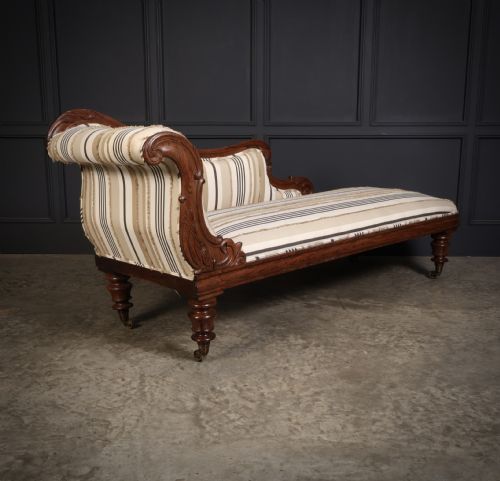

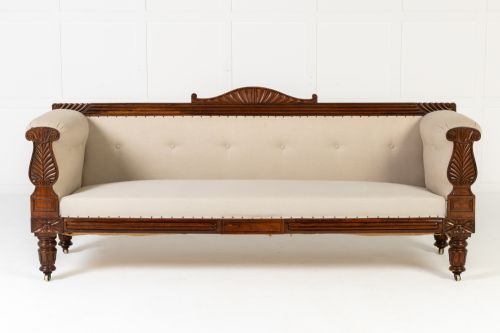


Dark Wood Scroll Sofa
These dark wood scroll sofas bring architectural gravity and sweeping timber lines to a room, drawing the eye with their characteristic rolled arms and rich grain.
Dark Wood Scroll Sofa
A dark wood scroll sofa sits at the intersection of classical revival and nineteenth-century cabinet-making, offering generous proportions and sculptural timber framing. When you search for a dark wood scroll sofa, you encounter examples spanning the Regency, William IV, and Victorian eras, alongside distinct Anglo-Indian and traditional Chinese forms. These pieces serve as both functional seating and commanding focal points within a traditional interior.
The selections here lean heavily toward nineteenth-century origins, featuring substantial rosewood and mahogany structures. You will find country house sofas designed for deep comfort alongside more formal chaise longues with cane seating or space for fresh upholstery. The stylistic vocabulary ranges from strict Regency restraint through to the heavier carving of the William IV period and the intricate detail of Anglo-Indian workshops.
Beyond standard sofas, the broader grouping includes related seating and console tables that share the same dark timber palette and scroll details. This variety allows a buyer to coordinate seating with occasional furniture drawn from the same design vocabulary. Each piece demonstrates the enduring appeal of dark hardwoods shaped into sweeping, scroll-ended silhouettes.
Materials and Construction
Makers of the period relied on dense, dark timbers such as rosewood, simulated rosewood, and mahogany to provide both structural integrity and a rich surface texture. Solid Rio rosewood and Brazilian mahogany were prized for their tight grain and deep natural colour, which took a high polish. Where solid timber was not used throughout, skilled cabinet-makers applied veneers over secondary woods with meticulous precision.
Structural elements like scroll arms and frames were frequently hand-carved, utilising the natural strength of hardwood to achieve sweeping, curvilinear forms without compromising support. Metal components, particularly brass, appeared as castors or subtle mounts that aided mobility and added restrained contrast. Secondary materials such as hessian, cane, and foundational upholstery webs provided the internal support for springing and padding.
George Smith inspired at least one table here, proving that even occasional furniture likes to drop famous names at dinner parties.
Judging Quality and Execution
The distinction between ordinary and exceptional examples rests in the crispness of the timber carving and the architectural confidence of the frame. Superior pieces display fluid, deeply undercut scrolls that feel integrated into the overall structural rhythm rather than applied as an afterthought. Timber selection also dictates grade, with beautifully figured grain patterns elevating the presence of a sofa significantly.
Construction methods reveal the hand of the master craftsman through tight joinery, substantial timber scantlings, and well-balanced proportions. Lesser examples may exhibit rigid lines, timid carving, or secondary timbers that lack the resonance and depth of prime rosewood or mahogany. The integrity of the underlying frame remains paramount, ensuring that the piece retains its strength alongside its decorative appeal.
The Dark Wood Scroll Sofa Glossary
- Rosewood
- A dense, heavily grained hardwood prized for its dark purple-brown colour and fine polish, commonly utilised in high-status nineteenth-century furniture. It forms the primary material for many of the finest sofas and tables on display.
- Chaise Longue
- An upholstered long chair designed for reclining, featuring a headrest and a partial backrest. These pieces combine the seating capacity of a sofa with the relaxed posture of a daybed.
- Simulated Rosewood
- A surface treatment where cabinet-makers painted or stained cheaper secondary timbers to mimic the dramatic grain of true rosewood. This technique provided the aesthetic of luxury at a more accessible cost.
- Altar Table
- A traditional Chinese form characterised by high placement and elongated proportions, often featuring shaped ends or carved friezes. These tables bring a distinct architectural presence that complements Western seating.
- Scroll Arm
- A structural arm rolled outward in a spiral or volute form, typical of Regency and Victorian seating design. This feature softens the linear geometry of the frame.
Dark Wood Scroll Sofa: Frequently Asked Questions
What defines a Regency sofa?
A Regency sofa draws heavily on classical Greek and Roman archetypes, favouring clean architectural lines, bold rosewood or mahogany veneers, and restrained brass mounts. These pieces often incorporate curved legs and scroll ends that reflect the neoclassical taste of the early nineteenth century.
They sit comfortably in both formal drawing rooms and curated modern spaces, offering a blend of strict geometry and rich timber grain.
How do I care for rosewood furniture?
Rosewood requires stable humidity levels and protection from direct sunlight to prevent the timber from drying out or fading over time. Regular dusting with a soft, dry cloth maintains the polish without building up chemical residues.
Conditioning oils should be used sparingly and only when the wood appears dry, preserving the natural depth of the grain.
Are these sofas comfortable for daily use?
While historic sofas were built with different ergonomic assumptions than modern lounge seating, many provide deep and supportive seating platforms. Examples intended for upholstery can be adjusted with modern interior webbing and cushioning to suit contemporary lounging habits.
Their substantial length also makes them effective daybeds for reading or resting.