



Regency Brass Fireplace Curb
Regency brass fireplace curb pieces bring distinct neoclassical weight to a hearth, offering a polished metal barrier designed to catch stray embers.
Regency Brass Fireplace Curb
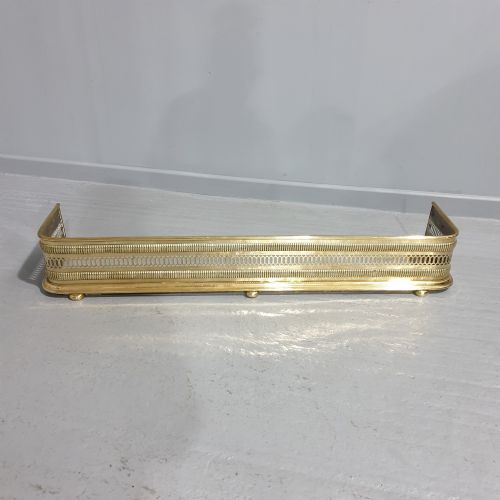
When you search for a regency brass fireplace curb, you encounter hearth furniture spanning the nineteenth century, including the Regency, William IV, and Victorian periods. These objects take the form of fire fenders, kerb fenders, and guards designed to enclose the hearth area.
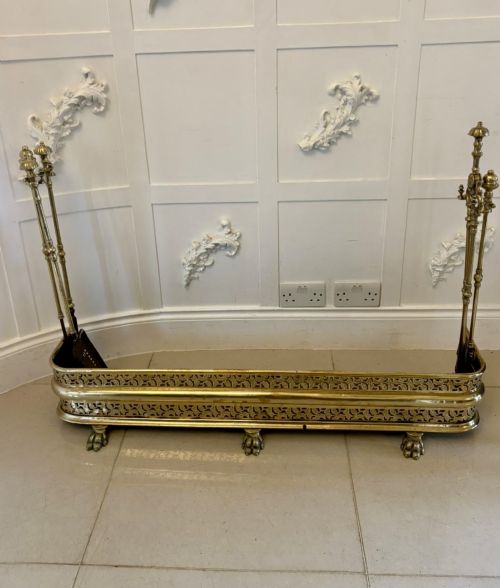
The pieces listed on this page appear predominantly from the nineteenth century alongside Georgian and Victorian eras, presenting curved or straight metallic barriers. Makers employ forms incorporating lions, garlands, and fire irons to complete the hearth arrangement.
Originating within classic neoclassical and grand Regency styles, these items combine functional protection with decorative metalwork. Buyers most frequently meet polished brass and steel constructions that define the visual centre of the fireplace.
Assessing quality and craftsmanship
Quality reveals itself in the weight of the metal and the crispness of the cast details, separating heavier, finely detailed pieces from simpler utilitarian guards. The integration of sculptural elements like lions or elaborate brass garlands demonstrates superior foundry work.
The choice of materials dictates the baseline of execution, with combinations of polished steel and cast brass showing greater ambition than plain iron alone. Original components, such as accompanying fire irons, elevate the integrity of the ensemble.
Some heavy fenders arrive accompanied by their original fire irons, ensuring the hearth keeps its matching tools intact after two centuries.
The Regency Brass Fireplace Curb Glossary
- Curb fender
- A low metal barrier placed around the hearth to contain ash and rolling embers. It sits directly on the floor before the fireplace opening.
- Neoclassical
- A style drawing inspiration from the classical art and architecture of ancient Greece and Rome. It dominates the decorative vocabulary of this period.
- Gilt bronze
- Bronze treated with a gold or gold-coloured finish to provide a rich metallic lustre. It offers high durability combined with a decorative surface.
- Cast brass
- Brass poured into a mould to create solid, three-dimensional decorative elements. This technique allows for complex ornamentation like garlands.
Regency Brass Fireplace Curb: Frequently Asked Questions
What is a regency brass fireplace curb?
A regency brass fireplace curb is a metal hearth barrier designed to keep burning logs and embers safely contained within the fireplace. These pieces date primarily from the nineteenth century and reflect classical styles.
They serve as both a safety feature and a decorative frame for the fireplace opening. Most examples utilise brass, steel, or iron construction.
How do I style a brass fender?
Place the fender directly on the hearth floor around the perimeter of the fireplace opening. It pairs well with traditional masonry or tiled hearths.
Complement the metalwork by pairing the curb with matching brass or steel fire irons. Keep the polished surfaces clean to maintain their reflective quality.
What materials are used?
These pieces incorporate brass, cast brass, bronze, and gilt bronze combined with iron or polished steel. The mix of metals creates contrast between the bright brass body and darker iron supports.
Heavier pieces frequently utilise solid cast elements for durability. Steel components appear alongside brass to provide structural strength.
How do I date a fireplace curb?
Dating relies on stylistic clues such as neoclassical motifs, curved profiles, and manufacturing techniques like sand casting. Pieces span the Georgian, Regency, William IV, and Victorian periods.
Evidence of hand finishing and the specific combination of metals help narrow down the era of production. Maker attributions, when present, also point to specific design circles.