
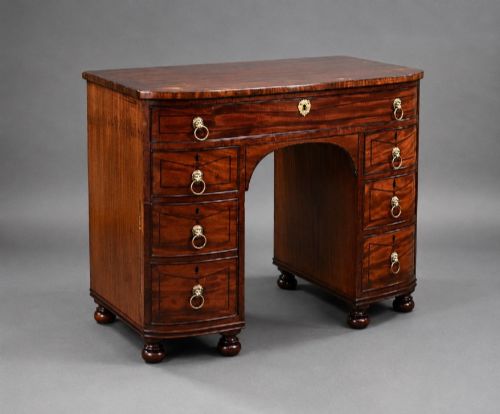


Regency Bow Front Table
A regency bow front table brings together the curving line and dense timbers of the early nineteenth century in a remarkably practical form.
Regency Bow Front Table
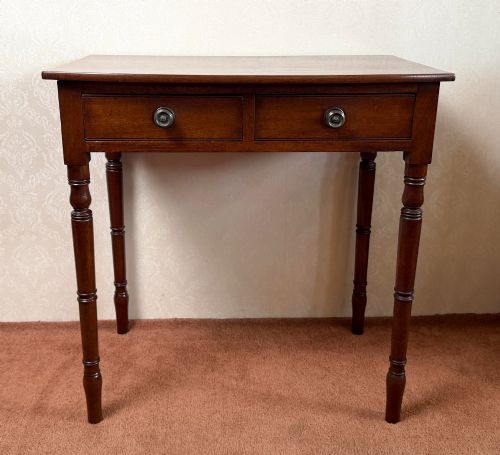
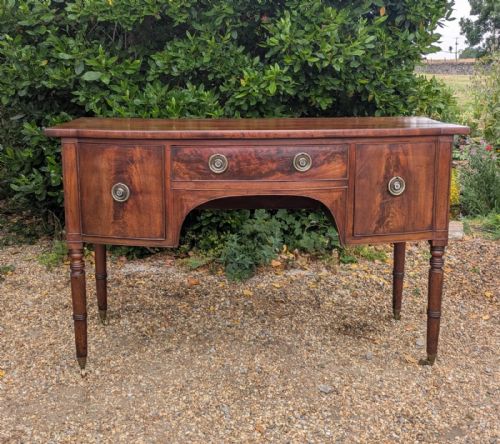
A regency bow front table typically appears as a side table, dressing table, or serving piece designed with a convex curved front that softens the corners of a room. The search for a regency bow front table frequently leads to side tables and dressing tables dating from the Georgian and Regency periods, alongside later revival pieces.
Makers of the period utilised the curved profile to save floor space while maintaining internal drawer capacity. Examples range from compact single-drawer side tables to larger dressing chests and console tables originating across the nineteenth century.
Alongside genuine period pieces from the Regency and George III eras, buyers will encounter later nineteenth-century interpretations and early twentieth-century revival furniture sharing the same characteristic bowed outline.
Materials and construction
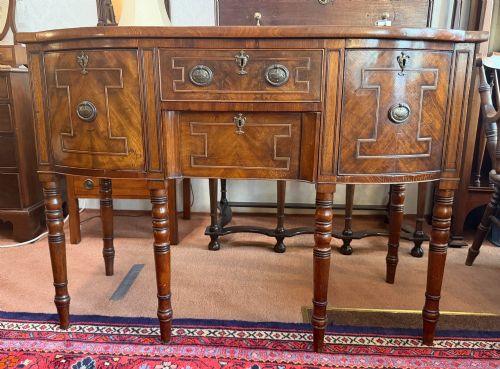
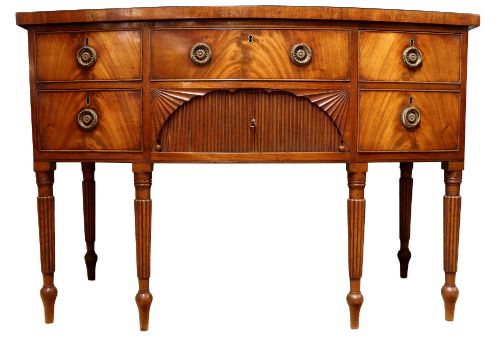
Cabinet makers relied primarily on solid mahogany and flame mahogany veneer, often accented with fine stringing lines in boxwood or ebony to frame the drawers and top edges. Secondary timbers such as oak frequently appear in the drawer linings and internal framing.
The curved front required specialised joinery to bend or shape the timber frames accurately without warping over time. Brass handles, escutcheons, and occasional glass components complete the construction of surviving examples.
Several corner washstands survive entirely intact, ready to hold water jugs for households that managed very well without indoor plumbing.
Assessing the workmanship
The distinction between standard utility pieces and finer examples rests on the choice of timber and the precision of the wood inlay. Flame mahogany veneer with strong natural figuring indicates a higher grade of material selection than plain stock.
Joinery detail reveals much about the origin, particularly in the hand-cut dovetailing of drawer boxes and the crispness of the edge banding. Superior pieces maintain alignment in the curved drawers and retain their original brass hardware.
George Oakley·S & H Jewell of London
The Regency Bow Front Table Glossary
- Bow front
- A convex curved front profile that projects outward from the frame. This shape was widely adopted on side tables and chests to create a softer silhouette.
- Flame mahogany
- A veneer cut from the fork of the mahogany tree where the branches meet the trunk. It creates a distinctive rippled, flame-like pattern across the surface.
- Stringing
- Thin strips of contrasting light or dark wood inlaid into grooves on the furniture surface. Boxwood and ebony were frequently used for this decorative outlining.
- Dovetail
- An interlocking joint used in drawer construction, formed by interlocking wedge-shaped fingers. Hand-cut dovetails are a hallmark of older cabinet making.
- Commode
- A low cabinet or chest of drawers designed for bedroom or dressing room use. Period versions often incorporate enclosed cupboard space or washing facilities.
Regency Bow Front Table: Frequently Asked Questions
What rooms suit a bow front table?
These tables work well in hallways, bedrooms, and drawing rooms where a projecting straight edge might obstruct movement. The curved front allows them to sit comfortably against walls while drawing the eye toward the grain of the wood.
Because many examples function as dressing tables, writing desks, or sideboards, their utility depends largely on their height and drawer configuration. Smaller side tables adapt easily to tight spaces as lamp or occasional tables.
How do I spot a later reproduction?
Later nineteenth-century and twentieth-century revival pieces often use machine-cut joints and modern adhesives that differ noticeably from early nineteenth-century work. Examining the drawer linings and the underside of the top reveals the age of the timber and the tools used.
Timber shrinkage over many decades creates natural undulations in older wood that modern reproductions rarely replicate accurately. The presence of secondary woods like oak inside the carcass also helps confirm the period.
Were these tables used for writing?
Many smaller tables with kneehole spaces or pull-through drawers served double duty for correspondence and dressing. Writing furniture from the Regency era prioritized versatility, allowing a single surface to function for multiple daily tasks.
Drawers fitted with compartments or original baize linings often indicate use as a writing or dressing surface rather than a simple serving table.
How should I care for mahogany veneer?
Mahogany responds best to occasional applications of natural wax rather than modern silicone polishes, which can build up a cloudy residue over time. Keeping the wood away from direct sunlight and strong heat sources prevents the veneer from drying and lifting.
Gentle dusting with a soft cloth preserves the polished surface and protects the delicate boxwood or ebony stringing from accidental damage.