
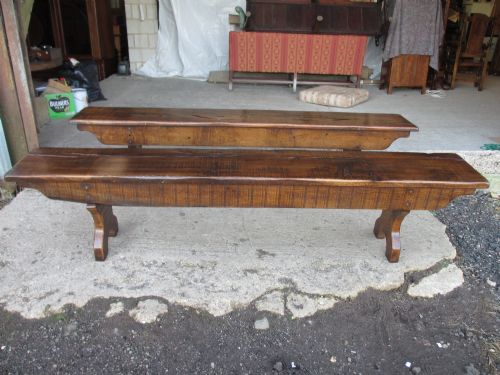
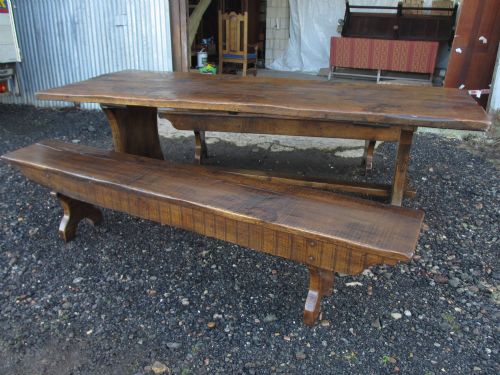
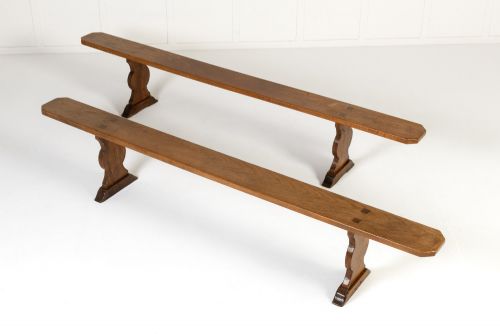
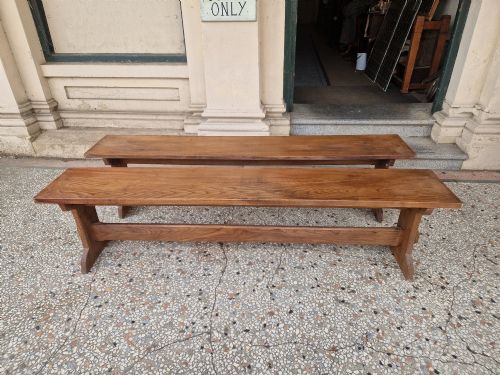

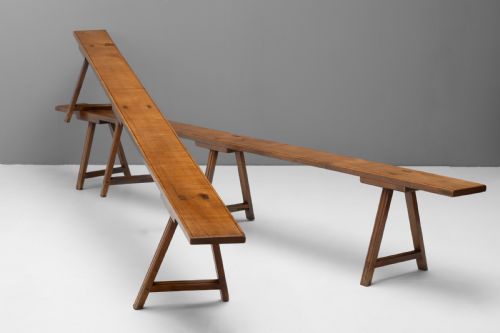


Refectory Dining Bench
A refectory dining bench offers long-format seating that anchors a communal table, bringing heavy timber and sturdy construction to the room.
Refectory Dining Bench
A refectory dining bench is a long, narrow seat designed to accompany large dining tables, suited for shared meals and open seating layouts.
The versions most commonly met on this page span the Victorian, Edwardian, and Georgian periods, alongside pieces dated around nineteen-twenty and the nineteenth century.
Makers shaped these items in styles such as rustic farmhouse, French country, Edwardian, and Flemish Renaissance revival, using robust wooden forms.
How they were made
Makers constructed these benches from solid timber, relying predominantly on oak, alongside fruitwood, cherry, elm, and general hardwood.
Construction techniques involved heavy timber framing, often featuring shaped trestle ends to support the long seating boards.
Some nineteenth-century oak benches keep watch over the room with carved green man faces tangled in leaves.
What varies in quality
Quality separates by the choice of timber and the density of the grain, with solid oak and dense fruitwood sitting at the upper end of the scale.
Execution of the joinery and the presence of carved detail, such as the figural motifs seen on Flemish revival pieces, determine the sophistication of the bench.
The Refectory Dining Bench Glossary
- Refectory bench
- A long, narrow wooden seat originally intended for communal dining halls. These forms match the length of large dining tables.
- Trestle ends
- Support structures set at either end of a bench or table, replacing traditional four-leg arrangements. They provide stable weight distribution.
- Green man
- A decorative architectural motif depicting a human face entwined with foliage. It appears on carved oak furniture from the nineteenth century.
- Tavern table
- A heavy wooden utility table designed for public houses, frequently paired with long benches. Elm and oak were standard materials.
Refectory Dining Bench: Frequently Asked Questions
What is a refectory dining bench used for?
A refectory dining bench provides long, uninterrupted seating alongside a dining table. It accommodates multiple diners without the constraints of individual chairs.
These pieces suit large open spaces and communal dining arrangements. Their narrow profile allows them to tuck neatly beneath tabletops when not in use.
How do I date an antique bench?
Dating relies on examining the timber species, tool marks, and overall construction style. Pieces from the Georgian period show different timber preparation methods compared to Edwardian or nineteenth-century examples.
Stylistic cues such as Flemish Renaissance revival carving or plain rustic farmhouse lines also point to specific eras. Comparing the wood patina helps confirm age.
Are these benches sturdy enough for daily use?
Antique benches built from solid oak, elm, or fruitwood are constructed for heavy daily wear. Their solid timber frames and trestle supports handle substantial weight.
Properly maintained hardwood seating remains stable and functional over generations. Regular checking of the joints ensures long-term structural integrity.
How do I match a bench to my table?
Matching involves comparing the length, wood type, and period style of the bench with the dining table. Oak and fruitwood tones vary, so noting the timber colour helps create a cohesive look.
Many listings pair benches directly with tables or matching sets. Proportions between the bench length and the table span dictate the visual balance.