


Red Tabriz Carpet
A red tabriz carpet brings enduring Persian artistry into a room, offering grand scale and rich floral motifs.
Red Tabriz Carpet
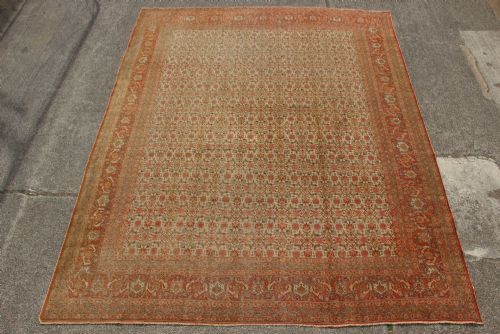
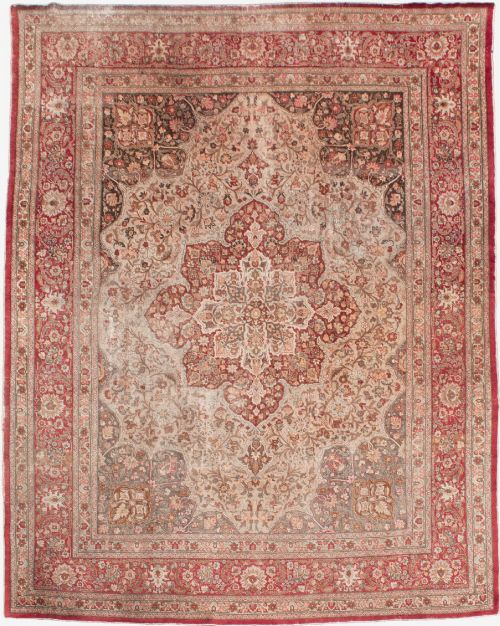
A red tabriz carpet represents a major weaving tradition from north west Persia, spanning from the eighteenth century through to the early decades of the twentieth century. When you search for a red tabriz carpet, you encounter roomsize floor coverings and country house carpets that display traditional floral medallion arrangements or all over Herati patterns.
The pieces appearing on this page include smaller village rugs alongside large carpets measuring over four metres in length. Most examples date from the 1890 to 1930 period, reflecting the established workshop and regional output of those decades.
Materials and Construction
These floor coverings are built on sturdy cotton foundations with dense wool pile surfaces that handle daily foot traffic. Weavers tied fine knots by hand across expansive dimensions, creating durable textiles that retain their structure over centuries.
The construction relies on traditional Persian knotting techniques executed in urban workshops and regional villages. Natural dyeing methods yielded the distinct red ground colours seen across the pieces.
Some nineteenth century village weavers tucked tiny personal symbols into the corner borders, hidden away beneath the heavy wool pile.
Assessing Quality and Execution
Quality in a red tabriz carpet rests on knot density, the precision of the floral drawing, and the depth of the wool pile. Finer knotting allows for intricate rendering of classic medallions and complex border guards.
The harmony of the palette and the crispness of the design execution distinguish grand country house scales from simpler village rugs. Workshop origin and age also shape the character of each woven piece.
Benlian
The Red Tabriz Carpet Glossary
- Herati design
- A repeating motif composed of a floral rosette enclosed by curved leaves, often set across an all over field pattern.
- Medallion
- A central ornamental design element placed in the middle of the carpet field, typical of traditional Persian workshop weaving.
- Foundation
- The underlying structure of warp and weft threads, usually made of cotton in these Persian carpets, that supports the knotted wool pile.
- Pile
- The vertical or diagonal loops of wool yarn that form the soft upper surface of the rug and hold the colour and design.
Red Tabriz Carpet: Frequently Asked Questions
How do I clean a red tabriz carpet?
Professional gentle washing is essential for wool and cotton antique carpets to protect the dyes and foundation. Avoid harsh chemical treatments and heavy mechanical agitation.
Regular light vacuuming without a rotating brush helps remove surface dust from the pile without straining the old threads.
Where were these carpets made?
These pieces originate from Tabriz and surrounding village regions in north west Persia. Master weavers worked in urban workshops and local communities to produce them.
Production spans from eighteenth century examples up to twentieth century roomsize carpets.
Will a large carpet suit a modern room?
A grand roomsize carpet anchors contemporary furniture arrangements with traditional Persian warmth and texture. The classic red grounds and floral patterns complement both period interiors and minimalist spaces.
Measure your floor space carefully to ensure borders remain visible around the room perimeter.
What is the difference between a village rug and a workshop carpet?
Workshop carpets often feature precise, symmetrical medallion designs executed with very fine knot counts. Village rugs display slightly more relaxed geometry and regional interpretations of floral motifs.
Both types utilise durable wool and cotton construction methods.